
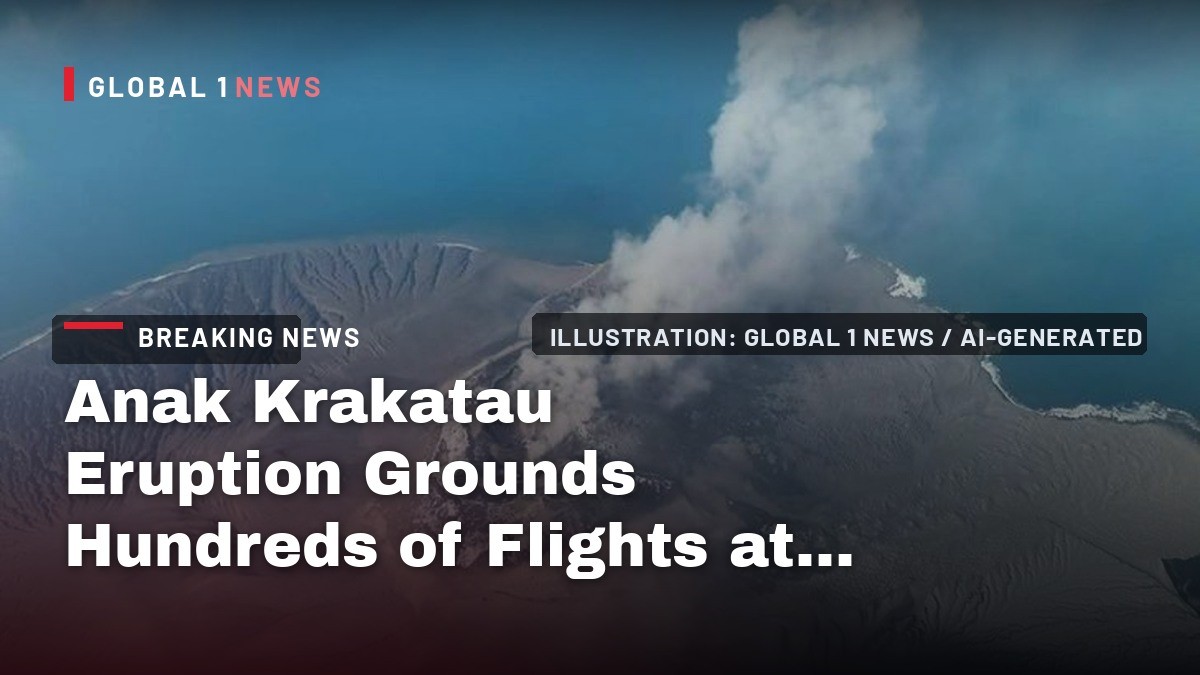
Anak Krakatau Eruption Grounds Hundreds of Flights at Jakarta's Soekarno-Hatta Airport
You know that sinking feeling when you’re staring at a departure board and every single row reads “CANCELLED”? Multiply that by about 22,800. That was the scene at Jakarta’s Soekarno-Hatta International Airport on Sunday morning, when a volcano decided it wasn’t done with 2026 yet. Anak Krakatau—the “child” of the most infamous volcano in modern history—blew its top at 3:53 a.m. local time. The eruption lasted roughly 30 seconds.
You know that sinking feeling when you’re staring at a departure board and every single row reads “CANCELLED”? Multiply that by about 22,800. That was the scene at Jakarta’s Soekarno-Hatta International Airport on Sunday morning, when a volcano decided it wasn’t done with 2026 yet.
Anak Krakatau—the “child” of the most infamous volcano in modern history—blew its top at 3:53 a.m. local time. The eruption lasted roughly 30 seconds. But those thirty seconds were enough to ground hundreds of flights, strand tens of thousands of passengers, and turn Indonesia’s busiest airport into a giant, humid parking lot for aircraft that couldn’t go anywhere.
This isn’t a drill, and it isn’t a movie. This is what happens when a restless mountain in the Sunda Strait decides to remind 270 million people that they live on the Ring of Fire. Let’s break down exactly what happened, what’s still happening, and why the scientists are watching this one very, very closely.
Sunday Morning Chaos at Soekarno-Hatta
If you were supposed to fly out of Jakarta on Sunday, you probably spent the morning in a daze. Soekarno-Hatta International Airport—the busiest in Indonesia—suspended all operations starting at 5:30 a.m. local time. The closure wasn’t a quick “hold on, let’s check the wind” situation. It was extended to at least 1:30 p.m. local time, which is 0630 GMT for those keeping score across time zones.
Here’s the scale of the mess: roughly 170 aircraft that had parked overnight at Soekarno-Hatta simply stayed put. They weren’t going anywhere. The total number of affected flight movements ranges from 209 to 516, depending on which agency you’re counting and how you define “affected.” Either way, that’s a lot of people staring at their phones, rebooking apps, and the long, unforgiving line at the customer service desk.
About 22,800 passengers were stranded at Soekarno-Hatta alone. That’s not a small town. That’s a small city, all crammed into terminals, trying to figure out how to get home, get to a meeting, or get to a honeymoon. Passengers were reportedly seeking refunds and reclaiming checked baggage as the departure boards filled with cancellations faster than staff could announce them.
The domestic route to Makassar in South Sulawesi got hammered. That’s a critical business and cargo corridor. Internationally, Singapore took the biggest hit—Singapore Airlines cancelled 19 flights to and from Jakarta, and budget carrier Scoot also pulled its services. Changi Airport in Singapore, ever the efficient operator, advised travellers to check with their airlines before heading to the terminal. Good luck with that phone line, folks.
This wasn’t just a Jakarta problem. Six airports across western Indonesia suspended flight operations on Sunday. Beyond Soekarno-Hatta, you had Halim Perdanakusuma in Jakarta, Radin Inten II in Lampung, plus disruptions at Bali’s I Gusti Ngurah Rai and Medan’s airport. When ash is drifting, it doesn’t respect airport boundaries or airline schedules.
Lukman F. Laisa, Indonesia’s Director General of Civil Aviation at the Ministry of Transportation, put out the standard but necessary statement: “Safety remains our top priority in every operational decision.” He also warned of the cascading effect—this isn’t just about Sunday’s flights. Aircraft rotations are thrown off, fleet availability drops, and terminal capacity gets stretched thin. Monday could be a nightmare of backlogged passengers and misplaced luggage. If you’re flying out of Indonesia this week, pack patience.
The Eruption: What Actually Happened
Let’s get to the science, because this wasn’t just a random burp from the earth. Indonesia’s Geological Agency said Anak Krakatau had been showing signs of increased activity since Friday. Then, at 3:53 a.m. Sunday, it erupted for about 30 seconds. CCTV footage captured lava flares shooting from the crater—a visual that’s both stunning and terrifying, depending on your distance from the blast zone.
No casualties have been reported. That’s the good news. The nearest settlement is more than 16 kilometers—about 10 miles—away from the island. Authorities have warned residents and visitors to stay at least 3 kilometers (roughly 2 miles) from the active crater. That’s the exclusion zone, and it’s non-negotiable.
But here’s where it gets complicated. The eruption produced not one, but two distinct ash clouds. The first plume rose to about 20,000 feet (6,100 meters) and drifted northeast, right over Jakarta, Banten, West Java, and nearby waters. That’s the one that shut down the airports. The second cloud was the real monster—it reached 50,000 feet (15,200 meters), spreading over Banten, Lampung, and Bengkulu provinces, the southern Sunda Strait, and sections of the Indian Ocean west of Sumatra.
For context, commercial jets typically cruise between 30,000 and 40,000 feet. Ash at 50,000 feet isn’t just a nuisance; it’s a jet engine killer. Volcanic ash is basically pulverized rock, glass, and silica. Suck that into a turbine at 500 miles per hour, and you’re looking at engine failure, scratched windshields, and compromised electronics. The Darwin Volcanic Ash Advisory Centre and Indonesia’s BMKG meteorological agency were tracking both clouds, feeding data to airlines in real time. This is why planes were grounded, not because of a little rain.
The Science: Why This Eruption Matters
Lana Saria, head of Indonesia’s Geological Agency, didn’t sugarcoat the situation. She told reporters that activity at Anak Krakatau has been intensifying since July. Sunday’s eruption, she said, was the strongest of the current unrest period. That’s a significant statement from the top scientist in charge of monitoring this volcano.
Here’s the key takeaway from Saria’s assessment: repeated eruptions indicate a continued supply of magma and volcanic gases. That means the plumbing system beneath Anak Krakatau is open and active. Magma is rising, gases are escaping, and the volcano is essentially breathing—heavily.
Officials cannot predict whether a larger eruption will occur. That’s the honest, frustrating truth of volcanology. They can monitor, they can measure, they can warn. But they can’t look into the crater and say, “Okay, Tuesday at 4 p.m., it’s going to blow big.” The main hazards right now are volcanic ash, high concentrations of gas, and the ejection of hot rocks around the crater. If you’re within that 3-kilometer exclusion zone, you’re playing Russian roulette with ballistic boulders.
Anak Krakatau has been on Alert Level III (Siaga, the second-highest of four levels) since July 2, 2026. That’s not a new status. But the intensity of Sunday’s eruption suggests the volcano is testing the upper limits of that alert level. The Geological Agency is watching for signs of a potential collapse—and that’s the part that keeps scientists up at night.
History Lessons: 1883 and 2018
You can’t talk about Anak Krakatau without talking about its parent. The name literally means “child of Krakatau.” And Krakatau—or Krakatoa, as Western history books call it—is one of the most violent volcanic events ever recorded.
In August 1883, the parent volcano erupted in a series of explosions so loud they were heard thousands of miles away. The blast destroyed most of the island, and the resulting tsunamis killed more than 36,000 people on the coasts of Java and Sumatra. The eruption injected so much sulfur dioxide into the stratosphere that global temperatures dropped for years. Sunsets turned blood-red around the world. It was a planetary event, not just a regional disaster.
Anak Krakatau emerged from the sea in the caldera left by that 1883 catastrophe. It’s been building itself up ever since, a new volcano growing on the ruins of its parent. But it carries the same genetic code, so to speak.
In December 2018, Anak Krakatau gave us a terrifying reminder of that lineage. A partial collapse of the volcano’s flank triggered a tsunami that killed at least 430 people on Sumatra and Java. The wave struck without the warning of a major earthquake, catching coastal communities completely off guard. Scientists later determined that the island was left at about a quarter of its original size after that collapse. The volcano basically lost a huge chunk of itself to the sea.
That’s the nightmare scenario that volcanologists are quietly worried about now. Anak Krakatau is growing again, and it’s active. If it collapses again, the Sunda Strait—one of the busiest shipping lanes on Earth, with millions of people living along its coasts—could face another tsunami. There’s no evacuation order right now, and the nearest settlement is 16 kilometers away. But the ocean doesn’t care about distance. A tsunami travels fast, and it doesn’t stop at the 3-kilometer exclusion zone.
Officials’ Warnings and Safety Advice
Berton Panjaitan, spokesperson for Indonesia’s National Disaster Management Agency (BNPB), is the voice of calm in the storm. He urged the public not to panic but to take sensible precautions. If ash falls in your area, wear a mask and eye protection. Limit time outdoors. Cover water sources so ash doesn’t contaminate them. And if you’re driving, be careful—volcanic ash turns roads into slick, low-visibility hazards.
This isn’t theoretical advice. On Saturday, before the big eruption, several schools in the region cancelled activities after students and residents complained of eye irritation from ash. Fishermen cancelled their trips. The ash was already affecting daily life before the volcano decided to go big on Sunday morning.
Panjaitan’s message is straightforward: respect the volcano, follow the guidelines, and don’t be a hero. If authorities say stay away from the coast or the crater, stay away. The volcano doesn’t negotiate.
The Same Day: Mount Semeru Erupts
As if Anak Krakatau wasn’t enough, Indonesia’s geological monitoring agency PVMBG reported that Mount Semeru in East Java also erupted on Sunday. Semeru sent an ash column about 1 kilometer (3,300 feet) above its summit. That’s smaller than Krakatau’s plume, but it’s still significant. PVMBG advised residents to stay at least 5 kilometers away from Semeru’s crater and warned of hot ash clouds and lava flows that could travel up to 17 kilometers from the summit.
Semeru is on alert level 3, the same as Anak Krakatau. So are Merapi, Lewotobi Laki-laki, and Sinabung. That’s five volcanoes at the second-highest alert level simultaneously. Indonesia sits on the Pacific “Ring of Fire,” a horseshoe-shaped zone of intense tectonic activity that runs from the west coast of the Americas through Japan, Southeast Asia, and down to New Zealand. It’s home to about 75% of the world’s active volcanoes. On any given day, some of them are rumbling. But having this many at elevated alert status is a reminder that Indonesia lives on the edge of the earth’s crust, and sometimes the crust pushes back.
What Happens Next
Here’s the honest answer: nobody knows for sure. Lana Saria and her team at the Geological Agency are monitoring Anak Krakatau around the clock. They’re tracking seismic activity, gas emissions, ground deformation, and the shape of the crater. The key indicators are whether the magma supply continues, whether the volcano inflates, and whether any cracks or weaknesses develop on its flanks.
For travellers, the immediate concern is ash. The wind patterns over the Sunda Strait will determine whether Jakarta’s airports reopen fully or face more disruptions. The closure at Soekarno-Hatta was extended to at least 1:30 p.m. Sunday, but airlines will need time to reposition aircraft and crews. Don’t expect a seamless return to normal. Expect delays, cancellations, and the kind of chaos that makes you appreciate the miracle of modern aviation—until it doesn’t work.
For residents of Banten, Lampung, and West Java, the advice is simple: stay informed, stay indoors if ash falls, and keep your masks handy. The BNPB is coordinating with local governments to distribute information and supplies if needed.
For the rest of us, this is a wake-up call. Anak Krakatau is not a dormant relic. It’s an active, growing, unpredictable volcano with a history of violence. The 1883 eruption killed tens of thousands. The 2018 collapse killed hundreds. The current unrest is the strongest since July, and the magma supply shows no signs of stopping.
We’re not saying the sky is falling. We’re saying the ground might shake, the ash might drift, and the flights might be cancelled. Pay attention to official warnings. Respect the exclusion zones. And if you’re in Jakarta and your flight is cancelled, don’t yell at the gate agent. They didn’t make the volcano erupt. They’re just as stuck as you are.
Stay safe, Indonesia. We’re watching.
This article was produced with AI-assisted research and editorial support. Sources: Reuters, The Associated Press, LA Times, Indonesia's Geological Agency, BMKG, PVMBG.
By Jessica Ali, Staff Writer
What's Your Reaction?
 Like
0
Like
0
 Dislike
0
Dislike
0
 Love
0
Love
0
 Funny
0
Funny
0
 Wow
0
Wow
0
 Sad
0
Sad
0
 Angry
0
Angry
0

Editor-in-Chief at Global1.News. Atlanta-based journalist who cuts through the BS and tells it like it is. Lead anchor, host, and the voice you hear when the spin stops and the truth starts.












Comments (0)