
South Korea’s $60 Billion Semiconductor Exports to Drive the KOSPI’s Resurgence
South Korea’s export surge in semiconductors this September has re‑energized the Korea Composite Stock Price Index (KOSPI), underscoring the nation’s deepening integration with the global artificial‑intelligence (AI) boom.
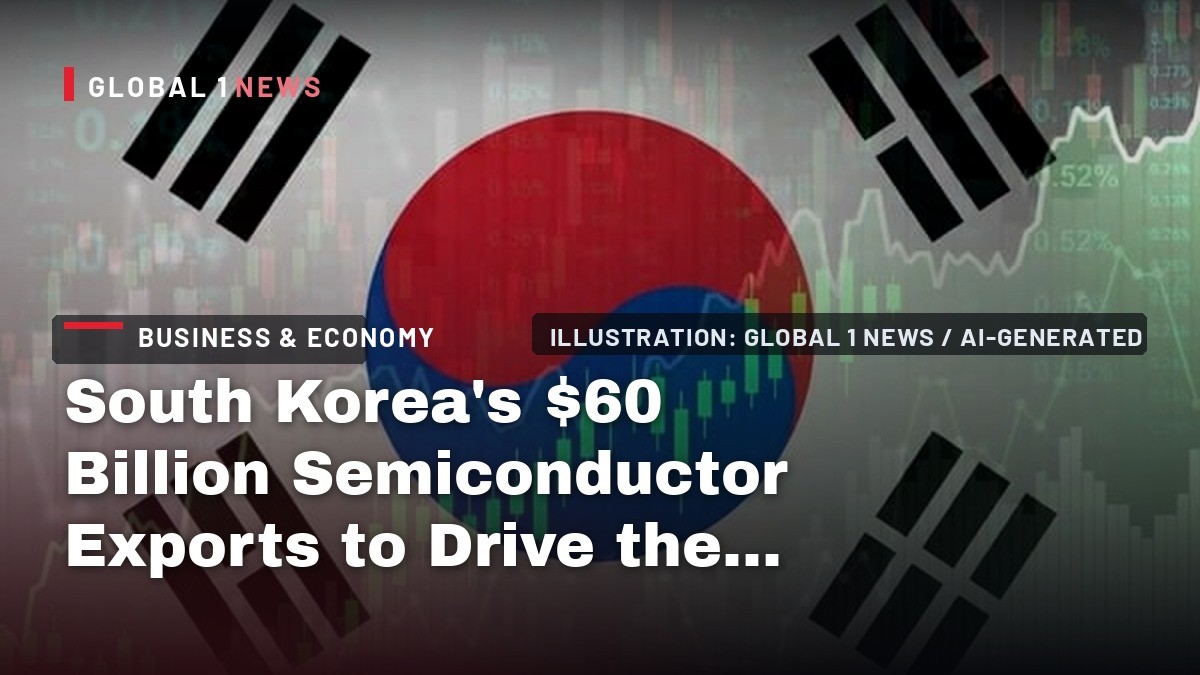
South Korea’s export surge in semiconductors this September has re‑energized the Korea Composite Stock Price Index (KOSPI), underscoring the nation’s deepening integration with the global artificial‑intelligence (AI) boom. According to government data, monthly semiconductor export value surpassed US$60 billion, propelling total exports beyond the US$120 billion threshold for the first time. This milestone, coupled with an 83.5 percent year‑over‑year increase in September’s figures and a daily average growth of 105 percent to US$5.63 billion, signals a decisive shift in the country’s trade composition toward high‑value AI‑related chips.
Semiconductor Dominance in the KOSPI
The KOSPI’s structure reflects the outsized role of semiconductors, with the sector accounting for roughly two‑thirds of the index’s market capitalisation. When the September export data were released, the index rose by 2 percent, a modest yet symbolically important response given the market’s recent volatility. Samsung Electronics and SK Hynix, the two dominant semiconductor firms, together represent 66 percent of the KOSPI’s total market value, reinforcing the index’s reliance on a narrow set of “star” stocks.
Both companies posted post‑release gains: Samsung rose by 2.79 percent and SK Hynix by 3.21 percent. Their price‑to‑earnings ratios—approximately 10.9 for Samsung and 7.4 for SK Hynix—remain relatively modest by global technology standards, suggesting that investor sentiment is anchored in tangible product demand rather than speculative excess.
Historical Context of the AI‑Driven Rally
Since the launch of ChatGPT in November 2022, the AI boom has reshaped South Korea’s export profile. The KOSPI climbed more than 270 percent to its 2026 peak, a trajectory that coincided with the rapid expansion of AI‑related semiconductor demand. However, the index has also experienced sharp corrections, falling 22.5 percent over the past three months—a reminder of the market’s sensitivity to over‑reliance on a single sector.
The index’s recent trajectory illustrates this volatility. After breaching the historic high of 9,000 in June, the KOSPI slipped back into the 8,000s within a week and spent the subsequent months largely within the 6,000‑range, even dipping to around 6,600 in early September amid rising global oil prices and U.S. Treasury yields.
Macro‑Economic Headwinds
External factors continue to exert pressure on South Korean markets. The escalation of the conflict in Iran has driven crude oil prices above US$100 per barrel, while 10‑year U.S. Treasury yields have breached the 5 percent mark. These developments have dampened net buying pressure on the KOSPI, contributing to its September trough.
Domestically, the KOSDAQ has traditionally underperformed following the Chuseok holiday season, further compounding the index’s downside risk. Nonetheless, the resilience of semiconductor exports offers a counterbalance, mitigating some of the macro‑economic uncertainty that surrounds the broader market.
Supply Constraints and Pricing Outlook
Analysts at Mirae Asset Securities project that DRAM and NAND memory chips will remain undersupplied through 2028. This anticipated scarcity is expected to sustain upward pressure on chip prices, reinforcing the revenue streams of Samsung and SK Hynix and, by extension, the KOSPI’s performance.
The ongoing shortage aligns with the broader AI infrastructure demand, exemplified by U.S. hyperscalers and AI adopters committing more than US$750 billion in capital expenditures for AI build‑outs. This external demand buttresses the Korean semiconductor sector’s growth prospects, even as global financial conditions tighten.
Labor Dynamics and Corporate Strategy
Labor stability remains a critical factor for Samsung, which accounts for roughly a quarter of South Korea’s total export volume. Recent negotiations averted a potential strike by granting workers bonuses averaging US$400,000. This resolution not only preserved production continuity but also signaled corporate willingness to invest in human capital amid heightened export momentum.
Such strategic labor management supports the broader economic outlook, as the avoidance of industrial disruption sustains the export pipeline that underpins both corporate earnings and national trade balances.
Forward‑Looking Scenarios for the KOSPI
Looking ahead, analysts caution that while a return to the historic 9,000 level appears unlikely in the near term—particularly given expectations of further rises in U.S. Treasury yields—the resilience demonstrated by semiconductor exports could sustain the index above the 6,000‑range through the fourth quarter of 2026.
The upcoming earnings season for Samsung and SK Hynix will be pivotal. Should these firms validate their export momentum and pricing power, the KOSPI could plausibly target the 9,000 threshold by the first quarter of 2027, marking a renewed phase of growth anchored in AI‑driven demand.
Implications for Policy and Regional Competitiveness
From a policy perspective, the export surge underscores the strategic importance of the semiconductor sector within South Korea’s industrial development framework. Continued government support for R&D, coupled with incentives to maintain supply chain resilience, will be essential to preserve the nation’s competitive edge in the AI‑centric global economy.
Regionally, South Korea’s performance sets a benchmark for neighboring economies seeking to capture AI‑related growth. The Korean experience illustrates how a focused export strategy, underpinned by world‑class manufacturing and skilled labor, can translate into tangible market confidence, even amid external shocks. As the AI landscape evolves, the interplay between export performance, corporate strategy, and macro‑economic stability will remain a defining feature of South Korea’s economic trajectory.
This article was produced with AI-assisted research and editorial support. Reporting is based on the source material cited below. Sources: The Diplomat; thediplomat.com; Global1.News (08 October 2026).
By Prof. David Park, Staff Writer
What's Your Reaction?
 Like
0
Like
0
 Dislike
0
Dislike
0
 Love
0
Love
0
 Funny
0
Funny
0
 Wow
0
Wow
0
 Sad
0
Sad
0
 Angry
0
Angry
0
East Asia/Technology Correspondent at Global1.News. Seoul-based voice covering Korean politics, technology, business, and culture. Analyzes how technology and geopolitics intersect across East Asia.









Comments (0)