
Manipur needed this much security: Mamata-TMC over police deployment in Delhi for anti-SIR stir
In the capital’s streets, a wave of protests against the Special Intensive Revision (SIR) of electoral rolls has drawn a massive police and paramilitary presence, prompting a sharp rebuke from a senior TMC legislator.
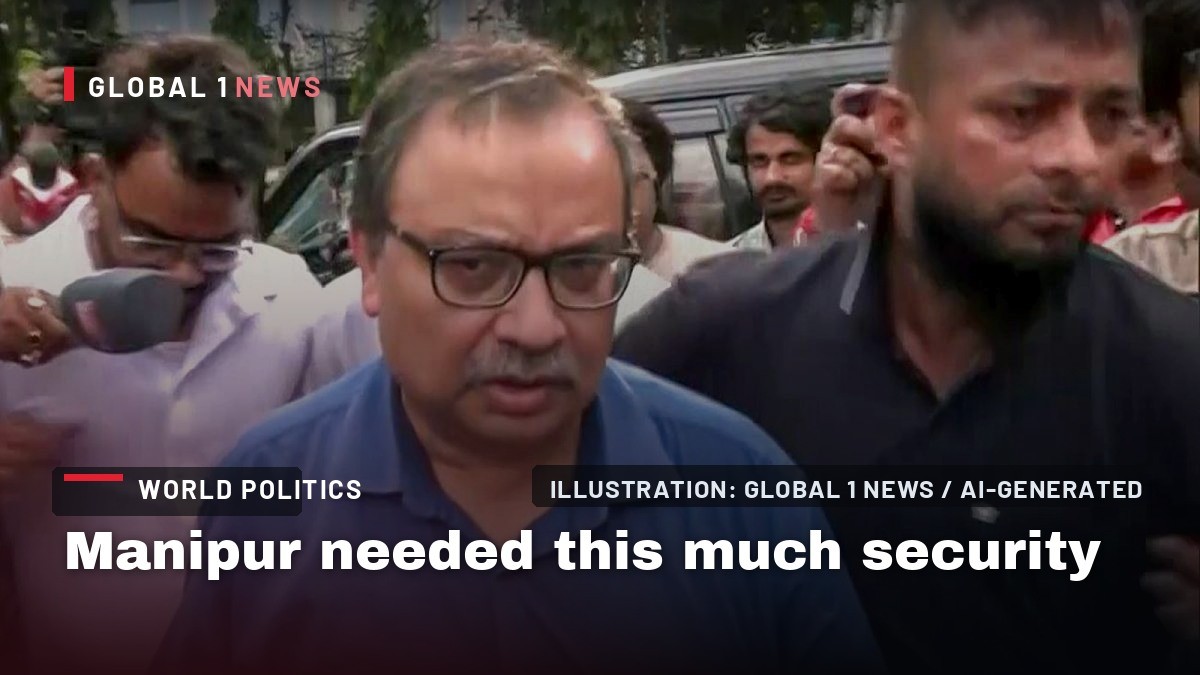
In the capital’s streets, a wave of protests against the Special Intensive Revision (SIR) of electoral rolls has drawn a massive police and paramilitary presence, prompting a sharp rebuke from a senior TMC legislator. Kunal Ghosh, a member of the Mamata‑Banerjee faction, questioned why the same level of security was not deployed in Manipur, where an ethnic conflict has simmered for more than three years. His remarks have ignited a broader debate about the allocation of security resources, the government’s response to youth‑led dissent, and the political stakes surrounding India’s electoral machinery.
Security Deployment in Delhi versus Manipur
The Defence Minister, Rajnath Singh, justified the deployment of “huge” forces in Delhi as a necessary measure to contain anti‑SIR protests. Ghosh countered that the same forces could have been redirected to Manipur, where the valley‑based Meitei and hill‑based Kuki communities have been locked in violent clashes since May 2023. He argued that the “right time” for such deployment was missed, implying that a stronger security presence might have curtailed the ongoing bloodshed.
Manipur’s conflict, according to the source, has claimed at least 306 lives and left several missing, with an additional around 50 people killed in Kuki‑Naga clashes since February of this year. The scale of loss underscores the gravity of the situation, yet the capital’s streets have witnessed a visible, heavily armed police presence aimed at curbing a largely peaceful protest. This contrast raises questions about the criteria the central government uses to prioritize security operations across the nation.
The Political Context of the SIR Protests
The protests in Delhi centre on allegations that the Election Commission’s Special Intensive Revision of electoral rolls has arbitrarily deleted voter names, prompting calls for the resignation of Chief Election Commissioner Gyanesh Kumar. Opposition parties and youth groups have framed the issue as a breach of democratic rights, while the ruling BJP has accused them of politicising the matter to stir unrest.
Ghosh’s intervention adds another layer: by linking the security deployment to the government’s “inability to answer” youth questions, he reframes the protest not merely as a law‑and‑order challenge but as a symptom of a broader democratic deficit. The narrative suggests that heavy‑handed policing may be a substitute for substantive engagement with citizen concerns, a point that resonates with ongoing debates about the health of India’s democratic institutions.
Implications for Federal Security Policy
India’s federal structure grants the central government authority over paramilitary forces, while state police handle routine law and order. The current episode highlights the tension between centralised deployment for national events and the need for rapid response to regional crises. Ghosh’s criticism implies that the central government may be over‑prioritising symbolic security in the capital at the expense of on‑the‑ground needs in conflict‑prone states.
From a policy perspective, the episode could prompt a review of the decision‑making matrix that determines force allocation. If the central command can mobilise large contingents for a protest that, while politically charged, remains largely peaceful, the same logistical capacity could be leveraged for conflict mitigation in the Northeast. Such a shift would require coordination between the Ministry of Home Affairs, the Ministry of Defence, and state governments, potentially reshaping the operational doctrine for internal security.
Youth Mobilisation and Democratic Engagement
The protests have been driven largely by young activists, exemplified by the involvement of student leader Neha Bora and the detention of CJP founder Abhijeet Dipke. Their participation reflects a growing willingness among India’s youth to challenge institutional decisions, especially those perceived to affect their civic rights. Ghosh’s statement that “when the new generation raises questions … it is your responsibility to convince them” underscores the political sensitivity of youth mobilisation.
In the broader context of Indian public health and education, the engagement of young citizens in democratic processes can be a double‑edged sword. On one hand, it signals an informed electorate; on the other, it places pressure on institutions to respond swiftly and transparently. The health of democratic discourse, much like the health of a nation’s public health system, depends on timely, evidence‑based communication and the capacity to address grievances before they fester.
Electoral Roll Revision: Technical or Political?
The Special Intensive Revision of electoral rolls, intended to update voter lists, has become a flashpoint. While the Election Commission maintains that the revision is a routine exercise to ensure accuracy, opposition groups allege that the process has led to arbitrary deletions, disenfranchising voters. The BJP’s accusation that opposition parties are politicising the issue adds a layer of partisan contestation.
From a data‑driven perspective, the integrity of electoral rolls hinges on robust verification mechanisms and transparent criteria for deletions. Any perceived opacity can erode public trust, especially in a nation where voter registration is a cornerstone of democratic legitimacy. The current unrest highlights the need for the Election Commission to adopt clearer communication strategies, perhaps leveraging technology platforms to allow affected citizens to verify and contest deletions in real time.
Law Enforcement Tactics and Civil Liberties
The police response in Delhi included detaining activists ahead of the “Lehra Do Tiranga” march organised by the Cockroach Janta Party (CJP). While authorities justified the arrests as a preventive measure, civil liberties advocates argue that pre‑emptive detention can suppress legitimate dissent. The balance between security and freedom of expression remains a contested terrain in India’s legal framework.
Legal scholars note that the Indian Constitution guarantees the right to peaceful assembly, yet the state retains the power to impose reasonable restrictions for public order. The current scenario tests the application of these principles, especially when the state deploys paramilitary forces against largely peaceful protesters. The outcome may set precedents for how future protests—whether over electoral issues, environmental concerns, or public health policies—are policed.
Future Trajectories: Policy Reform or Status Quo?
Looking ahead, the convergence of security deployment, electoral integrity, and youth activism could catalyse policy reforms. If the central government acknowledges the criticism regarding force allocation, it may consider establishing a rapid‑response framework that prioritises conflict zones like Manipur while maintaining proportionate security for national events.
Simultaneously, the Election Commission could enhance its transparency by publishing detailed criteria for roll revisions and establishing an independent grievance redressal mechanism. Such steps would address the twin concerns of democratic participation and law‑and‑order, reinforcing public confidence in both electoral and security institutions.
In the immediate term, the protests in Delhi are likely to continue, with opposition parties and youth groups pressing for accountability. The government’s handling of both the protests and the broader security calculus will be closely watched, not just by political analysts but also by public health experts who recognise that social stability is a prerequisite for effective health interventions. As India navigates these intertwined challenges, the decisions made in the coming weeks will reverberate across its democratic, security, and policy landscapes.
This article was produced with AI-assisted research and editorial support. Reporting is based on the source material cited below. Sources: The Hindu; thehindu.com; Global1.News (17 October 2026).
By Dr. Raj Patel, Staff Writer
What's Your Reaction?
 Like
0
Like
0
 Dislike
0
Dislike
0
 Love
0
Love
0
 Funny
0
Funny
0
 Wow
0
Wow
0
 Sad
0
Sad
0
 Angry
0
Angry
0
India/South Asia Correspondent at Global1.News. Analytical voice with a background in science and health journalism. Based in New Delhi, covering Indian politics, education, healthcare, technology, and policy. Breaks down complex data into clear, actionable reporting.









Comments (0)