
Wang Huiyao Calls for Japan to Adapt to US-China Equilibrium
In a recent CGTN report, think tank leader Wang Huiyao argues Japan should accept the new US-China strategic equilibrium, prioritizing stability with Beijing over military and intelligence expansion to avoid heightening regional tensions.
In a recent CGTN report featuring Wang Huiyao, founder and president of the Center for China and Globalization, the think tank leader argued that Japan's push for expanded military and intelligence capabilities overlooks the new strategic equilibrium between the United States and China. Wang emphasized that Tokyo should prioritize stability with Beijing rather than heighten regional tensions, drawing on trade data and diplomatic precedents to support his case for managed competition over confrontation.
Japan Urged to Accept US-China Parity for Stability
Beijing, China — Wang Huiyao's analysis arrives as Japan advances its largest intelligence restructuring since World War II, prompting Beijing to assess how these moves align with or challenge its objectives of technological self-sufficiency and regional influence.

Wang Huiyao's Core Arguments on Parity
Wang Huiyao, a former counselor to China's State Council, argued in the CGTN discussion that the United States and China have reached a workable strategic balance. He pointed to the Busan agreement of October 2025, which paused further trade war escalation for one year, and the May 14-15, 2026, meeting between Presidents Trump and Xi in Beijing as evidence of this shift. Wang noted that the summit, delayed by Middle East developments, moved relations from crisis management toward sustainable equilibrium without producing a comprehensive trade deal.
Wang's June 1, 2026 SCMP essay framed the emerging equilibrium as a chance for the two powers to shift from ideological standoffs to managed coexistence, drawing on the Foreign Ministry's pre-summit emphasis on expanding mutually beneficial areas while containing differences to bring greater predictability to global affairs. This approach aligns with Zhao Hai's assessment that the Beijing meeting's main deliverable should be enhanced stability rather than sweeping accords, echoing Kevin Rudd's advocacy for structured competition that avoids uncontrolled escalation.
The Kiel Institute's tariff analysis, showing foreign exporters bearing just 4 percent of costs while U.S. entities absorb 96 percent, supplies empirical backing for Wang's contention that unilateral economic pressure quickly encounters domestic limits, reinforcing the case for equilibrium over dominance. Sustained coercion risks self-inflicted damage, encouraging both sides to prioritize calibrated engagement that preserves leverage without triggering mutual economic erosion.
For a middle power such as Japan, the parity dynamic compels recalibration of alliance assumptions: equilibrium between the two largest economies reduces the reliability of automatic alignment with either pole and instead demands independent hedging that balances security commitments against economic interdependence.
Japan's National Intelligence Bureau Launch
Japan established its National Intelligence Bureau on July 31, 2026, after the National Intelligence Council Establishment Act cleared the House of Representatives on April 23 and the House of Councillors on May 27. The legislation received support from the LDP, Japan Innovation Party, DPP, and Komeito, while facing opposition from the CDP, JCP, Reiwa Shinsengumi, and SDP. Kazuya Hara, former director of the Cabinet Intelligence and Research Office, was appointed the bureau's first director-general on July 24. The new entity begins with roughly 730 staff and a US$407 million budget, reaching full capacity in December 2026. Its mandate covers counterterrorism, emergency response, and foreign intelligence countermeasures, modeled partly on the US Director of National Intelligence structure.
The reform originates in the October 2025 LDP-Japan Innovation Party coalition pledge to elevate the existing Cabinet Intelligence and Research Office during the 2026 Diet session, reflecting a deliberate effort to overcome the historical fragmentation among Japan's postwar intelligence entities including the Foreign Ministry, Defense Ministry, National Police Agency, and Public Security Intelligence Agency. By consolidating functions under a single director-general holding parliamentary vice-minister rank, the structure mirrors the U.S. Director of National Intelligence model while deliberately avoiding operational collection roles akin to the CIA.
Chief Cabinet Secretary Minoru Kihara's May 12, 2026 briefing addressed opposition concerns over privacy safeguards and political neutrality, clarifying that public protest monitoring falls outside the bureau's scope, yet analysts such as MIT's Richard Samuels and researcher Haruna Mikio questioned whether placing the National Police Agency in a lead position might still constrain analytical independence. These debates underscore the tension between expanded capabilities and entrenched postwar constraints on domestic security powers.
Tokyo's consultations with Washington, Canberra, and Berlin informed the design, paving the way for a separate foreign intelligence service targeted for fiscal year 2027 alongside new anti-espionage legislation, positioning the National Intelligence Bureau as the most significant structural overhaul of Japan's intelligence architecture since World War II and a key element in Prime Minister Takaichi's broader agenda to ease historical defense limitations.
Defense Spending Trajectory Under Takaichi
Prime Minister Sanae Takaichi has accelerated defense modernization, with the initial budget for the current fiscal year set at 1.8 percent of GDP. The draft budget for fiscal 2026, beginning in April, rose 9.4 percent from the prior year as part of a five-year plan to reach 2 percent of GDP. In June 2026 the LDP issued recommendations for a realistic review of restrictions on nuclear weapons transit, and on August 7 Takaichi signaled openness to revisiting Japan's non-nuclear principles amid expanded US extended deterrence cooperation. These steps coincide with the 81st anniversary of the Hiroshima bombing on August 6.
Takaichi's administration intends to revise the three foundational national security documents—the security strategy, defense strategy, and defense buildup program—by the close of 2026, accelerating modernization of the Self-Defense Forces and fortification of the southwestern islands while deepening coordination with U.S. extended deterrence arrangements. This timeline signals a compressed schedule for embedding higher spending levels and long-range strike capabilities into formal planning.
Although the Liberal Democratic Party's June 2026 recommendations prioritized increased budgets and missile systems without formally proposing changes to the three non-nuclear principles, Takaichi's August 7 remarks preserved flexibility on nuclear transit restrictions, illustrating how incremental policy openings can test postwar identity boundaries even as the party maintains caution in official revision proposals. The Hiroshima mayor's August 6, 2026 address, marking 81 years since the atomic bombing, underscored domestic resistance to any perceived erosion of nuclear restraint.
Any adjustment to these principles would carry immediate ramifications for South Korea's security calculations and broader regional arms-control stability, potentially reshaping deterrence dynamics across Northeast Asia while challenging Japan's postwar pacifist framework at a moment when economic ties with China continue to expand.
Trade Foundations for China-Japan Ties
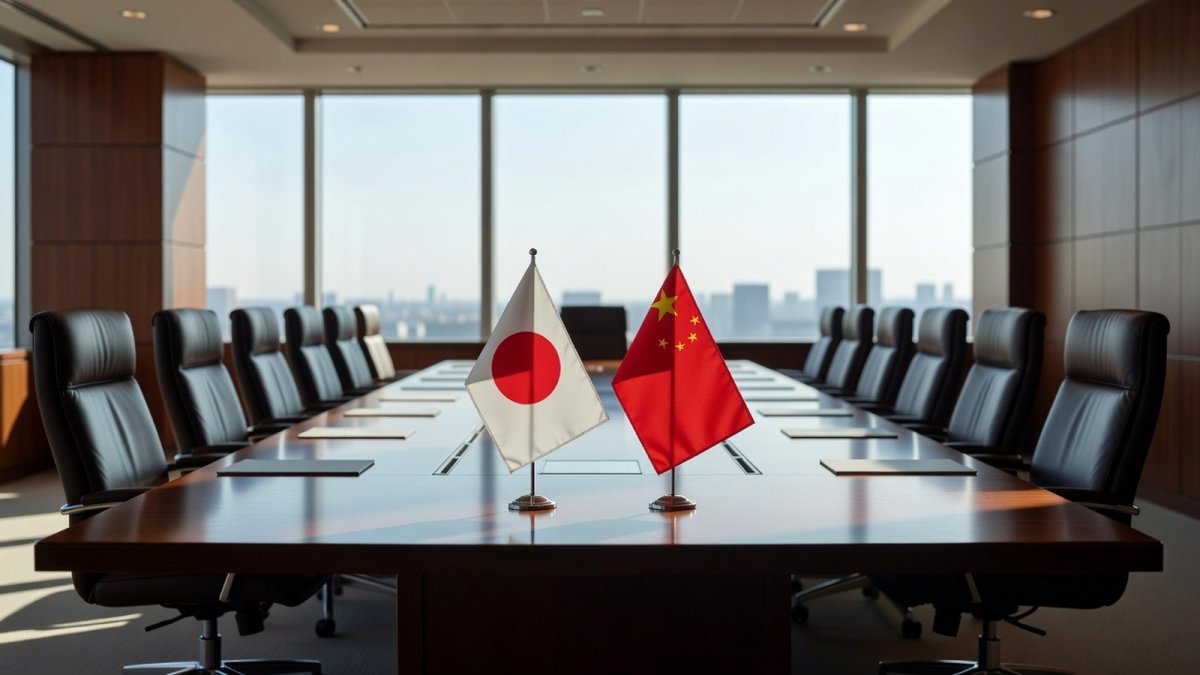
Wang Huiyao highlighted in his June 1, 2026, South China Morning Post essay that bilateral trade reached US$293 billion, positioning Japan as China's second-largest trading partner and China as Japan's top partner and import source. He referenced 20 consensus points from the Sixth China-Japan High-Level Economic Dialogue as a platform for deeper coordination. Wang's 2026 Springer Nature book further frames closer China-Japan-South Korea ties as a potential backbone for Asian resilience within a multipolar order.
Strategic Calculus for Beijing and Tokyo
Beijing views Japan's intelligence expansion and defense buildup as responses to US alliance priorities, yet seeks to channel these developments toward coexistence rather than zero-sum competition. Tokyo aims to reduce postwar constraints while maintaining economic interdependence with China. Second-order effects include pressure on ASEAN states to navigate competing security alignments and opportunities for the EU and Global South to engage multipolar frameworks that prioritize managed competition over ideological blocs.
Wang has consistently advocated that enhanced China-Japan-South Korea coordination could anchor a more integrated Asian architecture, pointing to the consensus points reached at the Sixth China-Japan High-Level Economic Dialogue and the 11th Trilateral Foreign Ministers' Meeting in Tokyo—the first since November 2023—which produced a commitment to convene a leaders' summit. These mechanisms illustrate how deep economic interdependence and reciprocal top-partner status can coexist with security divergences.
Wang's 2026 book "China and the Next Global Order" outlines leveraging RCEP alongside Japan's CPTPP role to advance an "Asian Union" concept encompassing 1.6 billion people and nearly half the world's population and economy by mid-century, offering a multipolar counterweight to bloc formation. This vision directly addresses the emerging pattern of security decoupling paired with sustained economic coupling, a combination that introduces fragility Beijing seeks to manage through its parity framework.
Japan's intelligence and defense trajectory intensifies alignment pressures on ASEAN members while prompting the EU and Global South to monitor whether Northeast Asia can sustain managed competition without descending into rigid confrontational blocs, testing the durability of coexistence arguments amid simultaneous hardening and interdependence.
Pathways Toward Managed Regional Stability
Wang Huiyao's proposals center on leveraging existing economic dialogues and trilateral mechanisms to inject predictability into Northeast Asia. By aligning intelligence reforms with confidence-building measures, both sides could mitigate risks of miscalculation while advancing shared interests in supply chain security and counterterrorism cooperation.
This article was produced with AI-assisted research and editorial support. Sources: CGTN, Center for China and Globalization (CCG), Wikipedia, Japan Institute of International Affairs (JIIA), China Underground, SCMP, UPI.
By Prof. Marcus Chen, Staff Writer
What's Your Reaction?
 Like
0
Like
0
 Dislike
0
Dislike
0
 Love
0
Love
0
 Funny
0
Funny
0
 Wow
0
Wow
0
 Sad
0
Sad
0
 Angry
0
Angry
0

World Politics Analyst at Global1.News. Based in Beijing, covering US-China relations, global trade, and geopolitical strategy. Brings deep analytical perspective to the power dynamics shaping international affairs.















Comments (0)