
Ukraine Strikes Deep into Russia as Moscow Targets Civilian Infrastructure in Deadly Night
Ukraine and Russia traded deep strikes overnight into August 6, 2026, with Kyiv hitting two major refineries in Bashkortostan and Yaroslavl while Moscow killed 17 in the Kyiv region and struck a wheat ship in Odessa. Zelensky called the attacks long-range sanctions.
What Happened: A Night of Reciprocal Long-Range Strikes
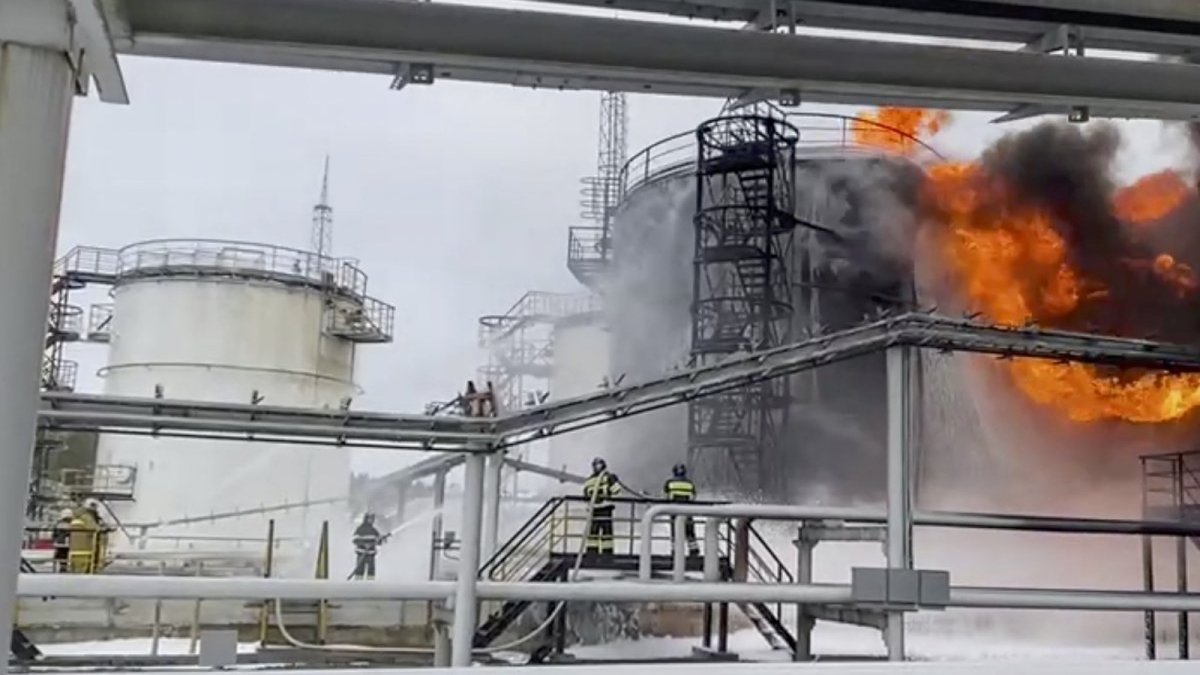
Overnight into Thursday, August 6, 2026, Ukraine launched long-range drones at two major Russian oil refineries while Russia responded with a barrage that killed 17 people across Ukrainian cities and struck a wheat-laden ship in Odessa. The exchanges marked one of the most intense 24-hour periods in the long-range phase of the war, with both sides hitting energy and transport targets.
President Volodymyr Zelensky confirmed the Ukrainian strikes on the Bashneft-Novoil refinery in Bashkortostan, 950 miles from Ukraine, and the Slavneft-YANOS facility near Yaroslavl, 435 miles from the border. Russian forces claimed to have downed 605 Ukrainian drones during the night, though footage verified by BBC showed thick black smoke rising over Yaroslavl.
Russia launched 101 drones and four missiles into Ukraine, with Ukrainian air defenses stopping 66 drones but allowing 29 drones and one missile to hit 18 locations. The pattern shows both nations escalating strikes on economic infrastructure to pressure the other's war effort.
These reciprocal attacks come after months of intensified long-range campaigns that have driven higher civilian casualties on both sides. Ukraine has focused on Russian oil revenue since early July, while Russia continues to target Ukrainian rail and port facilities.
The Two Refineries: Bashkortostan and Yaroslavl
The Bashneft-Novoil refinery in Bashkortostan sits roughly 950 miles from Ukrainian territory, placing it among the deepest strikes Ukraine has conducted. Zelensky described the operation as part of Kyiv's effort to limit Russian oil profits that fund the invasion.
The Slavneft-YANOS refinery in the Yaroslavl region processes around 15 million metric tons per year, equivalent to roughly 300,000 barrels per day, making it one of Russia's largest facilities. Yaroslavl Governor Mikhail Yevrayev reported that air defenses eliminated or disabled all 93 drones in the largest attack the region has seen, though falling debris injured four people and sparked fires at storage tanks.
Debris also ignited three private homes, shattered windows in apartment buildings, and damaged vehicles in Yaroslavl. Moscow Mayor Sergey Sobyanin stated that air defenses intercepted at least five drones heading toward the capital during the same overnight period.
Russian Defense Ministry statements claimed broad success against the drone waves, yet the verified smoke columns over Yaroslavl indicate that at least some Ukrainian munitions reached their targets despite the reported interceptions.
'Long-Range Sanctions': Zelensky's Strategy, Explained
Zelensky framed the refinery strikes as "long-range sanctions" designed to cut Russia's oil revenue that finances the war and the killing of Ukrainians. He credited Ukrainian Defense Forces with systematically building these capabilities to strengthen Kyiv's position at any future negotiating table.
The president stated that Russia must choose peace and thanked the soldiers developing long-range systems. His comments tie the strikes directly to diplomatic leverage rather than purely military objectives.
Ukraine also reported hitting two military patrol boats and shadow fleet vessels in the Black Sea during the same operation. This broader campaign since early July has included attacks on distribution hubs belonging to Russia's largest online retailer, Wildberries.
Damage to Wildberries and its sellers from July strikes alone is estimated at 215-280 billion rubles, or $2.7-3.5 billion. The refinery focus aims at the core revenue stream Moscow uses to sustain its military operations.
Moscow's Answer: Train Stations and a Wheat Ship
Russian forces struck a railway station in Brovary east of Kyiv on Wednesday, killing eight people waiting for a train. A missile hit a residential district in Balakliya southeast of Kharkiv, killing three and injuring five, according to Kharkiv Governor Oleh Syniehubov.
In Lozova, 85 miles south of Kharkiv, a drone attack on the rail station killed two men and injured five men and three women. At least one person died and three were injured when Russia targeted a bulk carrier loaded with wheat in the port of Odessa.
Russia's Defense Ministry said its strikes hit fuel and energy infrastructure, transportation nodes, logistics centers, drone storage sites, and temporary deployment points used by Ukrainian forces. About a dozen people were injured in Sumy during the same wave.
The attacks on civilian rail hubs and a commercial wheat ship signal Moscow's intent to disrupt Ukrainian logistics and export capacity in addition to military targets.
The Air Defense Crisis Behind Kyiv's 17 Dead
Wednesday night's Russian barrage killed 17 people in the Kyiv region, one of the deadliest single nights this year. Ukraine's air force reported that defenses intercepted none of the four missiles launched, allowing one to impact along with 29 drones.
Zelensky issued urgent calls for additional air defense systems following the strikes. The failure to stop the missiles highlights ongoing gaps in Ukraine's layered defenses against mixed drone and missile attacks.
Russian forces have maintained pressure on Ukrainian cities even as their ground advances have slowed dramatically. The 17 deaths in the Kyiv region alone underscore the human cost of these long-range exchanges.
Ukraine's General Staff reported that Russia suffered 42,860 personnel losses in July 2026, its highest monthly total of the year, yet the missile and drone campaign continues without apparent reduction.
The Numbers Behind the Escalation
Russian forces gained less than 40 square kilometers in July after capturing just 30 square kilometers the previous month, a sharp drop from the average of 405 square kilometers per month recorded in July 2025. This stalled advance coincides with the intensified long-range strikes.
Ukraine's July refinery and logistics attacks have produced cumulative damage estimates of 215-280 billion rubles to Wildberries alone. The Slavneft-YANOS facility's 15 million metric ton annual capacity represents a significant portion of Russia's refining output now under threat.
Russia claimed 605 Ukrainian drones shot down overnight, while Ukraine reported intercepting 66 of 101 Russian drones plus three of four missiles. The disparity in claimed interception rates reflects the different scales of each side's drone operations.
These figures illustrate a war of attrition where both nations are expending large numbers of unmanned systems to degrade the other's economic and military sustainment capacity.
Washington's Dilemma: Patriot Politics and Winter
US Ambassador to NATO Matthew Whitaker stated that the Trump administration is unlikely to finalize an agreement with Ukraine on joint production of Patriot air defense missiles before winter. The timeline follows President Trump's acceptance of a licensing plan at the NATO summit in Ankara on July 8 and subsequent reversal last week.
The delay leaves Ukrainian forces facing continued missile and drone threats without expanded domestic production of advanced interceptors. Zelensky's calls for more air defense supplies come directly after the 17 deaths in the Kyiv region.
An EU naval force led by the Italian Navy boarded the sanctioned Russian shadow-fleet tanker Toa Payoh in the Mediterranean on Sunday, showing continued Western efforts to constrain Moscow's maritime logistics even as air defense deliveries lag.
The winter deadline creates a narrow window for any production deal, with Ukrainian cities likely to face repeated long-range attacks in the meantime.
The Bottom Line
The overnight exchanges demonstrate that both Russia and Ukraine have the reach and will to strike deep into each other's territory, targeting energy infrastructure and civilian transport alike. The 17 deaths in the Kyiv region and fires at the Yaroslavl refinery show the immediate human and economic costs.
Ukraine's strategy of long-range sanctions on Russian oil capacity has produced measurable damage, yet Moscow's response has inflicted heavy civilian casualties without slowing its own operations. The stalled Russian ground advance of under 40 square kilometers in July suggests the air and drone campaign is becoming the primary arena of contest.
With Patriot production talks unlikely to conclude before winter and Russian monthly losses reaching 42,860 in July, the conflict shows no sign of de-escalation through either military or diplomatic channels in the near term.
Both sides appear committed to raising the economic pressure until one side's resolve cracks, leaving civilians on both sides of the border to absorb the consequences of the expanding long-range war.
By Jessica Ali, Staff Writer
This article was produced with AI-assisted research and editorial support. Reporting is based on sources cited in the article.
What's Your Reaction?
 Like
0
Like
0
 Dislike
0
Dislike
0
 Love
0
Love
0
 Funny
0
Funny
0
 Wow
0
Wow
0
 Sad
0
Sad
0
 Angry
0
Angry
0

Editor-in-Chief at Global1.News. Atlanta-based journalist who cuts through the BS and tells it like it is. Lead anchor, host, and the voice you hear when the spin stops and the truth starts.












Comments (0)