
Ukraine Drone Barrage Hits Rostov, Moscow Region as War Escalates
A massive Ukrainian drone barrage overnight struck deep into Russia, wounding seven in the Rostov region, killing two in a Belgorod minibus attack, and forcing airport closures and states of emergency across a dozen regions as Moscow and Yaroslavl came under fire in the escalating long-range war.
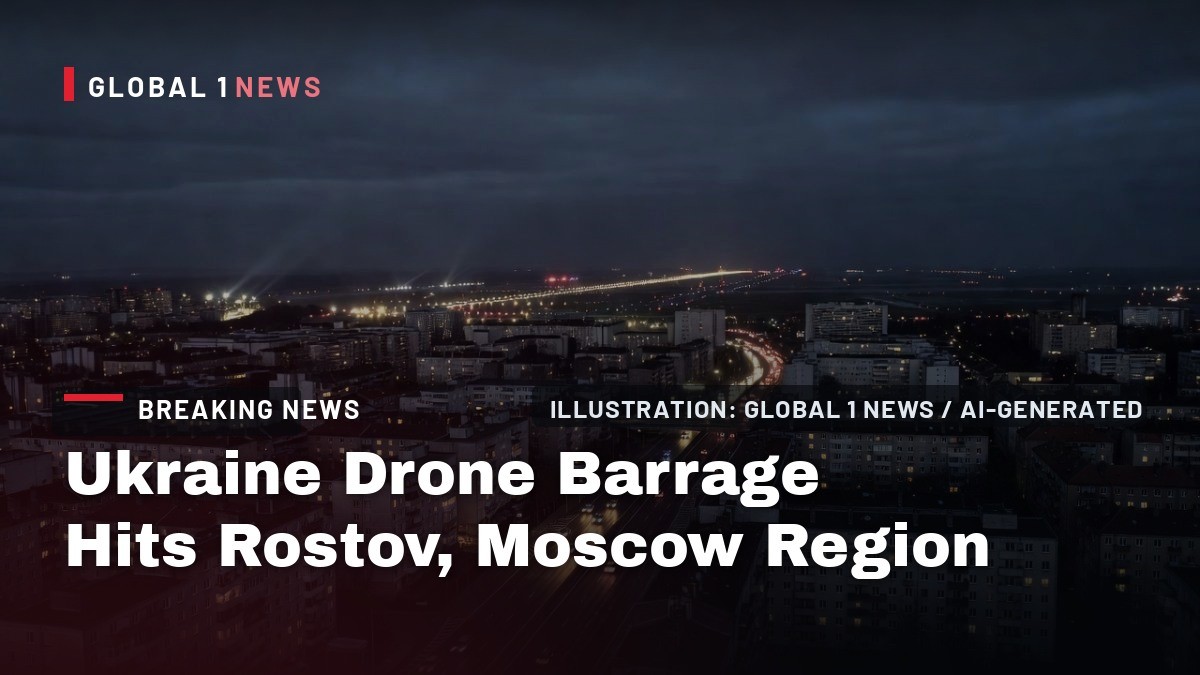
Folks, let’s cut through the noise right now. While much of the world was sleeping, the long-range war between Ukraine and Russia took another violent, sprawling leap into the night sky. Over the past 24 hours, we have seen one of the most widespread Ukrainian drone barrages of this conflict yet—striking from the Black Sea coast all the way to the Ural Mountains. We are talking about a dozen Russian regions under a state of emergency, civilian casualties in the south, airports shut down in the east, and black smoke rising over the Moscow suburbs. This is not a sideshow. This is the new front line of a war that refuses to stay contained.
Let’s be crystal clear about what happened overnight. According to Russian regional authorities and confirmed by Military Review, the Rostov Region bore the brunt of a massive attack. Governor Yuri Slyusar reported that seven people were injured. Four of them—two adults and two children—were rushed to hospitals in Rostov-on-Don, with one minor listed in serious condition. Three more people sought medical attention in the Aksaysky District. This wasn’t a pinprick. This was a coordinated, multi-district assault that hit residential areas, industrial zones, and even a forest belt.
We are not going to sugarcoat the reality here. This is a war of attrition fought with exploding drones, and the civilians on both sides are the ones paying the price. Let’s break down exactly what happened, where it happened, and why this moment matters more than any press release from the Kremlin or the Pentagon.
The Rostov Onslaught: A City Under Siege by Debris
Let’s start in the south, because that is where the human cost was highest. The attack on the Rostov Region wasn’t just about military targets; it was about terrorizing the civilian population. Governor Slyusar confirmed that the city of Rostov-on-Don, along with the Aksaysky, Bagayevsky, and Neklinovsky districts, were all hit simultaneously. The sheer volume of drones overwhelmed local air defenses, and the aftermath was chaos.
In Rostov-on-Don itself, two apartment buildings were damaged by falling debris. Think about that for a second. You are asleep in your bed, and suddenly a missile or drone is shot down, and the wreckage comes crashing through your roof. Residents were evacuated to temporary shelters, their homes now riddled with holes and their sense of security shattered. In the Aksaysky district, the situation was equally dire. UAV debris was found inside a warehouse, sparking a fire that spread to a nearby forest belt. Firefighters battled the blaze through the night, but the damage was done.
The injuries tell the story. Seven people wounded. Four hospitalized. Two of them children. One child in serious condition. This is the grim arithmetic of modern warfare. The Russian Ministry of Defense will call these "failed attacks" because they intercepted the drones. But tell that to the parents sitting in a hospital corridor in Rostov-on-Don, wondering if their kid is going to pull through. The debris is the weapon, and the civilians are the targets.
Moscow and Yaroslavl: The Capital’s False Dawn
Now, let’s pivot to the center of Russian power. Early on the morning of August 28, Moscow Mayor Sergei Sobyanin took to his Telegram channel with his usual terse update. Air defense, he said, had destroyed two UAVs flying toward the Russian capital. Emergency services were working at the site where debris fell. That’s the official line. But the visual evidence told a different story. Black smoke was seen rising over Pavlovsky Posad in Moscow Oblast. That is not a "successful interception" in the eyes of the people living there. That is a fire. That is fear.
The attacks weren’t confined to the capital region. Yaroslavl Oblast Governor Mikhail Yevrayev reported a "drone threat" that forced the closure of the M8 motorway toward Moscow. Intercity buses on that route were suspended. Public transport was rerouted. Imagine being on a bus at 5 AM, heading to work, and suddenly you are stopped on the highway because drones are flying overhead. The red alert was extended to the Vladimir and Ivanovo oblasts, as well as the south-east of Moscow Oblast. This is the new normal for millions of Russians.
What is striking here is the audacity. These drones are getting closer, they are getting more numerous, and they are getting through. Sobyanin has been complaining for weeks that the number of Ukrainian strike drone attacks on the capital has increased severalfold. He’s not wrong. The question is: what can he actually do about it? The air defense systems are being stretched thin, and the Ukrainians are learning. They are sending waves of decoys, swarms of cheap drones, to saturate the defenses and let the more sophisticated ones slip through.
Belgorod’s Bloody Morning: A Minibus Turned Tomb
We have to stop and acknowledge the tragedy in the Belgorod region, because it is a stark reminder that this war is not just about strategic targets. On August 28, a Ukrainian drone struck a civilian minibus. The regional operational headquarters confirmed the grim toll: two people were killed, and six others were injured. This wasn’t a military convoy. This was a vehicle carrying ordinary people, going about their daily lives, trying to get to work or the market.
This is the ugly underbelly of the drone war. When you launch hundreds of UAVs at a region, you are not going to hit every military installation perfectly. You are going to hit a bus. You are going to hit an apartment building. You are going to hit a warehouse. The Ukrainians will say they are targeting infrastructure and troop concentrations. The Russians will say they are defending their homeland. But the bodies on the ground don’t care about the narrative. They are just dead.
We report this not to assign blame, but to state facts. The Belgorod region has been a constant flashpoint for cross-border attacks. The people there have lived under the threat of shelling and drone strikes for years. And on this day, their luck ran out. Two families are now planning funerals. Six more are planning hospital visits. That is the cost of this escalation.
Airports Shut Down and a State of Emergency Across a Dozen Regions
Let’s talk about the logistical chaos. The ripple effects of these attacks are massive. In Izhevsk, the Kalashnikov and Kirov airports temporarily closed their operations. Russia’s Federal Air Transport Agency, Rosaviatsiya, said restrictions on arrivals and departures were imposed to ensure flight safety. That is a polite way of saying: "We are terrified a drone is going to hit a passenger jet." So they grounded everything. Thousands of passengers stranded, flights canceled, schedules thrown into disarray.
But the airport closures are just the tip of the iceberg. A state of emergency has been declared in a staggering number of Russian regions: Voronezh, Ulyanovsk, Nizhny Novgorod, Saratov, Tambov, Volgograd, Samara, Sverdlovsk, Penza, and Orenburg. That is not a localized incident. That is a national security crisis. Voronezh Region Governor Alexander Gusev went on the air and urged residents to take shelter in windowless buildings. Windowless buildings! That is the advice from a regional governor in 2026. We are living in a world where the official guidance is to hide in a room without windows because the sky is falling.
This is a massive disruption to the Russian economy and daily life. Factories are pausing operations. Schools are closing. People are being told to stay home. The Kremlin wants to project an image of stability, but a dozen regions under a state of emergency is the opposite of stability. It is a recognition that the war has come home, and it is not going away.
The Wider Long-Range War: A History of Escalation
To understand where we are, we have to look at where we’ve been. This isn’t a one-off event. This is a pattern of escalation that has been building for weeks. On August 16, officials called an attack "the largest-scale" this year—some 822 drones were used, with about 600 aiming for Moscow. At least seven people were killed in that barrage. Then, just two days later, on August 18, Ukraine launched more than 620 drones at Moscow in its largest such attack in years. That same day, Russian strikes killed 10 people in Ukraine’s Kharkiv region.
And let’s not forget early August, when five people were killed by a drone attack on an industrial area in the Moscow region. That was described as the deadliest on the capital region since 2022. So we are seeing a clear trajectory. The Ukrainians are not slowing down. They are ramping up. They are building more drones, they are flying them farther, and they are hitting harder.
This is a strategic choice by Kyiv. They cannot match Russia’s artillery or missile stockpiles. But they can build cheap, effective drones that can reach Moscow, Rostov, and even Izhevsk. They are trying to make the war unbearable for the Russian public. They want the Russian people to ask: "Why are we doing this? Why are our cities burning?" It is a brutal, cynical strategy, but it is a strategy.
Russia’s Response: Strikes on Ukraine Intensify
Of course, Russia is not taking this lying down. While Ukraine is launching drones, Russia is launching its own barrages. Russian drones hit Ukraine’s Kyiv region for a second straight day around August 28-29, hitting more than a dozen apartment buildings and storage depots. The Independent reported this, and the images are horrifying. Families are being pulled from the rubble. The Kyiv region is under constant threat.
And let’s not forget the massacre in Kharkiv on August 18, where Russian strikes killed 10 people. That is the symmetry of this war. Ukraine hits Rostov, Russia hits Kharkiv. Ukraine hits Moscow, Russia hits Kyiv. It is a cycle of violence that shows no signs of ending. The civilians are the ones who suffer. They are the ones who die. They are the ones who lose their homes.
Russian forces have simultaneously stepped up their drone and missile barrages on Ukraine. They are targeting energy infrastructure, trying to plunge Ukrainian cities into darkness as winter approaches. They are hitting residential areas, trying to break the will of the Ukrainian people. But if the last two years have taught us anything, it is that the Ukrainian people are not breaking. They are adapting. They are fighting back.
What This Escalation Means: A War Without Borders
Let’s step back and analyze this. What does this escalation actually mean? First, it means the concept of a "front line" is obsolete. This is a war without borders. Drones are flying hundreds of miles into enemy territory. They are hitting capitals, industrial hubs, and civilian infrastructure. The entire country of Russia is now a potential battlefield. The entire country of Ukraine is too.
Second, it means that air defense is not a silver bullet. Russia has some of the most advanced air defense systems in the world. And yet, drones are getting through. They are hitting apartment buildings. They are forcing airports to close. The sheer volume of attacks is overwhelming the systems. This is a lesson for every military in the world: swarms of cheap drones can defeat expensive defenses.
Third, it means the war is entering a new, more dangerous phase. The longer this goes on, the more likely it is that a mistake will be made. A drone will hit a nuclear power plant. A missile will strike a chemical factory. A cyberattack will take down a hospital. The potential for catastrophic escalation is growing every single day. And the international community is standing on the sidelines, wringing its hands, but doing nothing substantive to stop it.
The Diplomatic Backdrop: The Ratcliffe Visit and Its Aftermath
We cannot talk about this escalation without mentioning the elephant in the room: the diplomatic dance happening behind the scenes. CIA Director John Ratcliffe visited Moscow on August 25. His plane departed Vnukovo airport. And within hours of his departure, Ukrainian drone attacks on Moscow resumed. That is not a coincidence. That is a message.
European officials quoted by Bloomberg doubt the visit was mainly about an alleged attack-on-NATO plot. They believe it was about something else—perhaps a backchannel negotiation, perhaps a warning, perhaps an attempt to de-escalate. But the result was the opposite. Kyiv says Washington briefed Ukraine on the Moscow talks. So the Ukrainians knew what was said, and they didn’t like it. They responded with drones.
This is the dangerous game of geopolitics. The CIA Director is flying to Moscow to talk, while Ukrainian drones are flying to Moscow to bomb. The signals are mixed, the intentions are unclear, and the risk of miscalculation is enormous. The United States is trying to walk a tightrope, supporting Ukraine while avoiding a direct confrontation with Russia. But that tightrope is getting thinner and thinner.
Folks, here is the bottom line. We are in the third year of a war that has already killed hundreds of thousands of people. And instead of de-escalating, both sides are doubling down. They are building more weapons, launching more attacks, and killing more civilians. The drone barrage we saw overnight is not the end. It is just the latest chapter in a tragedy that is far from over.
What can you do? Stay informed. Do not let the 24-hour news cycle desensitize you to the human cost. Remember the names: Rostov-on-Don, Belgorod, Kharkiv, Kyiv. Remember the numbers: seven injured, two children in the hospital, two dead in a minibus. These are not statistics. These are people. And until the world leaders decide that peace is more important than pride, these people will continue to die.
Keep your eyes open. Keep asking questions. And do not look away.
By Jessica Ali, Staff Writer
This article was produced with AI-assisted research and editorial support. Sources: Ukrainska Pravda, Charter'97, Xinhua, BBC News, Al Jazeera, ABC News, The Independent, Kyiv Independent, RBC-Ukraine, Military Review, Meduza.
What's Your Reaction?
 Like
0
Like
0
 Dislike
0
Dislike
0
 Love
0
Love
0
 Funny
0
Funny
0
 Wow
0
Wow
0
 Sad
0
Sad
0
 Angry
0
Angry
0

Editor-in-Chief at Global1.News. Atlanta-based journalist who cuts through the BS and tells it like it is. Lead anchor, host, and the voice you hear when the spin stops and the truth starts.












Comments (0)