
Turkish Jets Over Giza: Cairo-Ankara Axis Reshapes Region
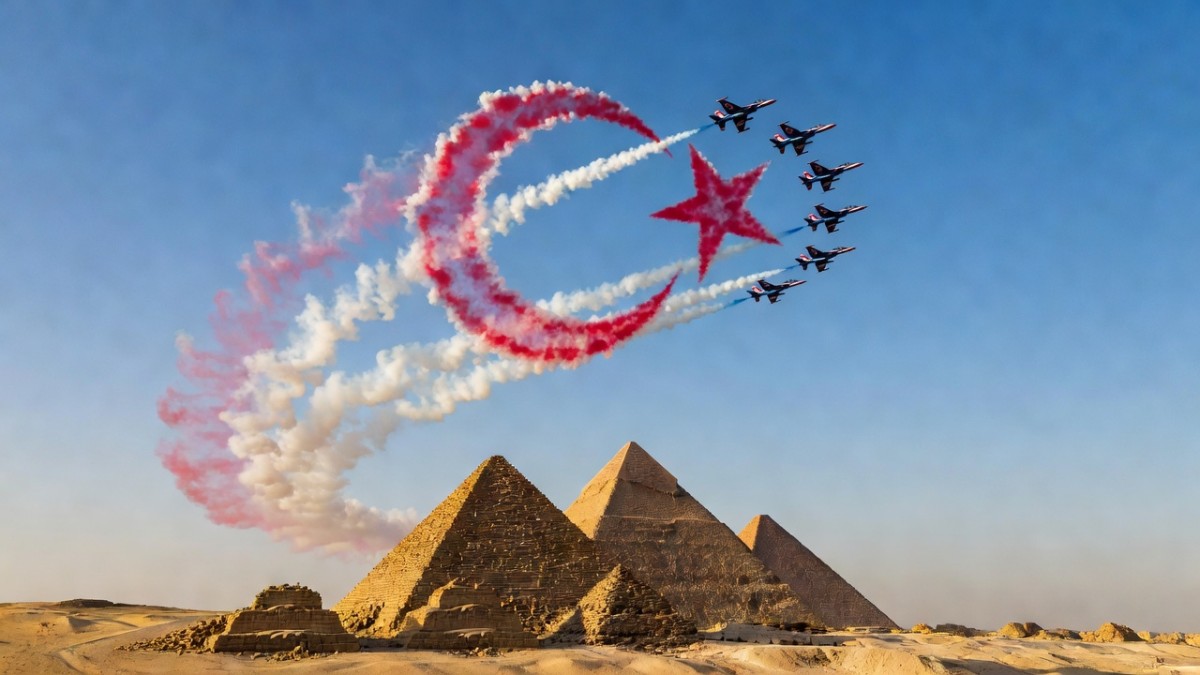
Turkish warplanes tracing the crescent and star over the Giza pyramids is not just spectacle - it is the most visible symbol yet of a Cairo-Ankara axis that is redrawing the eastern Mediterranean.
Turkish warplanes tracing the crescent and star over the Giza pyramids is not just spectacle - it is the most visible symbol yet of a Cairo-Ankara axis that is redrawing the eastern Mediterranean. The September 8 flyover by the Turkish Stars aerobatic team, staged hundreds of kilometers from Israel's borders, carried a strategic payload far heavier than the red-and-white smoke trailing from their wings. For a region accustomed to rivalry, the image of Turkish NF-5 jets saluting Egypt's ancient monuments marked a definitive public embrace between two powers that spent a decade backing opposite sides in Libya's civil war and trading accusations over Islamist movements.
Turkish Stars Over Giza: The New Cairo-Ankara Axis Takes Flight
El Alamein, Egypt - September 9, 2026 - The roar of Turkish supersonic jets over the Giza plateau on Tuesday was not merely an aerobatic flourish. It was the culmination of a diplomatic arc that began with a handshake in Doha in November 2022 and has accelerated into a full-spectrum rapprochement encompassing military protocols, defense-industrial partnerships, and a shared strategic posture toward the eastern Mediterranean. The Turkish Stars, based at Konya's 3rd Main Jet Base and flying NF-5A/NF-5B aircraft in service since 1987, performed their display as part of the second edition of the El Alamein International Airshow 2026 (EIAS 2026), held September 8-10 at El Alamein International Airport in New El Alamein City, Matrouh Governorate. Turkiye's Ministry of National Defense shared footage of the jets leaving the image of the Turkish crescent and star above the pyramids, explicitly framing the maneuver as a salute to the Egyptian public.
The choice of venue was deliberate. El Alamein, site of the pivotal 1942 battle that turned the North Africa campaign, now hosts an airshow that has become a microcosm of the region's multipolar diplomacy. The event gathered the UAE, Saudi Arabia, Russia, and the United States alongside Turkey and Egypt - a snapshot of how Cairo is hedging among great powers while simultaneously deepening ties with Ankara. The flyover drew international attention not only for its visual impact but because it occurred in Egypt's Mediterranean backyard, a theater where Turkish and Egyptian interests once collided over maritime boundaries and Libya's future. Now, those same interests are converging, and the airshow provided the backdrop for Ankara to showcase its domestic defense industry - including Turkish Aerospace Industries (TAI), Aselsan, and MKE - to an Egyptian audience and a regional one.
Crescent and Star Over Giza
The Turkish Stars' performance on September 8 was the centerpiece of a carefully choreographed display. Seven NF-5 aircraft flew in formation, painting the Turkish national symbol across the sky above the pyramids - an image that Turkiye's Ministry of National Defense disseminated widely. The team, formed in 1992 and based at Konya, is one of the oldest aerobatic units in the region, and its presence over Giza gave the display a symbolic weight no routine airshow appearance could carry. The flyover came on the opening day of EIAS 2026, which organizers expected to feature more than 100 aircraft and confirmed participation from six aerobatic teams: the UAE's Al Fursan, Russia's Russian Knights and Swifts, South Korea's Black Eagles, Greece's Zeus Demo Team, India's Surya Kiran, and Turkey's Turkish Stars and Solo Turk.
The event's organizers - Egypt's Ministry of Defense, the Egyptian Air Force, the Ministry of Civil Aviation, the Egyptian Space Agency, and EgyptAir - framed the airshow as a showcase of Egypt's openness to global defense cooperation. An Aerospace Future Technology Symposium opened the programme on September 7, with Lockheed Martin as headline sponsor, underscoring the continued US presence in Egypt's defense ecosystem. Yet the Turkish participation carried a distinct diplomatic weight. The sight of Turkish jets over Giza, broadcast across regional media, signaled to Cairo's traditional partners - and to Israel - that the Egypt-Turkey relationship had moved beyond diplomatic niceties into visible military-to-military symbolism.
An Airshow With a Message
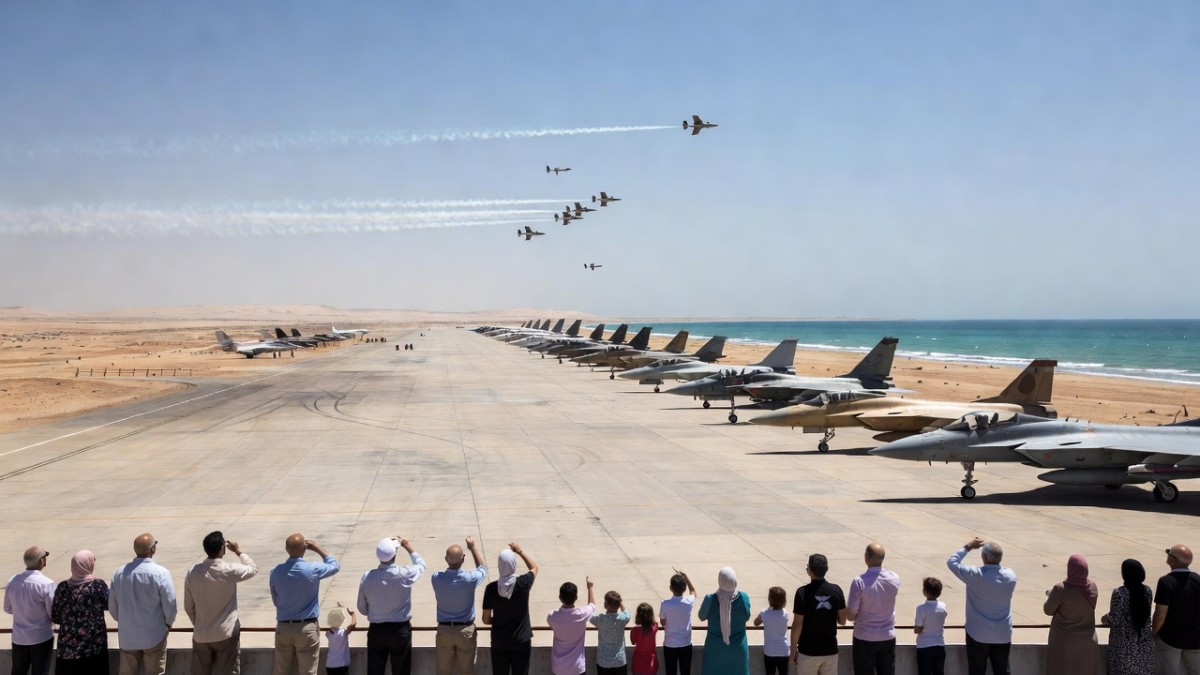
The El Alamein airshow was never merely about aviation. Its second edition assembled participants including host Egypt, Turkey, Russia, India, France, Spain, Saudi Arabia, the UAE, Greece, South Korea, and the US Air Force - a roster that reflects Egypt's deliberate strategy of diversifying its security relationships. The UAE opened a national pavilion featuring EDGE Group, GAL, and ADNEC, while Turkish defense manufacturers exhibited prominently, including TAI, Aselsan, and MKE. For Ankara, the exhibition was an opportunity to showcase its ambitions: the KAAN fifth-generation fighter programme and the HURJET advanced jet trainer/light combat aircraft, whose first production aircraft destined for the Turkish Air Force made its maiden flight in late August 2026.
The audience was as significant as the exhibitors. Egyptian military leadership, including Chief of Staff Lieutenant General Ahmed Khalifa, had hosted Turkish Chief of the General Staff General Selcuk Bayraktaroglu just weeks earlier, on June 27, when they co-chaired the closing session of the fifth Egyptian-Turkish Military Cooperation Committee. The airshow thus served as a public confirmation of a military relationship that had been quietly institutionalized. For regional observers, the presence of Greek and Turkish teams at the same event - Athens and Ankara have their own fraught history - underscored how rapidly alignments are shifting. The airshow's location on Egypt's Mediterranean coast - a maritime theater where Ankara and Cairo once wrangled over boundaries - added a layer of strategic signaling that was not lost on defense attaches in attendance.
From Rivalry to Rapprochement
The trajectory from hostility to partnership has been swift but carefully managed. Egypt-Turkey ties ruptured after the 2013 ouster of Mohamed Morsi and the Muslim Brotherhood's removal in Egypt. For nearly a decade, Cairo and Ankara backed rival sides in Libya's civil war, clashed rhetorically over the eastern Mediterranean, and competed for influence across the Arab world. The thaw began with an Erdogan-Sisi handshake in Doha in November 2022, followed by the exchange of ambassadors in 2023. Erdogan visited Cairo in February 2024, and Sisi reciprocated in Ankara in September 2024, with the two presidents setting a target of $15 billion in bilateral trade.
The pace quickened in 2026. In February, Sisi and Erdogan co-chaired the High-Level Strategic Cooperation Council in Cairo. On June 21, Egyptian Foreign Minister Badr Abdelatty met Turkish Foreign Minister Hakan Fidan in Cairo on the sidelines of a consultative gathering of four regional countries. Both praised rapid developments in bilateral relations, agreed to convene a second joint planning group meeting, and discussed trade, investment in the Suez Canal Economic Zone (SCZone), and coordination on Libya, Sudan, and Syria. The military track followed days later with the Khalifa-Bayraktaroglu meeting and the signing of a protocol covering joint activities and exchange of military expertise. The rapprochement has been driven by mutual necessity: Egypt seeks to diversify its strategic dependencies, while Turkey, isolated in parts of the region, needs a reliable Arab partner with weight in the Gaza file and Libya.
The Defense Courtship
The defense-industrial dimension of the rapprochement is where rhetoric meets concrete contracts. At Egypt's EDEX 2025 defense exhibition in Cairo in December 2025, Turkish officials brought 81 defense companies, and the two sides agreed to exchange technical delegations and explore new manufacturing partnerships. The most tangible sign came on September 2, 2026, when Egypt's Heliopolis Company for Chemical Industries (Military Factory 81) and Helwan Company for Engineering Industries (Military Factory 99) signed an MoU with Turkey's state-owned MKE at the First Balkan Shield Industrial Expo in Sarajevo. Egypt's Minister of State for Military Production Salah Soliman Gomblat said the deal implements President Sisi's directives to build strategic partnerships with friendly countries and expand Egypt's defense-industrial base.
For Egypt, the partnership addresses a long-standing vulnerability: ammunition production has been identified as a key priority, and Cairo has sought to diversify suppliers beyond its traditional reliance on the United States, which provides F-16s and approximately $1.3 billion in annual military aid, as well as Russia and other partners. Turkey's MKE brings decades of experience in small-caliber and medium-caliber ammunition manufacturing, giving the framework a concrete industrial base on which to build. For Ankara, the Egyptian market offers access to a large military establishment and a gateway to African and Arab markets. The defense courtship is still in its early stages - the MoUs signed so far are frameworks rather than production contracts - but the trajectory is unmistakable. Turkish defense firms exhibited at El Alamein with the explicit aim of moving from memoranda to manufacturing.
Strategic Calculus: What Cairo and Ankara Want
Beneath the ceremonial handshakes lies a hard-nosed strategic calculus. Egypt's approach under President Sisi has been to hedge among great powers while maximizing its own leverage. The same month that Turkish jets flew over Giza, Egypt hosted China's Xi Jinping from August 30 to September 1, 2026, issuing a joint communique that signaled deepening Sino-Egyptian ties. Cairo is simultaneously managing relationships with Washington, Moscow, Beijing, and now Ankara - a multipolar balancing act that gives Egypt room to maneuver but also creates competing obligations. Turkey, for its part, sees Egypt as essential to its ambitions in the eastern Mediterranean and North Africa, where Ankara has sought to break out of the isolation that followed its interventions in Syria and Libya.
Both countries share a critical commonality: vocal criticism of Israel's war in Gaza. Egypt mediates in the Gaza file, while Erdogan has been among Israel's harshest regional critics. This convergence has facilitated coordination on Palestine, even as Cairo maintains its peace treaty with Israel and its role as a security broker. The two governments have also coordinated positions on Libya's push toward elections, seeking to avoid a return to the proxy conflict that defined their relationship from 2014 to 2020. Analysis in August 2026 by Daily News Egypt reported that Ankara had been pushing to draw Egypt into a newly signed regional mutual-defense framework. Fidan has described the cooperation as serving peace, stability, and prosperity in the region, calling bilateral intelligence and diplomatic coordination excellent. Israel watches this military rapprochement closely, aware that a Cairo-Ankara axis changes the strategic geometry of its neighborhood.
Regional Implications
The Turkish Stars' smoke over Giza will fade, but the strategic alignment it symbolized will persist. The rapprochement between Egypt and Turkey - two of the region's most populous and militarily significant states - is redrawing the map of the eastern Mediterranean. For Israel, the prospect of Egyptian-Turkish military cooperation adds a new variable to an already complex security environment. For Libya, coordinated Egyptian-Turkish positions on elections could either stabilize the country or create a new condominium of influence. For the Gulf states, the axis offers both opportunities and cautions: the UAE participated in the same airshow that hosted Turkey, reflecting the region's fluid alignments.
The economic track is equally consequential. Cairo has promoted a 'Fast Track' licensing mechanism for Turkish investors, proposed an integrated Turkish industrial zone inside the SCZone, worked to reactivate a roll-on/roll-off (Ro-Ro) maritime line between Egyptian and Turkish ports, and pitched Turkish firms on mining investment ahead of September's Egypt Mining Forum. A joint-committee decision on rules of origin under the free trade agreement has been signed. The $15 billion trade target is ambitious but plausible given the momentum. What began as a diplomatic necessity has become a strategic partnership with institutional depth - military committees, defense MoUs, and presidential councils. The crescent and star over the pyramids was a photograph; the Cairo-Ankara axis is a policy.
By Malik Hassan, Staff Writer
This article was produced with AI-assisted research and editorial support. Reporting is based on sources cited in the article.
What's Your Reaction?
 Like
0
Like
0
 Dislike
0
Dislike
0
 Love
0
Love
0
 Funny
0
Funny
0
 Wow
0
Wow
0
 Sad
0
Sad
0
 Angry
0
Angry
0

Middle East Correspondent at Global1.News. Based in Beirut, covering politics, conflict, energy, and society across the Middle East. Brings context and depth to a region often reduced to headlines.











Comments (0)