
Tragedy in Isaan: Man, 52, Dies in Rice Field as Family Suspects Heatstroke
A 52-year-old farmer died in a rice field in Nakhon Ratchasima on Sunday, with authorities suspecting heatstroke. The man, identified as Boonnam Chiansanthia, was found face-down in a water channel after failing to return home, prompting renewed attention to heat risks for Thailand's farm workers.
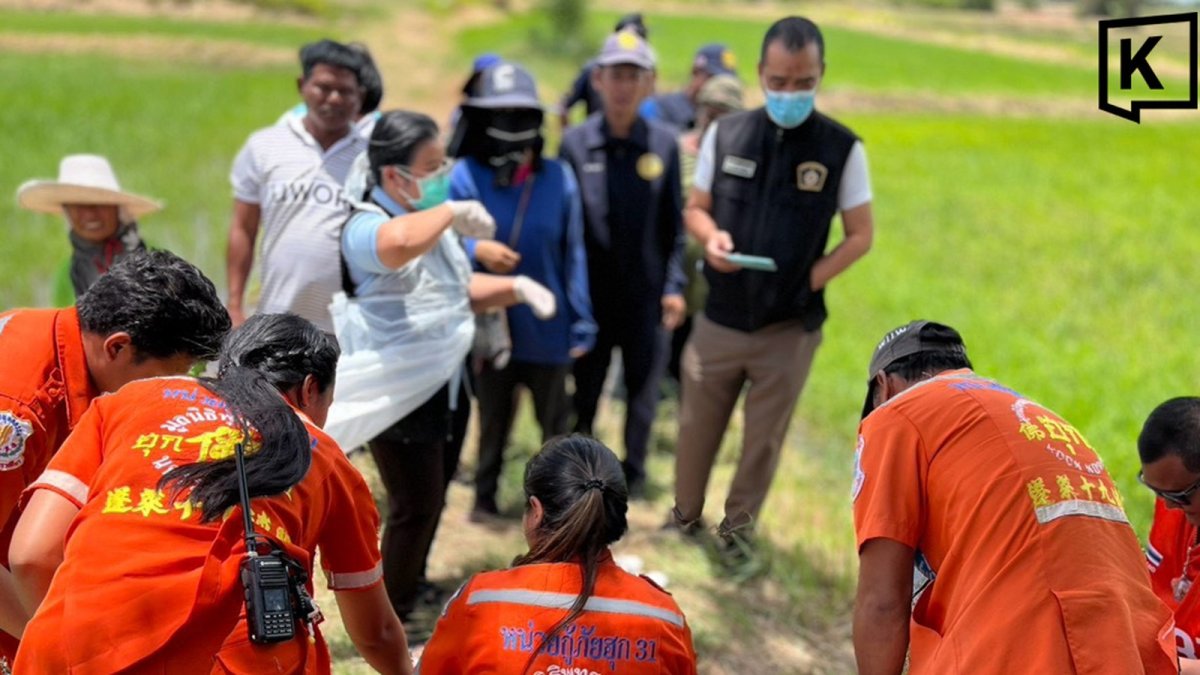
NAKHON RATCHASIMA — A 52-year-old farmer died on Sunday morning in a rice field in Nakhon Ratchasima province, with authorities initially suspecting heatstroke as the cause. The man, identified as Boonnam Chiansanthia, was found lying face-down in a water channel along a field embankment in Ban Nong Thuriang, Non Mueang subdistrict, Kham Sakaesaeng district, after he failed to return home by late morning.
The incident unfolded around 10:53 on Sunday when Hook 31 Korat rescue volunteers at the Kham Sakaesaeng unit were alerted by Pol. Lt. Col. Thiwakorn Chaemklang, an investigator at Kham Sakaesaeng Police Station. The remote field, a considerable distance from the main road, forced rescuers to abandon their vehicle and trek on foot, carrying stretchers and rescue equipment across the uneven terrain.
The Discovery and Victim Identification
At the scene, rescue workers found Boonnam's body in a shallow water channel running alongside the rice field embankment. He was dressed in black trousers and a long-sleeved blue shirt, with a waist bag still attached. Police officers, local officials, and villagers gathered to observe as authorities carefully brought the body out of the water for examination. Inside the waist bag, investigators discovered a mobile phone and Boonnam's national identification card, which confirmed his identity as a resident of Huai Thalaeng district, Nakhon Ratchasima. A preliminary examination revealed no wounds or signs of assault on the body, leading authorities to rule out foul play in the initial stages of the investigation. The scene itself speaks to the quiet solitude of rural life in Isaan. Ban Nong Thuriang is the kind of small village where everyone knows everyone, where daily life follows the sun and the seasons. The presence of the village headman, local officials, and villagers at the scene reflects the communal nature of these tight-knit settlements. The identification process, while routine for authorities, carries particular weight in rural Thailand. The national identification card, a small laminated document that every Thai citizen carries, becomes a crucial tool in moments like this. For Boonnam, who had moved from Huai Thalaeng to Kham Sakaesaeng after marriage, the card confirmed not just his identity but also his roots.Family Account: A Morning That Turned to Grief
Relatives told authorities that Boonnam had originally come from Huai Thalaeng district but had moved to Kham Sakaesaeng after marrying a local woman. Before leaving home at around 08:00 on Sunday, he informed his family that he intended to clear grass and weeds in the rice field—a routine task for farmers preparing their land during this period. When Boonnam had not returned by late morning, his family grew concerned and went to search for him. The search ended in tragedy when they found him dead at the scene. The family immediately alerted the village headman, who then contacted police and rescue workers to handle the situation. This pattern of a farmer heading out early to beat the heat, only to be struck down while working alone, resonates deeply across Isaan's agricultural communities. Leaving at 08:00 suggests Boonnam was trying to make the most of the cooler morning hours, a common practice among farmers. Yet even the morning hours can prove treacherous when temperatures climb and humidity remains high. The role of the village headman, or phu yai ban, is worth noting. In rural Thailand, the headman serves as the crucial link between the community and official institutions. When Boonnam's family found him, they did not call the police directly—they called the headman first, reflecting the deep trust rural communities place in their local leaders.Suspected Heatstroke and the Forensic Process
Authorities initially suspected that Boonnam had suffered heatstroke due to the hot and humid weather conditions typical of the Isaan region during this time of year. The working theory is that he may have become dizzy, lost consciousness, and fallen face-down into the water channel, where he was unable to help himself and remained unnoticed until his death. Rescuers transported Boonnam's body to Kham Sakaesaeng Hospital for a forensic examination to determine the exact cause of death. Following the examination, the body will be released to relatives for religious rites, allowing the family to conduct proper Buddhist funeral ceremonies in accordance with local traditions. The forensic process, while clinical in nature, serves a deeper purpose in Thai society. Determining the exact cause of death brings closure to families and answers the inevitable questions that arise after a sudden loss. In cases like this, where foul play has been ruled out, the examination confirms what the family and community already suspect—that this was a tragic accident of heat, exertion, and isolation. The period between death and the funeral is a sacred time in Thai Buddhist tradition. The body is typically kept at home or at a temple, where monks are invited to perform chanting ceremonies each evening until the cremation. For Boonnam's relatives, the coming days will be filled with these rituals—the washing of the body, the offering of robes to monks, the chanting that guides the spirit toward its next existence.The Hidden Danger of Thailand's Heat for Farm Workers
This tragic incident highlights a persistent and often overlooked danger facing Thailand's agricultural workforce, particularly in the northeastern Isaan region. Farm workers routinely spend long hours under the direct sun, often wearing long-sleeved clothing for protection against insects and vegetation, which can exacerbate heat retention. The combination of high temperatures, high humidity, and physical exertion creates conditions where heatstroke can strike suddenly and without warning. Heatstroke occurs when the body's temperature regulation system fails, and it can be fatal if not treated promptly. Symptoms include confusion, dizziness, rapid pulse, and loss of consciousness. For farmers working alone in remote fields, the risk is amplified—there is often no one nearby to notice when a worker collapses or to provide immediate assistance. The case of Boonnam, working alone in a field far from the road, illustrates this vulnerability starkly. His family's quick response when he did not return was not enough to save him; the time between his collapse and discovery proved critical.What This Means for Rural Thai Communities
For communities across Nakhon Ratchasima and the wider Isaan region, this incident serves as a somber reminder of the risks that come with agricultural work during the hot season. Local authorities and village headmen often advise residents to avoid strenuous outdoor work during the peak heat hours of late morning to early afternoon, and to stay hydrated throughout the day. The tragedy also underscores the importance of checking on family members and neighbors who work alone in fields. In rural Thai communities, where social bonds are strong and neighbors often look out for one another, this incident may prompt renewed conversations about safety practices. The seasonal patterns of Isaan's climate make this an especially relevant concern. The hot season, typically running from March through May, brings daytime temperatures that regularly exceed 40 degrees Celsius in many parts of the northeast. This is also the period when farmers prepare their fields for the upcoming rainy season, clearing land and burning off dry vegetation—work that must be done regardless of the heat. In the aftermath of this tragedy, community leaders may consider informal check-in systems, where neighbors agree to look out for one another during the hottest months. Some villages have experimented with buddy systems, where farmers working in nearby fields keep an eye on each other and raise the alarm if someone appears to be struggling. For the family of Boonnam Chiansanthia, the coming days will be filled with funeral preparations and the traditional Buddhist ceremonies that honor the deceased. The community of Kham Sakaesaeng district, still processing the shock of the sudden loss, will likely rally around the grieving family. As the forensic examination at Kham Sakaesaeng Hospital proceeds, authorities will work to confirm the exact cause of death. But for now, the initial suspicion of heatstroke stands as a cautionary tale for farmers across Thailand's agricultural heartland—a reminder that even routine tasks can become deadly under the relentless Isaan sun. This article was produced with AI-assisted research and editorial support. Sources: Khaosod English. By Ann Srisawat, Staff WriterWhat's Your Reaction?
 Like
0
Like
0
 Dislike
0
Dislike
0
 Love
0
Love
0
 Funny
0
Funny
0
 Wow
0
Wow
0
 Sad
0
Sad
0
 Angry
0
Angry
0

Ann Srisawat
Southeast Asia Correspondent at Global1.News. Based in Bangkok, covering Thai and Southeast Asian politics, economy, technology, and culture. Deep regional perspective on one of the world's most dynamic regions.













Comments (0)