
TotalEnergies Exits Arctic LNG 2 as Sanctions Reshape Russia's LNG Ambitions
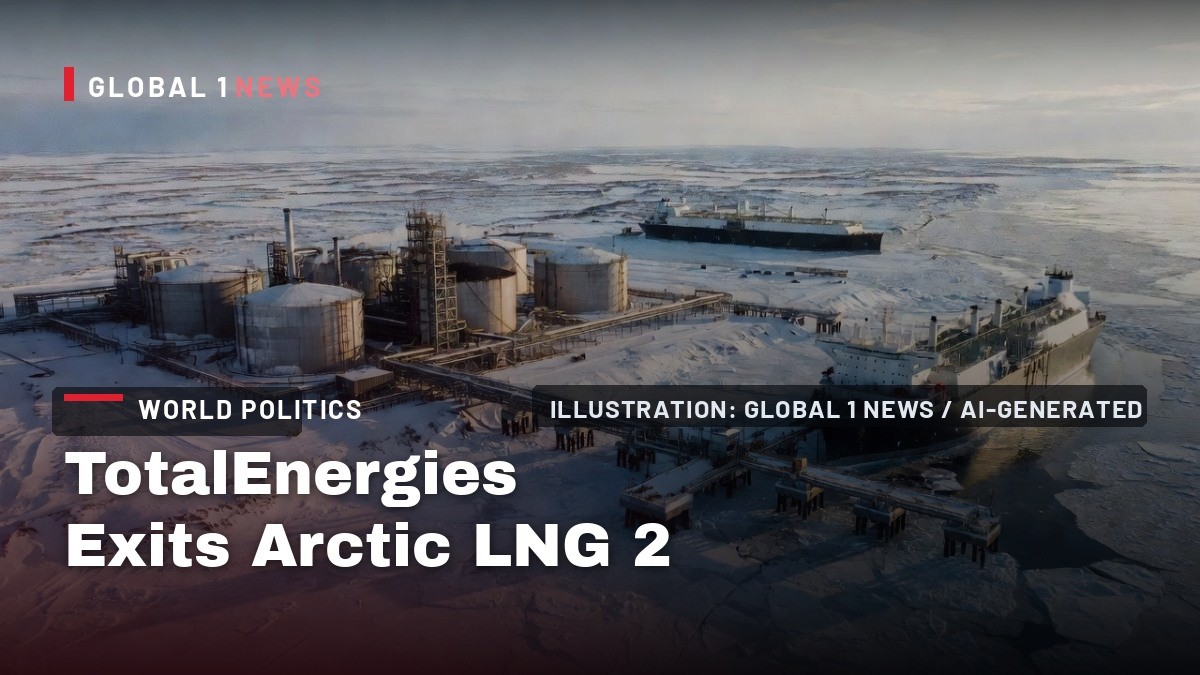
French energy giant TotalEnergies has completed its exit from the US-sanctioned Arctic LNG 2 project, transferring its 10% stake to Novatek subsidiary NordLine. The Kremlin-authorized move deepens Russian control over Arctic gas development as Western partners withdraw under sanctions pressure.
TotalEnergies Exits Arctic LNG 2 as Sanctions Reshape Russia's LNG Ambitions
Moscow, Russia — French energy giant TotalEnergies confirmed Thursday that it has completed the transfer of its 10% stake in the Arctic LNG 2 project to a subsidiary of Russia's Novatek, formally ending its involvement in one of the Kremlin's most strategically important energy ventures. The exit, announced by CEO Patrick Pouyanne in July and authorized by a presidential decree in June, marks a significant milestone in the unraveling of Western corporate participation in Russia's Arctic gas development.
The move comes more than two years after the United States placed the project under blocking sanctions, effectively freezing foreign shareholders' participation and crippling the facility's ability to reach its planned production capacity. For Moscow, the departure of a long-standing Western partner underscores the mounting costs of its energy confrontation with the West.
The Exit Deal
TotalEnergies confirmed in a statement that the transfer of its 10% interest in Arctic LNG 2 to NordLine, a Novatek subsidiary, has been completed. "TotalEnergies is therefore no longer a shareholder," the company said, closing a chapter that began with high hopes for Arctic energy cooperation and ended under the shadow of unprecedented sanctions.
The company had already written down $4.1 billion from its stake in the project in 2022, following Russia's full-scale invasion of Ukraine. The write-down reflected the near-total loss of value of an asset that was once considered a crown jewel in TotalEnergies' global LNG portfolio.
Pouyanne had signaled the exit plan in July, noting that the company had received the necessary approval from Russian authorities. Under Russian law, foreign companies seeking to divest from strategic energy assets require presidential authorization, a process that has become increasingly politicized since the invasion.
A Decade of Partnership Unravels
The Arctic LNG 2 exit represents the latest casualty in a partnership that once defined Franco-Russian energy cooperation. Novatek, founded in 1994, has been TotalEnergies' principal Russian partner for over a decade. In 2013, the two companies jointly launched the Yamal LNG project in Siberia, which continues to ship liquefied natural gas to Europe and Asia.
TotalEnergies still holds a 19.4% stake in Novatek itself and a 20% stake in Yamal LNG. The company maintains it cannot sell those stakes under the current sanctions regime, leaving it in a state of frozen engagement with the Russian energy sector.
The Arctic LNG 2 project, located on the Gydan Peninsula across the Ob Bay from Yamal, was designed as Novatek's second large-scale LNG venture. With three planned trains, each with a capacity of 6 million tonnes per year, the facility was expected to produce 19.8 million tonnes of LNG annually — surpassing Yamal's 16.5 million tonnes — along with 1.6 million tonnes of stable gas condensate.
The $1.3 Billion Question
While TotalEnergies has exited its equity stake, the company noted that it retains the right to reimbursement of $1.3 billion in loans it provided to the project alongside other shareholders. However, the company was candid about the prospects for repayment, stating that "such reimbursement might be implemented in the future subject to applicable sanctions."
The loans represent a significant financial exposure that could remain unresolved for years. Western sanctions on the project, coupled with Russia's restrictions on capital outflows, make any near-term recovery unlikely. For TotalEnergies, the exit may have removed its equity stake from the balance sheet, but the financial entanglement is not fully severed.
The broader shareholder structure of Arctic LNG 2 before the transfer included Novatek with 60%, TotalEnergies with 10%, China's CNPC with 10%, CNOOC with 9.9%, and a Japanese joint venture of JOGMEC and Mitsui with 10%. Foreign shareholders froze their participation after the US sanctions were imposed in November 2023, leaving Novatek to shoulder the project's operational burdens alone.
Sanctions That Bind
The sanctions regime against Arctic LNG 2 has been layered and comprehensive. On 14 September 2023, the US Department of the Treasury added companies providing construction and engineering services for the project to its blocking sanctions list. Companies and vessels involved in the logistics chain for both Yamal LNG and Arctic LNG 2 were also targeted.
On 2 November 2023, Arctic LNG 2 itself was placed under US blocking sanctions aimed at Russia's energy production and export capabilities. The United Kingdom followed on 22 February 2024, adding the project to its sanctions list for operating in a sector considered strategically significant to the Russian government.
The sanctions have had a crippling effect. Reports in December 2023 indicated that force majeure disruptions had affected supplies involving Chinese and Spanish participants. The project's ability to secure ice-class LNG carriers, crucial for shipping through Arctic waters, has been severely constrained. Of the 21 Arc7 ice-class carriers contracted — 15 from Russia's Zvezda Shipbuilding Complex and six from South Korea's Hanwha Ocean — many remain undelivered or unable to operate under sanctions.
A Project Far Below Capacity
The gap between Arctic LNG 2's ambitions and its reality is stark. The project was designed to produce 19.8 million tonnes of LNG annually, with the first train scheduled for 2023, the second for 2024, and the third for 2026. By the end of 2021, the project was reported to be 59% complete, with the first train 78% complete.
Despite these early advances, production remains a fraction of nameplate capacity. Industry reporting indicates the project produced just 147,000 tonnes in 2024 and approximately 221,000 tonnes last year. The first train was completed on schedule in July 2023, but sanctions have prevented the project from scaling up operations or securing the necessary export logistics.
Novatek chairman Leonid Mikhelson has insisted that the company obtained all necessary equipment before sanctions were imposed and that the second and third trains would launch on schedule. The third train's tentative sail-away date was set for July 2026, with work continuing at the Belokamenka LNG construction center. However, analysts remain skeptical about whether the project can overcome the logistical and financial hurdles imposed by sanctions.
Kremlin Consolidation
The transfer of TotalEnergies' stake to NordLine, a Novatek subsidiary, represents a consolidation of Russian control over the project. President Vladimir Putin signed a decree on 3 June authorizing the transfer, part of a broader pattern of the Kremlin tightening its grip on strategic energy assets as foreign partners depart.
Russia has made it increasingly difficult for foreign companies to exit, requiring presidential authorization for sales and imposing conditions on divestments. The Arctic LNG 2 transfer was approved, but other exits have faced significant hurdles, including mandatory discounts and contributions to the Russian budget.
For Novatek, the acquisition of TotalEnergies' stake strengthens its position as the dominant shareholder with 70% control. But the project's future remains uncertain. The company faces the challenge of completing construction and securing export markets without the participation of Western partners or access to Western technology and financing.
What It Means for Russia's LNG Ambitions
Arctic LNG 2 was central to Russia's ambitions to increase its global LNG market share from around 8% to 20% by 2035. The project, along with Yamal LNG and planned ventures like Arctic LNG 1 and Arctic LNG 3, was expected to cement Russia's position as a major LNG exporter alongside Qatar and Australia.
Those ambitions now appear increasingly out of reach. The sanctions on Arctic LNG 2 have demonstrated the West's willingness to target Russia's future energy capabilities, not just its current revenue streams. The project's struggles also highlight the challenges Russia faces in developing Arctic energy resources without Western technology, financing, and markets.
Japan, which pledged $3 billion in investment in the project in 2019 following a meeting between Putin and then-Prime Minister Shinzo Abe, has seen its participation frozen. China's CNPC and CNOOC have also halted active involvement, despite Beijing's broader energy cooperation with Moscow.
Analysis and Implications
The TotalEnergies exit from Arctic LNG 2 could signal the beginning of the end for large-scale Western involvement in Russia's Arctic energy sector. While the company retains stakes in Novatek and Yamal LNG, those positions are frozen under sanctions and provide no operational control or financial benefit.
For the Kremlin, the departure of TotalEnergies is a symbolic blow. The French company was one of the few major Western energy firms that maintained a significant presence in Russia after the 2014 annexation of Crimea, and its partnership with Novatek was seen as a bridge between Russian energy and Western markets.
The Arctic LNG 2 experience also offers lessons for other Russian energy projects. Sanctions have proven effective not just in limiting revenue but in preventing the development of new export capacity. The project's production levels — a tiny fraction of its design capacity — demonstrate the difficulty of operating complex LNG facilities without full international participation.
For ordinary Russians, the project's struggles have broader implications. Arctic LNG 2 was expected to create thousands of jobs and generate significant tax revenue for regional budgets. Its underperformance represents a missed opportunity for economic development in Russia's Arctic regions, where the state has invested heavily in infrastructure including the Utrenniy Airport built in 2021 to serve the project.
The coming months will be critical for Arctic LNG 2's future. Novatek's ability to complete the second and third trains, secure ice-class carriers, and find buyers for its LNG will determine whether the project can eventually approach its design capacity or remains a monument to the costs of Russia's confrontation with the West.
By Irina Volkov, Staff Writer
This article was produced with AI-assisted research and editorial support. Sources: The Moscow Times, Reuters, Wikipedia.
What's Your Reaction?
 Like
0
Like
0
 Dislike
0
Dislike
0
 Love
0
Love
0
 Funny
0
Funny
0
 Wow
0
Wow
0
 Sad
0
Sad
0
 Angry
0
Angry
0
Russia/Eastern Europe Correspondent at Global1.News. Covering Russian politics, energy, security, and the shifting dynamics of the post-Soviet space. Provides clear-eyed analysis on one of the world's most opaque regions.












Comments (0)