
India's North-South Fertility Divide: Why Birth Rates Are Reshaping the Nation
The latest data from the National Family Health Survey (NFHS-6) confirms what demographers have long warned: India is no longer a single demographic entity but two distinct nations divided by a fertility line that runs roughly along the Vindhyas.
New Delhi – August 27, 2026
India stands at a demographic crossroads, and the map of its future is being redrawn by the quiet, relentless arithmetic of birth rates. The latest data from the National Family Health Survey (NFHS-6) confirms what demographers have long warned: India is no longer a single demographic entity but two distinct nations divided by a fertility line that runs roughly along the Vindhyas. While the national Total Fertility Rate (TFR) has slipped to 2.0—below the replacement level of 2.1 needed to keep the population stable—this average masks a chasm between a rapidly ageing South and a still-youthful North.
As Raj Chengappa, Editor-in-Chief of India Today, noted in his recent commentary on the North-South fertility divide, this is not merely a statistical curiosity. It is a tectonic shift with profound implications for India's economy, its healthcare system, and its very political constitution. The choices made in the next decade—on delimitation, on social policy, and on health infrastructure—will determine whether this demographic divergence becomes a source of national strength or a fracture line of regional grievance.
India's North-South Fertility Divide: A Demographic Chasm With Political Stakes
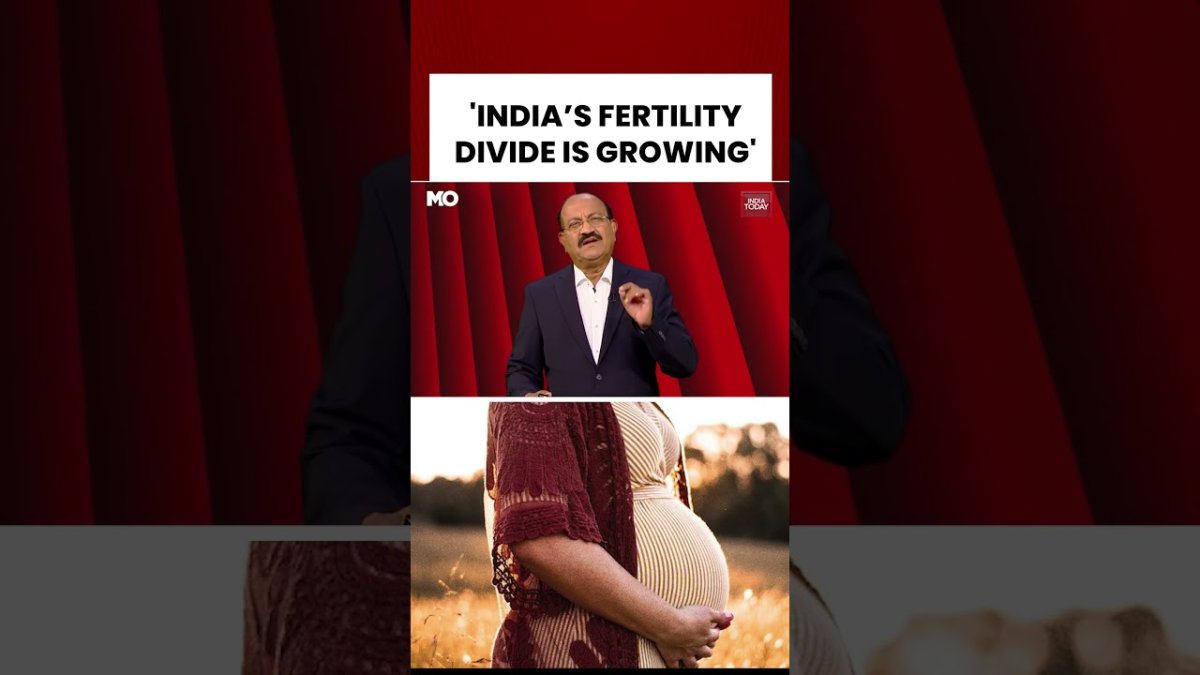
The Great Fertility Chasm: A Tale of Two Indias
The numbers from NFHS-6 and the 2019-21 NFHS-5 are unambiguous. In the southern states, the fertility transition is complete, and arguably overshot. Tamil Nadu leads the decline with a TFR of just 1.4—the lowest among major states—followed closely by Andhra Pradesh, Telangana, and Kerala at 1.5, and Karnataka at 1.6. Even the national capital, Delhi, has plummeted to 1.2, a figure that rivals ageing societies like Japan and Italy. These states have not merely reached replacement level; they have fallen far below it, meaning each generation will be significantly smaller than the last.
Contrast this with the northern and eastern heartland. Bihar's TFR stands at a staggering 2.9, the highest in the nation, with Uttar Pradesh at 2.6, Madhya Pradesh at 2.4, and Rajasthan at 2.3. These states are still in the midst of their demographic transition, adding millions to their populations each year. The gap between Tamil Nadu's 1.4 and Bihar's 2.9 is not a minor statistical variance; it represents a fundamental divergence in family formation, female education, and economic opportunity. For health policymakers, this means a nation split between states that need to invest in geriatric care and those that desperately need maternal and child health services.
Understanding the 2.1 Replacement Level
To grasp the gravity of this divide, one must understand the concept of the replacement level. A TFR of 2.1 is the magic number—the average number of children a woman must bear to keep a population stable without migration. It accounts for the fact that not all children survive to reproductive age and that slightly more boys are born than girls. When a state's TFR falls below 2.1, as it has in all of South India, the population is on an irreversible path to decline, absent significant in-migration.
India crossed this threshold nationally in NFHS-5 (2019-21), and the NFHS-6 data confirms the national TFR has held steady at 2.0. While this is a triumph for family planning and women's empowerment, it creates a policy paradox. The states that successfully implemented population control measures are now facing the economic consequences of a shrinking workforce and a ballooning elderly population. Meanwhile, the states with higher fertility are poised to supply the nation's future labour force but currently struggle with higher rates of malnutrition and child mortality. This is the crux of the "demographic dividend" dilemma: the dividend is not evenly distributed, and the costs of ageing are not evenly shared.
The Silver Tsunami: India's Ageing Population Crisis
The most pressing consequence of this fertility divide is the rapid ageing of the Indian population, particularly in the South. According to the Technical Group on Population Projections (July 2020) and UN data, India's elderly population (60+) is projected to surge from approximately 100 million in 2011 to around 230 million by 2036—roughly 15 per cent of the total population. The UN further projects that between 2022 and 2050, India's total population will grow by about 18 per cent, but the older population will explode by 134 per cent.
For states like Kerala and Tamil Nadu, this is not a future problem; it is a present crisis. Kerala, with its 1.5 TFR, already has a population age structure resembling Europe. The demand for geriatric care, pension outlays, and chronic disease management is rising exponentially, even as the working-age population shrinks. Tamil Nadu's Health Minister has already indicated the state could consider incentives for couples to have more children, citing the falling TFR and the growing elderly population. This is a stark reversal from the state's earlier two-child norm, which was once held up as a model for the rest of India.
Tamil Nadu's U-Turn: The Maternity Leave Reversal
Nowhere is the policy whiplash more evident than in Tamil Nadu. In August 2026, the state government announced a dramatic reversal of its earlier two-child norm: it will now provide 365 days of paid maternity leave for women government employees who have a third child. This is a direct attempt to nudge fertility upward in a state where the TFR has collapsed to 1.4. The move has sparked intense debate, with Karti Chidambaram publicly opposing the measure, arguing that the state should not encourage larger families and that paternity leave should also be considered to ensure gender equity (India Today, Aug 19, 2026).
This policy reversal is a bellwether for the nation. It signals that the demographic transition has reached a point where states are actively reversing population-control policies that were once considered sacrosanct. The question is whether such incentives can actually move the needle on fertility. Demographers are sceptical; once a society's fertility falls below 1.5, it is notoriously difficult to reverse, as seen in Japan and South Korea despite massive government spending. The Tamil Nadu experiment will be watched closely by other southern states, but it may be too little, too late to prevent a significant population decline.
The Delimitation Bomb: Political Representation at Stake
The most explosive political consequence of this fertility divide is the impending delimitation of Lok Sabha constituencies. The Constitution mandates that parliamentary seats be redrawn after the first Census following 2026. With the Census delayed to 2027, the debate has been reopened with a vengeance. Parliament seats were last redrawn on the basis of the 1971 Census; the exercise has been paused since to avoid penalising states that successfully lowered fertility. That pause is now ending.
Southern leaders, including Tamil Nadu Chief Minister M.K. Stalin, have demanded "fair delimitation," warning that population-based seat reallocation could cut Tamil Nadu's parliamentary representation. The math is unforgiving. The four southern states plus the Union Territory of Puducherry contribute a large share of India's GDP and tax revenues, yet their population share is shrinking. If seats are reallocated purely on population, the North—with its higher fertility—will gain significant political power at the expense of the South. This creates a perverse incentive: states that invested in family planning and women's education are being punished, while states with higher fertility are rewarded with more political clout.
This is not merely a political squabble; it is a question of federal equity. Why should a state like Tamil Nadu, which contributes disproportionately to the central exchequer, lose its voice in Parliament because it successfully controlled its population? The delimitation debate is a ticking time bomb that could redefine Indian federalism, and it is directly rooted in the fertility data.
Healthcare's Two Fronts: Geriatric Care vs. Maternal Health
For the health system, the North-South divide demands a bifurcated strategy. The ageing states of the South require a massive expansion of geriatric care infrastructure, including specialised hospitals, trained geriatricians, and long-term care facilities. The 230 million elderly Indians projected by 2036 will place an unprecedented burden on a healthcare system that is currently oriented towards infectious diseases and maternal-child health. The rise of non-communicable diseases—diabetes, hypertension, cardiovascular ailments—will accelerate in these states, requiring a shift towards chronic disease management and palliative care.
Conversely, the high-fertility states of the North and East—Bihar, UP, Madhya Pradesh, and Rajasthan—require sustained investment in maternal and child health, nutrition, and education. These states have higher rates of maternal mortality, child stunting, and anaemia. The government's focus must remain on ensuring that the children being born in these states are healthy, educated, and skilled, so they can eventually migrate to fill the labour shortages in the South. This internal migration is already happening, but it needs to be facilitated with better urban infrastructure and social safety nets. The alternative—a large, unskilled, and unhealthy youth population in the North—would be a demographic disaster rather than a dividend.
Conclusion: A Nation Divided by Demography
India's North-South fertility divide is the defining demographic challenge of the 21st century. It is not a problem that can be solved by a single policy or a single ministry. It requires a whole-of-government approach that addresses the political economy of delimitation, the healthcare needs of an ageing South, and the human capital development of a youthful North. The national TFR of 2.0 is a success story, but it is a success that has created two Indias with divergent needs and divergent futures.
As Raj Chengappa's analysis underscores, the choices made in the next few years will determine whether this divide becomes a source of strength—through managed migration and federal cooperation—or a source of conflict. The Census of 2027 and the subsequent delimitation will be the first major test. For now, the data is clear: India is ageing, the South is shrinking, and the North is still growing. How the nation manages this imbalance will define its trajectory for the rest of the century.
— By Dr. Raj Patel, Staff Writer
This article was produced with AI-assisted research and editorial support. Reporting is based on sources cited in the article.
What's Your Reaction?
 Like
0
Like
0
 Dislike
0
Dislike
0
 Love
0
Love
0
 Funny
0
Funny
0
 Wow
0
Wow
0
 Sad
0
Sad
0
 Angry
0
Angry
0

India/South Asia Correspondent at Global1.News. Analytical voice with a background in science and health journalism. Based in New Delhi, covering Indian politics, education, healthcare, technology, and policy. Breaks down complex data into clear, actionable reporting.















Comments (0)