
Why Elon Musk is taking on India's richest man over Starlink
Elon Musk’s recent public challenge to Mukesh Ambani has brought India’s satellite‑internet rollout into sharp focus. The ministry described any suggestion of bias as “baseless and misconceived”.
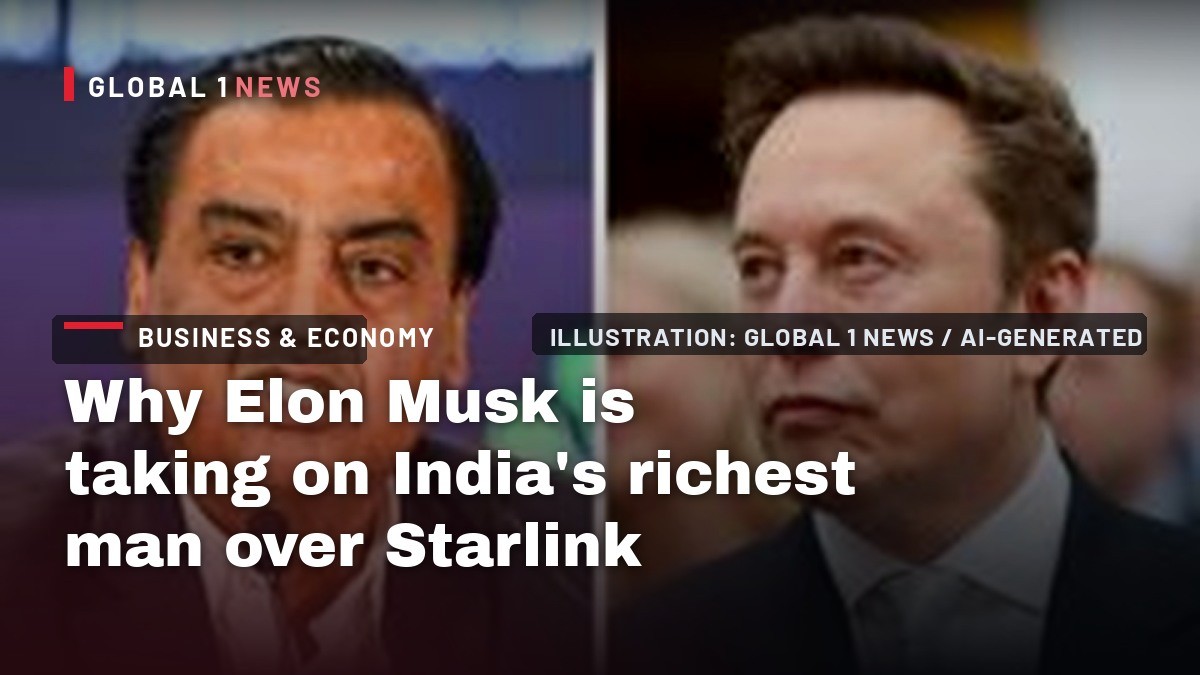
Elon Musk’s recent public challenge to Mukesh Ambani has brought India’s satellite‑internet rollout into sharp focus. Musk, via his X account, accused unnamed “powerful business interests” of blocking Starlink’s entry and singled out the Reliance conglomerate, suggesting that Ambani might be the “real boss of India”. The Indian government rejected these claims, insisting that its satellite‑communications framework is fair and that all operators, including Starlink, are at a similar stage of approval. This dispute highlights the complex interplay of regulatory hurdles, market competition, and strategic partnerships shaping the country’s emerging satellite‑internet sector.
Regulatory Landscape and Approval Process
The Ministry of Communications confirmed that Starlink, Eutelsat OneWeb and Jio Satellite Communications are each awaiting the same final steps: security clearances and spectrum allocation. The ministry described any suggestion of bias as “baseless and misconceived”. This statement underscores that the delay is procedural rather than targeted, and that the government is applying a uniform process to all applicants.
Starlink’s journey in India began in 2021, when the company secured key licences but has since been stalled by the need for these final clearances. The requirement for security controls reflects India’s heightened sensitivity to foreign satellite operators, especially after incidents in 2024 where Starlink equipment was recovered during a drug‑smuggling probe in the Andaman and Nicobar Islands and a military operation in Manipur. SpaceX’s Lauren Dreyer emphasised that Starlink has incorporated extensive security measures to meet Indian standards, indicating a willingness to align with regulatory expectations.
Strategic Partnerships with Domestic Players
In March 2025, Reliance Jio and Bharti Airtel each signed agreements with SpaceX to distribute Starlink equipment and services, contingent on government approval. These agreements also opened the possibility of sharing network infrastructure, suggesting a collaborative approach despite the competitive stakes. At the India Mobile Congress in Delhi, executives from Starlink, Jio and Airtel discussed their satellite‑internet plans, reinforcing the interdependence of foreign and domestic players.
Akash Ambani, chairman of Reliance Jio Infocomm, noted that Jio is developing its own satellite communications technology while pursuing regulatory clearance. His response to Musk’s allegations was measured, focusing on delivering value rather than engaging in public debate. Similarly, Bharti Airtel’s Sunil Bharti Mittal confirmed his firm’s pending approvals, illustrating that all three entities share a common regulatory bottleneck.
Market Competition and the Emerging Satellite‑Internet Sector
India’s satellite‑internet market is rapidly intensifying. Beyond Starlink, Eutelsat OneWeb and Jio Satellite Communications are vying for a foothold, while Reliance Jio and Bharti Airtel are preparing to launch their own services. The competition is amplified by the fact that Starlink has already partnered with both Jio and Airtel, creating a paradox where collaboration coexists with rivalry.
This competitive environment is driven by the vast, unevenly served Indian internet market. While urban areas enjoy robust broadband and mobile coverage, remote regions remain under‑connected due to the high cost of laying fibre or building extensive mobile infrastructure. Satellite‑internet providers see an opportunity to fill this gap, positioning themselves as essential to national digital inclusion.
Economic Viability and Pricing Concerns
Affordability remains a central question for Starlink’s Indian rollout. Musk has argued that the service could deliver “high‑speed, affordable internet connectivity” for those unable to afford existing options. However, the company has not disclosed pricing for India, and analysts note that Starlink’s pricing in other markets, such as the United States where residential plans start at $55 per month, may be beyond the reach of many Indian households.
The lack of transparent pricing makes it difficult to assess the service’s competitiveness against existing mobile broadband plans offered by Jio and Airtel, which benefit from extensive domestic infrastructure and economies of scale. Until Starlink clarifies its cost structure, its potential to attract mass-market users in India will remain speculative.
Security Concerns and Government Scrutiny
Security considerations have been a recurring theme in India’s assessment of foreign satellite operators. The 2024 incidents involving recovered Starlink equipment heightened governmental vigilance. While Musk dismissed the relevance of the seized equipment, stating that it could not have been used to access Starlink’s network, the incidents reinforced the need for robust security protocols.
SpaceX’s Lauren Dreyer highlighted that Starlink has built security controls into its network to satisfy Indian requirements, suggesting that the company is actively addressing these concerns. Nonetheless, the final security clearance remains a prerequisite for launch, indicating that the government will continue to scrutinise any potential vulnerabilities before granting full operational permission.
Political and Diplomatic Dimensions
Musk’s public accusations against Ambani and unnamed “oligarchs” have introduced a diplomatic element to the commercial dispute. By framing the blockage as a “crime against the people of India”, Musk sought to mobilise public sentiment and pressure regulators. The Indian Ministry of Communications, however, responded without naming Musk, focusing on procedural fairness and rejecting any implication of discriminatory treatment.
This exchange illustrates how high‑profile tech ventures can become entangled in broader political narratives, especially when they involve foreign entities seeking market access in a geopolitically sensitive environment. The Indian government’s emphasis on a non‑discriminatory framework seeks to maintain sovereignty over its communications infrastructure while still encouraging foreign investment.
Future Outlook for Satellite Internet in India
Looking ahead, the trajectory of Starlink’s Indian entry will hinge on the resolution of security clearances and spectrum allocation. If approvals are granted, the existing partnerships with Jio and Airtel could facilitate rapid deployment, leveraging their extensive retail and service networks to distribute equipment and support customers.
Conversely, unresolved pricing and affordability concerns may limit adoption, especially in rural markets where cost sensitivity is high. The competitive landscape, with multiple operators awaiting similar approvals, suggests that the eventual market structure will be shaped by how each player balances regulatory compliance, pricing strategy, and partnership dynamics.
In sum, the current dispute underscores the intricate balance of regulatory rigor, market competition, and strategic collaboration that defines India’s satellite‑internet sector. As the government moves toward final decisions, the outcomes will not only affect Starlink’s ambitions but also set precedents for how foreign satellite providers engage with one of the world’s largest and most complex internet markets.
This article was produced with AI-assisted research and editorial support. Reporting is based on the source material cited below. Sources: BBC News Asia; bbc.co.uk; Global1.News (11 October 2026).
By Kenji Tanaka, Staff Writer
What's Your Reaction?
 Like
0
Like
0
 Dislike
0
Dislike
0
 Love
0
Love
0
 Funny
0
Funny
0
 Wow
0
Wow
0
 Sad
0
Sad
0
 Angry
0
Angry
0

Japan Correspondent at Global1.News. Tokyo-based voice covering Japanese politics, technology, economy, and culture. Tracks the intersection of tradition and innovation in one of the world's most dynamic societies.














Comments (0)