
They're Sinking AI Data Centers Into the Ocean — and the Land Squeeze Made Them Do It
AI infrastructure is moving to the ocean. China's $226 million underwater data center is already commercial, Thiel-backed Panthalassa's wave nodes are testing, and Aikido targets 2028. A hosting founder on the land squeeze, the connectivity bottleneck, and what it means for independent providers.
They're Sinking AI Data Centers Into the Ocean — and the Land Squeeze Made Them Do It
I've been running hosting infrastructure for over a decade, and I'll tell you something I never thought I'd say: putting data centers in the ocean is starting to make sense. Not because it's a good idea — the maintenance alone gives me nightmares — but because every alternative on land is getting worse by the week. Grid operators can't guarantee the power. Communities are voting the projects down. Water is becoming a political weapon. And the cost of all of it keeps climbing.
So now we've got Silicon Valley billionaires betting $210 million on wave-powered compute platforms in the middle of the Pacific, a Chinese state-backed underwater data center selling commercial capacity, and a global fleet of floating and subsea projects from Singapore to Maine. The conversation around AI infrastructure has officially left dry land. Ent?
The Land-Side Squeeze — Why the Ocean Suddenly Looks Good
Let me give you the numbers that explain why rational people are looking at saltwater and corrosion and thinking "yes, please." PJM, the grid operator serving 65 million people across 13 US states, has confirmed it will be six gigawatts short of reliability requirements in 2027. In the PJM market alone, data centers added $9.3 billion to capacity costs in 2025-26. Electricity prices are up 42% since 2019. Residential bills in Maryland and Ohio are running $16 to $18 a month higher because of data center demand.
Meanwhile, the Gallup poll from March 2026 found 70% of Americans oppose building AI data centers in their communities. Hundreds of projects are stuck in interconnection queues measured in years, not months. And the water situation — 264 billion gallons a year and rising — means drought-prone regions are running out of patience. When every square foot of land comes with a power fight, a water fight, and a zoning fight, the open ocean starts looking like the last unclaimed territory on Earth. And here's the kicker: more than half the world's population lives within 120 miles of a coast. The ocean isn't just empty space — it's the closest empty space to most of humanity.
The Wave-Powered Bet — Peter Thiel's $210 Million Gamble
The loudest bet comes from Panthalassa, an Oregon-based startup that has raised $210 million, including a $140 million round led by Peter Thiel. Marc Benioff's TIME Ventures, Max Levchin's SciFi Ventures, and John Doerr's Kleiner Perkins are in too. These are people who backed Palantir, PayPal, Google, and Amazon early. They don't throw eight figures at wave energy for fun.
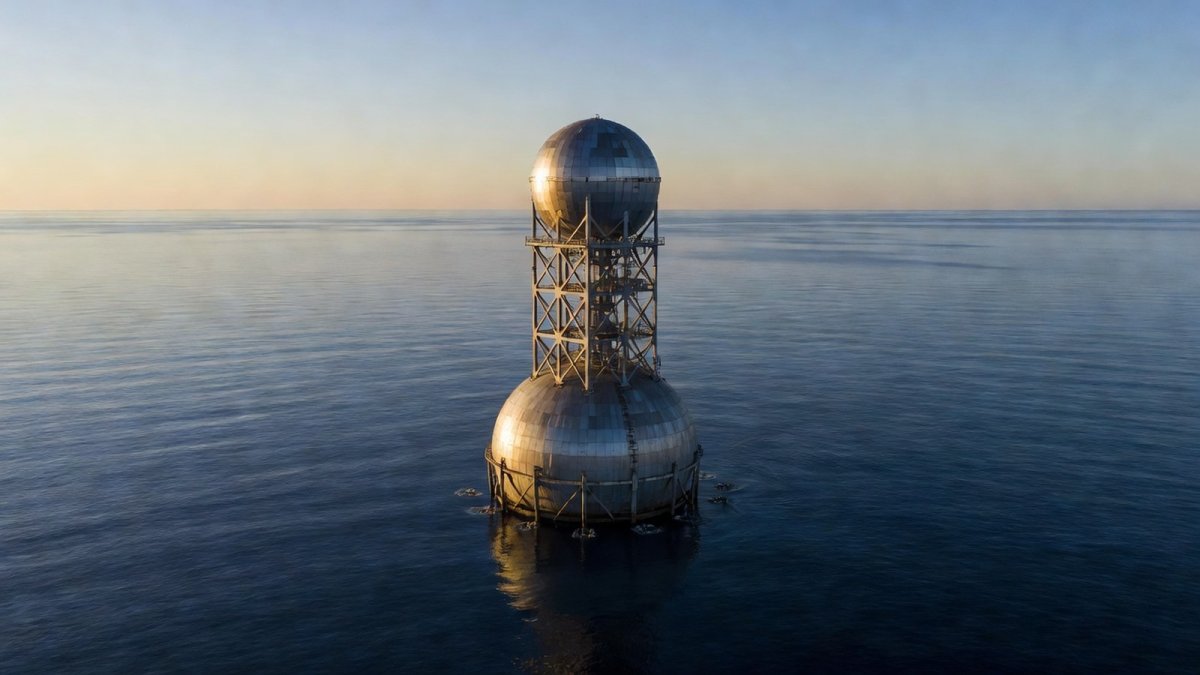
The design is genuinely clever. Each node is an 85-meter steel structure — roughly the height of Big Ben — with a spherical top and a tube extending 60 to 70 meters below the surface. Wave motion forces seawater into a pressurized reservoir inside the sphere; the water spins a turbine that generates electricity for AI chips in hermetically sealed containers. Seawater cools the chips directly. Data goes to customers via low-Earth-orbit satellites. As University of Pennsylvania computer architect Benjamin Lee put it: "Panthalassa's idea transforms an energy transmission problem into a data transmission problem."
The company has tested prototypes since 2021 — Ocean-1, then Ocean-2 off the Washington coast in 2024. Ocean-3, the newest node, is scheduled for testing in the northern Pacific later this year, with commercial systems targeted for 2027. CEO and co-founder Garth Sheldon-Coulson says he hopes to eventually deploy thousands of nodes.
The Floating-Wind Variant — Aikido and the 2028 Promise
Panthalassa isn't alone. Aikido Technologies, a California offshore infrastructure company, unveiled a floating offshore wind platform that packs 10 to 12 megawatts of AI compute alongside a 15 to 18 megawatt wind turbine and battery storage. The company says the design scales from 30 megawatts to over a gigawatt of IT load — self-sufficient AI factories built at sea. A 100-kilowatt prototype is due off Norway by the end of this year, with the first commercial project targeted for 2028 off the coast of Great Britain.
"Before we go to land, we should go to the offshore world," Aikido CEO Sam Kanner said. That line tells you everything about how bad the land situation has gotten: a company is now arguing that the offshore oil and gas playbook — used by the industry forty years ago to exploit deep-sea resources — is the right template for AI infrastructure.
The State-Backed Fleet — China, Japan, Singapore, Korea, and Maine
The private money is only half the story. The state-backed fleet is already in the water. China built what's likely the world's first wind-powered commercial underwater data center near Shanghai — a $226 million facility that launched in June 2025 and began full commercial operations in May 2026. It uses seawater as coolant, claims at least 30% less electricity than traditional data centers, and pairs with offshore wind turbines to cut carbon emissions. The engineering contractor, HiCloud, reported the seawater near the facility warmed by less than one degree Celsius.
Japan is testing containerized data centers on a floating platform near Yokohama, powered by onboard solar and batteries, through March 2027. Singapore — a country where land is the scarcest resource on Earth — has Keppel building a four-story floating data center for 2028. South Korea's Ulsan is planning an underwater facility that could house more than 100,000 servers. In Maine, DeepGreen Western Passage wants to put a submersible AI data center in the Bay of Fundy, powered by tidal turbines. Even Portugal's SIN01 facility in Sines is piping Atlantic seawater through a land-based data center for cooling.
The Secondary Bottleneck Nobody's Talking About — It's Not the Waves, It's the Wire
Here's where I put my hosting hat on. Everybody's focused on whether these platforms can survive storms, corrosion, and biofouling. That's the wrong question. The real bottleneck is connectivity, and it's the same reason the whole thing might stay niche.
Satellite links top out at hundreds of megabits per second per terminal — fine for individual inference responses, brutal for training runs or anything that needs nodes coordinating with each other. The analysis from Ars Technica put it plainly: frequent communication between nodes is going to be challenging, and moving larger volumes may mean physically shipping storage disks to the nodes by boat. Disks. By boat. In the year 2026, the plan for moving serious data to the ocean's AI frontier involves a cargo ship.
And maintenance — this is the one that gives me pause. The company's own job listings say the nodes must survive "more than a decade in the harshest ocean conditions" without human intervention. Microsoft's Project Natick proved sealed underwater servers fail at about one-eighth the rate of land-based ones — but Microsoft still ended the project in 2024. Analysts say the reasons included regulatory hurdles and the sheer difficulty of upgrading and replacing equipment. On land, a bad drive is a fifteen-minute job. Underwater, the whole sealed module comes up, even if one computer needs work. That's not a maintenance model; that's a salvage operation.
What This Means for Independent Hosting Providers
First, watch the connectivity value chain. If ocean compute needs fiber, the real winners might be cable landing stations and colocation near them. That's where the latency advantage concentrates.
Second, remember your maintenance moat. The ocean pitch leans hard on "no humans needed." But every operator I know has a war story about the human who saved the day at 3am. Land-based facilities with real staff keep the reliability argument for the workloads that matter.
Third, treat the pilots as pilots. Ocean-3 tests later this year; Aikido's Norway prototype lands at year-end; Keppel's floating data center opens in 2028. The pattern here is exactly the small modular reactor pattern — big promises, small proof points. When a hyperscaler signs an actual ocean lease for actual capacity, that's when it becomes your problem. Until then, it's a science project with very rich backers.
Fourth, don't price your business against the ocean. These platforms are built for batch workloads and inference at the edge of the grid — not for the low-latency, hands-on hosting that keeps the lights on for the customers you already have. The ocean doesn't take your customers. It takes the megawatt-scale land projects that were never coming to your market anyway.
The Bottom Line
The ocean isn't a miracle. It's the land problem wearing a life jacket. Every force that pushed these projects to sea — grid shortfalls, water fights, community backlash, land prices — is still there on land, and it's getting worse. The ocean trades those problems for a new set: bandwidth measured in hundreds of megabits, maintenance measured in salvage operations, and thermal pollution that nobody has priced.
But don't mistake my skepticism for dismissal. When the grid can't deliver six gigawatts and the voters won't let you build on land, the open ocean is the only place left where nobody can tell you no. That's not a fantasy. That's a market signal. And if you're in the hosting business, you should be watching it the same way you watch every other signal — with your eyes open, your capacity plan realistic, and your customers closer to home.
— Allan Ali, Founder
This article was produced with AI-assisted research and editorial support. Sources: The Conversation (Nir Kshetri) via phys.org, Ars Technica, heise online, SCMP, Shanghai government release.
What's Your Reaction?
 Like
0
Like
0
 Dislike
0
Dislike
0
 Love
0
Love
0
 Funny
0
Funny
0
 Wow
0
Wow
0
 Sad
0
Sad
0
 Angry
0
Angry
0

Publisher of Global1.News. Automation architect, systems builder, and the guy making sure the truth gets published.













Comments (0)