
USS Benfold Power Failure Exposes Navy Readiness Strain
The U.S. Navy is answering hard questions this week after one of its front-line destroyers spent four days drifting powerless through the South China Sea last month — no working toilets, no air conditioning, no galley, no drinkable water, in blistering late-July heat.
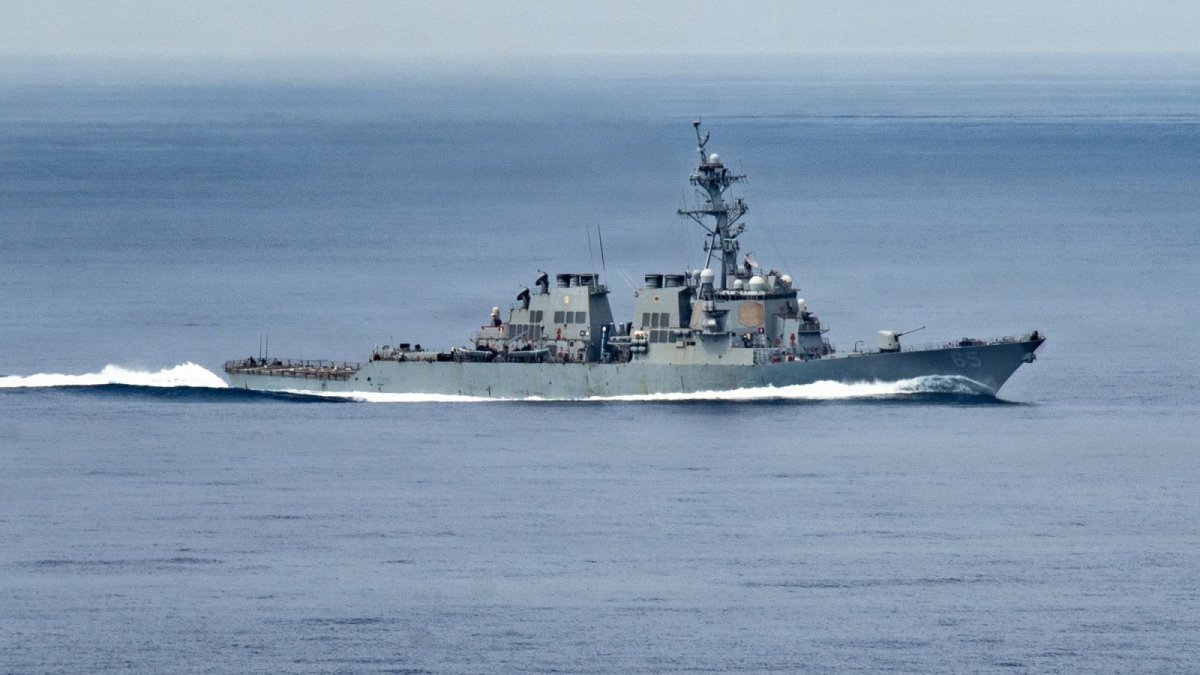
The U.S. Navy is answering hard questions this week after one of its front-line destroyers spent four days drifting powerless through the South China Sea last month — no working toilets, no air conditioning, no galley, no drinkable water, in blistering late-July heat. The USS Benfold's ordeal, confirmed by the U.S. 7th Fleet and first reported by USNI News, is the second time this year an Arleigh Burke-class destroyer has lost power in the Indo-Pacific. And it lands at a moment when the fleet is stretched thin by the war with Iran and a carrier group that has spent more than 200 days without a port call.
USS Benfold power failure exposes Navy readiness strain
Washington, D.C. — The guided-missile destroyer USS Benfold (DDG-65) lost all electrical power in the South China Sea on July 24 after what the Navy called an "engineering casualty involving its generators." The nearly 10,000-ton warship — roughly 500 feet long, with a crew of 329 to 359 — spent four days unable to maneuver on its own, with galley services, toilets, air conditioning and potable water all knocked out. There were no injuries. There is, however, an investigation, a tow to Subic Bay, and a fleet that is being forced to ask whether its workhorse destroyers are being pushed past their limits.
Four Days Without Power in the South China Sea
The trouble began on July 24, 2026, while the Benfold was conducting routine operations in the Indo-Pacific. According to Cmdr. Matthew Comer, spokesperson for the U.S. 7th Fleet, the ship reported an engineering casualty involving its generators — a failure that stripped the destroyer of more than just propulsion.
For four days, the crew lived without the basics a modern warship is supposed to guarantee: no working toilets, no galley services, no air conditioning, no potable water. The Navy did not disclose the exact location of the breakdown, but daytime temperatures in the South China Sea in late July average between 89 and 98 degrees Fahrenheit — 32 to 37 degrees Celsius. In that heat, with ventilation and climate control down, the conditions aboard a steel-hulled destroyer would have been punishing.
Comer's statement to CNN was blunt about the crew's performance: "There were no injuries to the crew, who demonstrated resilience, grit, professionalism, and unwavering steadiness in their response." The Navy says the cause of the generator failure remains under investigation.
The Investigation and the 7th Fleet's Account
The incident was first reported by USNI News, the U.S. Naval Institute's news service, which broke the story of the Benfold's four-day stall. The 7th Fleet confirmed the details to CNN: an engineering casualty involving the destroyer's generators, a four-day loss of power, and a formal investigation into what went wrong.
The Navy has not said what caused the failure, and officials have not offered a timeline for the investigation's conclusions. What is known is that this was not a minor electrical hiccup. A destroyer that cannot maneuver on its own is a destroyer that cannot do its job — and in a contested region like the South China Sea, where naval traffic is heavy and tensions run high, a dead-in-the-water warship is a serious liability, even during peacetime operations.
Rescue and Repairs: USS Robert Smalls and Subic Bay
The Benfold was not left to fend for itself. During the four-day outage, the guided-missile cruiser USS Robert Smalls provided cooked meals to the crew, and other ships from the Japan-based USS George Washington Carrier Strike Group pitched in with aid. Comer said the assistance came as the destroyer awaited recovery.
Eventually, the Benfold was towed to Subic Bay in the Philippines for repairs — a former U.S. naval facility that remains a key logistics hub for American and allied forces in the region. The Navy said repairs were completed by August 8, and the destroyer returned to duty. That is the good news. The bad news is that the Benfold's breakdown was not an isolated event.
A Second Destroyer Failure This Year: USS Higgins
In May 2026, the USS Higgins — another Arleigh Burke-class guided-missile destroyer — lost power and propulsion for several hours in the Indo-Pacific after what the Navy described as an "engineering casualty" in its electrical system. A U.S. defense official confirmed the details to CNN at the time. The Navy did not disclose where that incident occurred.
Two power losses on the same class of ship in the same year, inside the U.S. Pacific Command's area of responsibility, is a pattern — and it is a worrying one. The Arleigh Burke class is the workhorse of the U.S. surface fleet, with more than 70 destroyers in service. These are the ships the Navy leans on for everything from carrier escort to strike missions to forward presence. When the class starts losing power at sea, readiness questions follow.
Comer did not say whether the two incidents are connected, and each investigation is separate. But naval analysts and veterans watching the fleet have taken note: two engineering casualties in the Indo-Pacific in a matter of months, at a time when the Navy is being asked to do more with fewer ships than it has in decades.
A Navy Stretched Thin: The Iran War and the Abraham Lincoln
The Benfold's breakdown lands against a backdrop of extraordinary strain on the U.S. Navy. The service is juggling combat operations tied to the war with Iran — U.S. and Israeli attacks on Iran began February 28, over the Strait of Hormuz and Tehran's nuclear program — while maintaining a massive forward presence in the Indo-Pacific.
Consider the USS Abraham Lincoln. The aircraft carrier has been at sea for roughly nine months, having left California in November 2025, and has endured more than 200 days without a port call during operations against Iran. There have been reports of low morale and mental health concerns aboard. President Donald Trump dismissed those concerns, saying when asked whether sailors' families were worried: "No, they're not." He rejected claims the carrier had been deployed too long and confirmed the Lincoln would soon be replaced.
Its relief is already on the way: the USS George Washington Carrier Strike Group is heading to the Middle East to replace the Lincoln and its group, a Navy official told CNN. The Benfold is often part of the strike group that accompanies the George Washington — but the Navy has not said whether the destroyer was sent along to the waters off Iran. Ship spotters in Japan, according to USNI News, report the vessel has arrived there.
Analysts and Democratic lawmakers have warned for months that the Navy is being stretched thin by the demands of the Iran war and its global commitments. The Benfold's four days without power is exactly the kind of incident that puts that warning in sharp relief: a workhorse destroyer, operating at a punishing tempo, brought low by its own engineering plant.
What It Means for Readiness: An Expert's View
Carl Schuster, a former U.S. Navy captain who once endured about four hours aboard a destroyer without power near Puerto Rico, described what a loss like that feels like from the inside.
"It would have been quite stressful. Operations officers were worried about crew morale and operational concerns, the engineers were focused on how to solve it and the navigator was worried about the direction they were drifting and what weather was coming. The crew was worried about weather, food and what was next. The (commanding officer) and (executive officer) were worried about all of that and when help would arrive," Schuster said.
Then he put the Benfold's ordeal in perspective: "I can assure you four hours in the waters southeast of Puerto Rico is not nearly as stressful as four days in the South China Sea."
Schuster's point cuts to the heart of the matter. A four-hour power loss is an emergency. A four-day power loss, in the South China Sea, in July, with no AC, no galley and no potable water, is an endurance event — for the crew and, by extension, for the fleet that depends on them. The Benfold is back on duty. The Higgins was repaired too. But the questions the Navy must answer are bigger than any single generator: Is the fleet's operational tempo sustainable? Are maintenance and engineering resources keeping pace with deployment demands? And how many more destroyers are one casualty away from drifting?
For the sailors who serve on these ships — and for the families who worry about them, even when the Commander in Chief says they don't — the Benfold's four days in the dark are a warning that deserves more than a shrug. The Navy is asking its people and its ships to do a lot right now. The least it owes them is the truth about how much strain is too much.
This article was produced with AI-assisted research and editorial support. Sources: CNN, USNI News, The Guardian, India Today, Times Now.
By Jessica Ali, Staff Writer
What's Your Reaction?
 Like
0
Like
0
 Dislike
0
Dislike
0
 Love
0
Love
0
 Funny
0
Funny
0
 Wow
0
Wow
0
 Sad
0
Sad
0
 Angry
0
Angry
0

Editor-in-Chief at Global1.News. Atlanta-based journalist who cuts through the BS and tells it like it is. Lead anchor, host, and the voice you hear when the spin stops and the truth starts.















Comments (0)