
Thai PM: Defense Ties with US Not for Tariff Negotiation
A Delicate Balance: Defense and Trade Kept Separate at Government House On a humid Thursday afternoon at Government House in Bangkok, Prime Minister Anutin Charnvirakul received a visitor whose presence carried the weight of a superpower’s strategic pivot. Elbridge Colby, the US Under Secretary of
A Delicate Balance: Defense and Trade Kept Separate at Government House
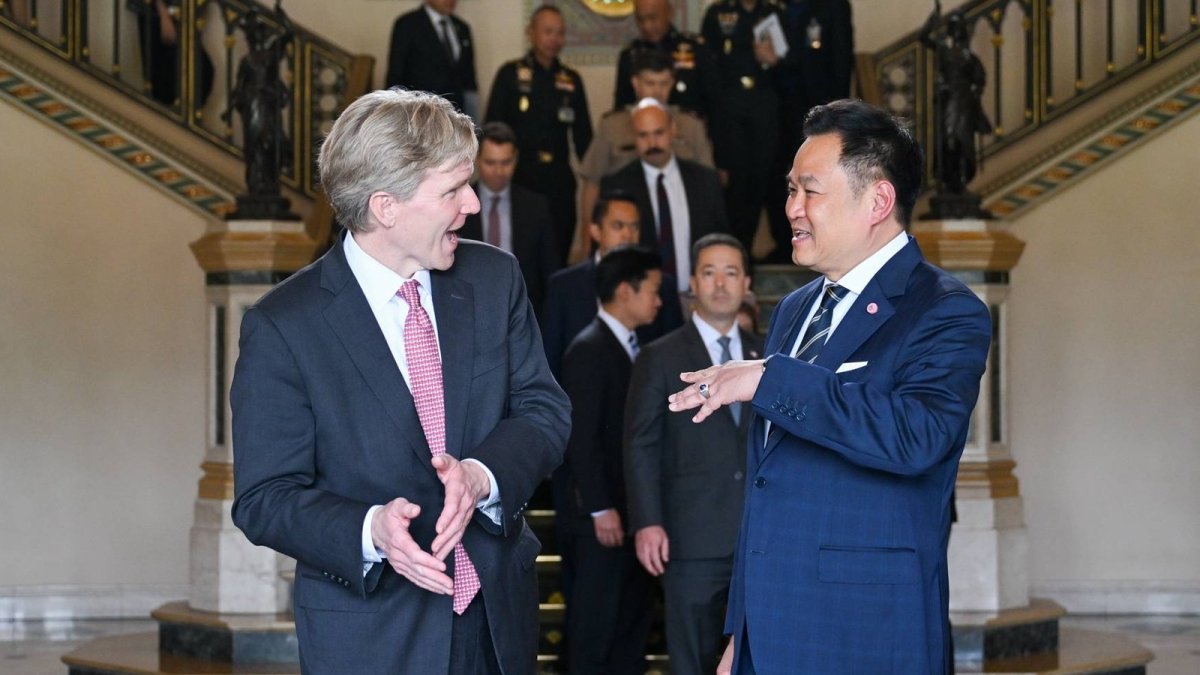
On a humid Thursday afternoon at Government House in Bangkok, Prime Minister Anutin Charnvirakul received a visitor whose presence carried the weight of a superpower’s strategic pivot. Elbridge Colby, the US Under Secretary of Defense for Policy, arrived for his first official visit to Thailand, a meeting that underscored the enduring, if complex, relationship between Bangkok and Washington. The conversation, which lasted into the early evening, was framed by the prime minister’s clear and deliberate message: Thailand’s defense ties with the United States are a pillar of trust, not a tool for trade leverage.
Government spokesperson Rachada Dhnadirek briefed reporters after the talks, detailing a meeting that was both warm in tone and precise in its diplomatic language. Prime Minister Anutin, who also holds the interior portfolio, welcomed Colby with a focus on the positive trajectory of Thai-US relations. But the core of his message was a firm rejection of any notion that security cooperation could be bartered in exchange for tariff relief. “Trade and security discussions proceed on the basis of mutual interests and through the relevant mechanisms for each area,” Anutin said, according to the official readout. It was a statement designed to reassure both domestic audiences and regional partners that Thailand’s alliances are not for sale.
The timing of this visit is significant. With global trade tensions simmering and Washington’s tariff policies creating ripples across Southeast Asia, the meeting served as a critical signal. For Thai officials, the distinction between the defense relationship and the trade file is not merely procedural; it is a matter of national dignity and strategic clarity. The prime minister’s words were a gentle but firm reminder that while Thailand values its American partnership, it will not allow that partnership to be reduced to a transactional bargaining table.
The 193-Year Alliance: A Bond Forged in History, Tested by the Present
Prime Minister Anutin took care to anchor the conversation in the deep historical roots of the relationship. He highlighted the 193 years of Thai-US military ties, a bond that predates many modern nation-states and has weathered wars, ideological shifts, and regional upheavals. This is not a casual friendship, he seemed to suggest; it is a legacy built on mutual respect and shared sacrifice. The alliance, he noted, has benefited both countries and contributed to peace, security, and stability across the region for nearly two centuries.
For Thai readers, this history is a source of quiet pride. Thailand is the only country in Southeast Asia that was never colonized by a Western power, and its relationship with the United States has always been one of partnership rather than patronage. From the opening of diplomatic ties in the 19th century to the mutual defense cooperation during the Vietnam War era and the current Cobra Gold exercises, the alliance has been a constant. By invoking this long timeline, Anutin was not just being nostalgic; he was establishing a framework for the future. He called for the two countries to strengthen their alliance in response to a changing international environment and emerging security threats, a clear nod to the shifting power dynamics in the Indo-Pacific.
Colby, for his part, reciprocated the sentiment. He described Thailand as an important US ally and emphasized that Washington places strategic importance on the region. His words were carefully chosen to reassure Bangkok of America’s continued commitment, even as the US repositions its forces and priorities globally. The under secretary reaffirmed the US commitment to strengthening security cooperation with Thailand to address increasingly complex challenges, signaling that the Pentagon views Thailand as a linchpin of its regional strategy, not a peripheral partner.
Beyond the Battlefield: Modernization, Industry, and the Fight Against Transnational Crime
The substance of the talks went far beyond diplomatic pleasantries. The two sides agreed to deepen security cooperation across several concrete areas, with a focus on modernizing Thailand’s armed forces. This is a topic of keen interest in Bangkok, where military planners have long sought to upgrade aging equipment and enhance interoperability with US forces. The agreement to expand defense industry cooperation is particularly notable, as it suggests a move toward co-production and technology sharing, rather than simple arms sales. For Thailand, this could mean greater self-reliance and a boost to its domestic defense sector, a point that resonates with the government’s broader economic ambitions.
Another key area of discussion was the fight against transnational crime. Prime Minister Anutin raised this issue directly, referencing his meeting with FBI Director Kash Patel in July. The prime minister’s focus on law enforcement cooperation is a reflection of growing concerns in Thailand about cybercrime, human trafficking, and drug smuggling, issues that do not respect national borders. The two sides discussed strengthening their ability to respond to these modern security challenges, a pragmatic acknowledgment that the threats of the 21st century are often non-state actors operating in the shadows.
This emphasis on practical cooperation is a hallmark of the Thai approach. In a region where great-power competition often plays out in abstract terms, Thailand prefers to focus on tangible outcomes. Whether it is joint patrols, intelligence sharing, or training exercises, the goal is to build a resilient security architecture that can protect citizens and promote stability. The mention of the FBI cooperation is a subtle signal that the relationship extends beyond the military, encompassing the full spectrum of law enforcement and justice.
The Cambodia Border: A Quiet Thank You and a Call for Peaceful Resolution
No discussion of regional security in Bangkok would be complete without addressing the situation on the Thailand-Cambodia border. Prime Minister Anutin took the opportunity to thank US President Donald Trump for his constructive role in supporting efforts to ease tensions along the disputed frontier. This was a diplomatic gesture that acknowledged Washington’s influence while also reinforcing Thailand’s commitment to resolving the issue through bilateral mechanisms. Anutin reaffirmed Thailand’s adherence to international law, good-neighborly relations, and a peaceful resolution, specifically citing the implementation of the Kuala Lumpur Accords.
The border issue is a sensitive one for Thai policymakers, who must balance national sovereignty with the need for regional harmony. By raising it in the context of the US visit, Anutin was signaling to both Phnom Penh and Washington that Thailand is a responsible actor, committed to dialogue over confrontation. The reference to the Kuala Lumpur Accords is a reminder that the framework for peace already exists; what is needed is the political will to implement it. The prime minister’s thanks to President Trump were carefully calibrated, acknowledging the US role without ceding any of Thailand’s agency in the matter.
For the broader region, this is a reassuring message. Southeast Asia has long been wary of external powers meddling in internal disputes, but Thailand’s approach here is one of constructive engagement. By keeping the US informed and involved at a diplomatic level, while insisting on bilateral resolution, Thailand is threading a needle that many of its neighbors watch with interest. It is a demonstration of mature statecraft, one that prioritizes stability and rule of law over nationalist posturing.
Trade Talks and Tariffs: The Elephant in the Room
While defense dominated the agenda, the specter of trade loomed large. Prime Minister Anutin reaffirmed Thailand’s commitment to concluding an Agreement on Reciprocal Trade with the United States as soon as possible. This is a delicate dance. On one hand, Thailand is eager to secure favorable terms and avoid punitive tariffs that could hurt its export-driven economy. On the other hand, the prime minister was explicit that this negotiation will not be influenced by defense cooperation. The message to Washington is clear: Thailand is a reliable partner on security, but it expects to be treated fairly on trade.
This distinction is crucial for Thai businesses and farmers, who are watching the tariff situation with anxiety. Agricultural exports, electronics, and automotive parts are all vulnerable to US trade actions. By keeping the two tracks separate, Anutin is protecting Thailand’s negotiating position. He is saying, in effect, that Thailand will not be bullied into a bad trade deal by the implicit threat of reduced security cooperation. This is a stance that resonates with the Thai public, who value their country’s independence and are wary of being seen as a pawn in larger geopolitical games.
The prime minister’s readiness to continue the long-standing relationship and further strengthen the alliance, while expanding cooperation that benefits people in both countries, suggests a pragmatic path forward. He is betting that the US, which has its own strategic interests in the region, will ultimately see the value in a mutually beneficial trade agreement. The ball, as they say, is now in Washington’s court.
What This Means for Thailand and ASEAN: A Regional Anchor in Shifting Sands
For Thailand and its ASEAN neighbors, this meeting is more than a bilateral affair; it is a barometer of the region’s geopolitical climate. As the United States and China vie for influence in Southeast Asia, smaller nations are being forced to navigate an increasingly complex landscape. Thailand’s stance—maintaining strong defense ties with the US while refusing to link them to trade—is a model of strategic autonomy. It demonstrates that a middle power can engage with a superpower without sacrificing its own interests or becoming entangled in a zero-sum rivalry.
For ASEAN, Thailand’s role is pivotal. As one of the founding members and a key economic hub, Bangkok’s relationships often set the tone for the bloc. By hosting Colby and engaging constructively, Thailand is signaling that it remains open to US engagement, even as it deepens ties with China. This balancing act is not easy, but it is essential for regional stability. The prime minister’s emphasis on peace, security, and stability is not just rhetoric; it is a practical necessity for a region that thrives on trade and connectivity.
Looking ahead, the true test will be in the implementation. Will the defense industry cooperation yield tangible projects? Will the trade agreement be concluded without acrimony? And will the border situation with Cambodia continue to de-escalate? These are the questions that will define the legacy of this meeting. For now, however, Thailand has sent a clear message: it is a friend to the United States, but it is its own master. In a world of shifting alliances and transactional politics, that is a position of quiet strength.
This article was produced with AI-assisted research and editorial support. Sources: Khaosod English.
By Ann Srisawat, Staff Writer
What's Your Reaction?
 Like
0
Like
0
 Dislike
0
Dislike
0
 Love
0
Love
0
 Funny
0
Funny
0
 Wow
0
Wow
0
 Sad
0
Sad
0
 Angry
0
Angry
0

Southeast Asia Correspondent at Global1.News. Based in Bangkok, covering Thai and Southeast Asian politics, economy, technology, and culture. Deep regional perspective on one of the world's most dynamic regions.















Comments (0)