
Thai Egg Prices Climb to Two-Year Peak as Weather Stress Hits Layer Farms
Thai consumers are paying more for a kitchen staple this week after four layer farmer cooperatives raised the recommended farm-gate price for mixed chicken eggs to 4 baht each.
Thai consumers are paying more for a kitchen staple this week after four layer farmer cooperatives raised the recommended farm-gate price for mixed chicken eggs to 4 baht each. The increase, effective Friday, directly affects households in Bangkok, Chiang Mai and across the Isaan region where kai jeow and khao kai remain daily meals. The move comes as ASEAN nations monitor food inflation pressures tied to seasonal weather patterns.
Thai Layer Cooperatives Lift Egg Prices to 4 Baht Amid Weather-Driven Supply Drop
Bangkok, Thailand – Saturday — Four cooperatives representing layer farmers in Ang Thong, Chachoengsao, Chiang Mai and Chon Buri set the new farm-gate price at 4 baht per egg, up from 3.80 baht. The Layer Farmers Association confirmed the change after supplies fell due to fluctuating heat and rain that reduced hen productivity. Thailand currently maintains 53.85 million caged laying hens expected to produce 43.35 million eggs daily, a 3 percent drop from standard output.
Price Increase Details and Farmer Challenges
Manoch Chootubtim, president of the Layer Farmers Association, stated that changing weather increased hens' vulnerability to illness and forced farmers to add nutritional supplements. Feed costs rose from 13 baht per kilogramme earlier this year to 14-16 baht now, pushing production costs above the 3.70 baht per egg recorded last year. The cooperatives cited these exact pressures when announcing the 20-satang increase effective August 7.
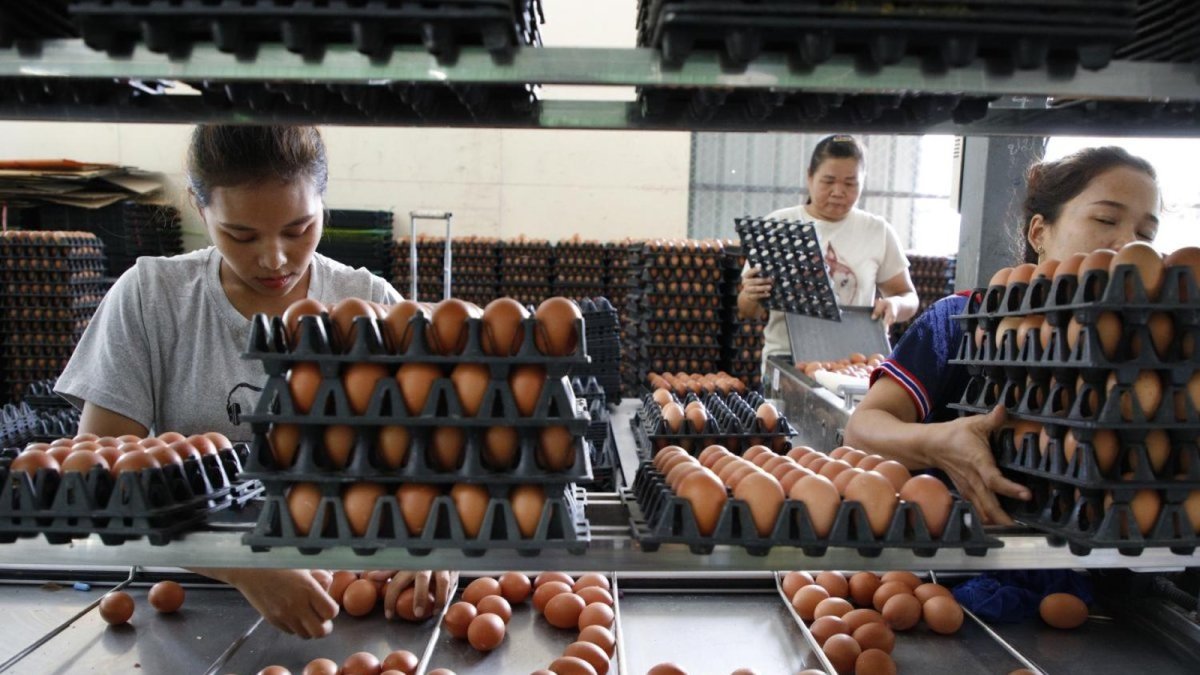
In Thailand’s central plains, smallholders in Ang Thong and Chachoengsao now weigh every satang against rising feed costs that have climbed from 13 to between 14 and 16 baht per kilogram. The shift from last year’s 3.70-baht production cost to the current 4.00-baht threshold leaves little margin once electricity for cooling sheds and veterinary supplies are tallied. Many families describe the decision to keep older hens longer as a quiet gamble on tomorrow’s prices.
During the wet season, sudden heat spikes followed by heavy downpours stress layer flocks, weakening immunity and inviting illness that cuts into production. Farmers describe spending extra hours on cooling and ventilation, yet the added effort rarely offsets the thinner shells and lower output that follow. These quiet daily struggles shape the true cost behind each egg reaching market.
For households buying a standard tray of thirty eggs, the twenty-satang rise adds roughly six baht — an amount that accumulates across weekly market visits. Farmers, meanwhile, watch spent-hen prices and weigh whether current margins can fund the next flock cycle, leaving many smallholders wondering how long their modest operations can continue.
Thailand Context and Daily Household Impact
Eggs form the base of Thai street food such as kai jeow served over rice and pad krapow topped with a fried egg at morning markets in Chachoengsao and Ang Thong. A 20-satang rise at the farm gate reaches every household budget and every vendor selling khao kai in Bangkok's fresh markets. The Department of Livestock Development recorded Thailand produced 43 million eggs daily in 2025, with 97 percent consumed domestically.
Across morning markets from Bangkok’s narrow sois to provincial towns, eggs anchor everyday meals—kai jeow draped over steaming rice, soft-boiled eggs nestled in fragrant khao kai, or the bright yolk floating in tom yum. When farm-gate prices edge upward, vendors at street stalls quietly recalculate portions, knowing that a single fried egg atop pad krapow or a bowl of ba mee often decides whether a customer returns tomorrow.
Because nearly all of Thailand’s eggs are consumed at home, even modest ripples travel swiftly from farm to plate. Merit-making during Buddhist holidays amplifies demand as families donate trays of eggs to temples, turning a kitchen staple into a quiet act of generosity. The gentle rise therefore touches not only household budgets but also the cultural rhythm of giving that binds communities.
Street-stall operators in tourist districts watch the same price movement with particular care, balancing the need to keep kai jeow at familiar 10–15 baht while preserving thin margins. Because eggs travel short distances from nearby farms, any sustained increase quickly appears in the cost of simple dishes that locals and visitors alike rely upon for quick, nourishing meals.
Implications for Southeast Asia
Higher Thai egg prices signal broader ASEAN food security concerns as wet-season weather patterns affect multiple regional producers. Thailand's export share remains small yet any sustained rise influences cross-border trade flows tracked by the Thai Ministry of Commerce. Regional buyers watch the August supply dip of roughly 3 percent for signs of similar pressure in neighboring markets.
Across ASEAN, poultry feed costs tied to imported soybean and maize have climbed in tandem, leaving neighboring producers facing similar weather-related stresses during the monsoon. Thailand’s position as a regional food basket means its domestic price signals can influence planting decisions and trade flows, even when export volumes remain modest compared with internal consumption.
In Bangkok, Phuket, and Chiang Mai, hotels and restaurants watch egg costs closely, knowing that menu adjustments may eventually reach visitors seeking authentic Thai flavors. A sustained rise could prompt subtle shifts toward alternative proteins or smaller portions, gently reshaping the dining experiences that help define the kingdom’s tourism appeal.
Regional observers note that Thailand’s measured response offers a template for managing staple inflation without disrupting supply chains. By balancing farmer support with consumer relief, the country demonstrates how careful stewardship of everyday foods can contribute to broader stability in a region where rice, poultry, and eggs remain central to both diets and economies.
Expert Perspectives from Industry Leaders
Chanon Koetcharoen, president of the Restaurant Association, said operators may shift to smaller eggs while street-food fried egg prices at 10-15 baht each are unlikely to change. Manoch Chootubtim added that improved weather should lift output by October and ease prices as more eggs reach markets. Asian Agribiz reported spent hens selling at USD0.54 per kilogramme, below the farmers' target of USD0.75-0.78 per kilogramme.
Government Response Through Thai Chuay Thai
The Department of Internal Trade will sell 3.42 million eggs nationwide from August 13-31 under the Thai Chuay Thai initiative at 10 percent below market rates. Director-General Witthayakorn Maneenet confirmed sales points will operate in all 76 provinces plus Bangkok Blue Flag community outlets that also offer rice and cooking oil. Consumers can call the DIT hotline 1569 to report excessive pricing, with violators facing fines up to 140,000 baht or up to seven years imprisonment under the Price of Goods and Services Act B.E. 2542.

Under the Commerce Ministry’s “Thais Helping Thais” initiative, Blue Flag shops — known as Thong Fah — have long served as neighborhood anchors offering staple goods at controlled prices. These outlets provide a visible network where families can still find eggs without the full weight of recent increases, preserving a sense of everyday fairness.
Inspectors coordinate with the Department of Livestock Development to monitor supply flows at every level of trade, and the stiff penalties attached to Section 29 violations underscore how seriously authorities treat sudden spikes in politically sensitive staples like eggs.
Government attention to egg prices stems from their role as an accessible protein that appears in nearly every kitchen and temple offering. By intervening early through Thai Chuay Thai, officials aim to cushion the most vulnerable households while encouraging steady production, recognizing that stable egg costs quietly support both nutrition and social harmony across the kingdom.
What to Watch For
Officials will monitor daily production figures through the end of August to confirm the 43.35 million egg output level. Farmers expect weather stabilization in October to restore normal laying rates and bring prices down. Households in Chiang Mai and Chon Buri can access the discounted eggs at provincial commerce offices starting August 13.
October’s weather outlook will be closely followed, as lingering rains or unexpected heat could further affect laying rates and feed quality, and any supply tightness before the next production cycle would draw immediate attention from the Department of Internal Trade.
Restaurants may begin weighing the merits of smaller eggs to maintain portion costs, while street vendors strive to keep kai jeow at the familiar prices customers expect. The sales window from August 13 to 31 offers a brief period for households to stock up, yet longer-term decisions about replacing aging layer flocks will shape availability well into the cooler months.
Farmers themselves are considering whether current margins justify expanding flocks or simply maintaining existing numbers. These quiet calculations, made in farm offices across the central plains, will ultimately determine whether prices ease or remain elevated, influencing both daily meals and the wider rhythm of Thailand’s food system.
By Ann Srisawat, Staff Writer
This article was produced with AI-assisted research and editorial support. Reporting is based on sources cited in the article.
What's Your Reaction?
 Like
0
Like
0
 Dislike
0
Dislike
0
 Love
0
Love
0
 Funny
0
Funny
0
 Wow
0
Wow
0
 Sad
0
Sad
0
 Angry
0
Angry
0

Southeast Asia Correspondent at Global1.News. Based in Bangkok, covering Thai and Southeast Asian politics, economy, technology, and culture. Deep regional perspective on one of the world's most dynamic regions.















Comments (0)