
South Korea's Margin-Call Reprieve Arrives Monday, With the KOSPI 44.5% Below Its Peak
South Korea has waived the 140% collateral rule on margin loans for three months from 9 November, leaving forced selling to brokers' discretion rather than banning it, after the KOSPI closed at 5,059.69, 44.5% below its June peak, and the opposition demanded a presidential apology.
South Korea's financial authorities have spent the weekend preparing a rule change that takes effect on Monday morning, and the wording matters more than the headline. Brokers will no longer be required to hold 140 per cent collateral against margin loans. They are not required to stop selling either.
South Korea's Margin-Call Reprieve Arrives Monday, With the KOSPI 44.5% Below Its Peak
Seoul, South Korea — The KOSPI closed on Friday at 5,059.69, down 324.11 points, or 6.02 per cent, after falling as far as 4,911.28 in the first three minutes of trading. It was the lowest close since 31 March. From Monday, the rule that produced the selling pressure behind that session is suspended for three months.
What Starts on Monday, and What It Does Not Do
Under the current financial investment rules, a securities firm lending an investor money to buy shares must keep collateral worth at least 140 per cent of the loan. When prices fall and the pledged shares no longer cover that ratio, the broker demands more collateral, and if the investor cannot deliver, it sells the position at market or at the lower price limit. That forced selling is what turns a decline into a cascade.
The government said on Friday that the 140 per cent maintenance requirement will be waived for three months from 9 November. MoneyToday reported that the Financial Supervisory Service is expected to issue a no-action letter on Monday exempting brokers from the obligation. The waiver does not prohibit forced liquidation. It gives each securities firm the discretion to set its own threshold, with 120 per cent and 130 per cent the figures under discussion.
Brokers answered on Friday with conditions rather than commitments, cutting collateral ratios by 10 to 20 percentage points only for clients who apply, and deferring forced sales by a single day.
Friday's Session, in Numbers
The index opened at 5,263.26, already down 120.54 points or 2.24 per cent, and lost the 5,000 line within minutes. The Korea Exchange halted all stock and derivatives trading at 9:03 a.m. local time for 20 minutes, the eleventh circuit breaker of the year. A sell-side sidecar followed, suspending program sell orders for five minutes after the restart.
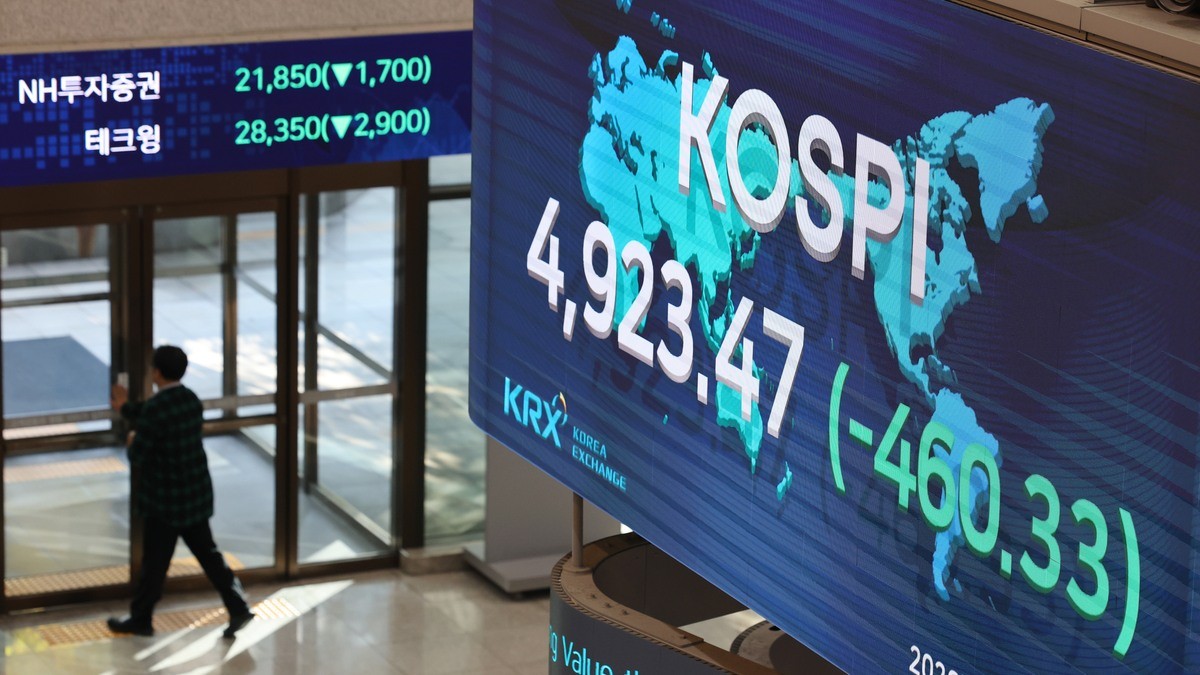
By the close, 760 KOSPI stocks had fallen against 131 that rose, and the KOSDAQ had shed 34.14 points, or 5.03 per cent, to 644.27 after touching 629.17 and triggering a sell-side sidecar of its own. That was the KOSDAQ's lowest level since 9 December 2024, the week of the martial law declaration. BusinessKorea counted 669 stocks across both markets closing at their lowest levels of the year and 260 at all-time lows. The KOSPI's market capitalisation fell by 267 trillion won in a single session to 4,174.8 trillion won.
The Two Days Before Friday
Friday was not a single shock. It was the second half of one. On Wednesday the KOSPI had closed up 35.01 points, or 0.62 per cent, at 5,683.80 after swinging more than four per cent intraday. On Thursday it gave back 300.00 points, or 5.28 per cent, to 5,383.80, its lowest close since 3 April, with a sell-side sidecar triggered for the 29th time this year. Foreigners sold 3.4242 trillion won on the main board that day, a fifth straight session of net selling, while retail investors bought 2.2721 trillion won and institutions 845.6 billion won — enough to take the other side, not enough to stop the fall.
Across those two sessions the index lost 10.98 per cent, or 624.11 points. Measured against the record close of 9,114.55 reached on 22 June, Friday's finish was 44.5 per cent lower. Reuters, writing from Seoul on Friday morning while the index was still sliding, put the drawdown at 43 per cent and noted that the KOSPI remains up 23 per cent for the year.
The Shock Was Imported
The trigger was American. Democrats' sweep of both chambers in Tuesday's midterm elections raised the prospect of tighter rules on AI data centres, and the Philadelphia Semiconductor Index fell more than 12 per cent overnight. Reports that Microsoft was reviewing its data-centre programme added to the pressure, as did a spike in CoreWeave's corporate bond yields and record credit default swaps on SpaceX.
Seoul's market had already been trading on leverage and on a single theme. Reports that Leopold Aschenbrenner's AI hedge fund had liquidated large positions added strain of its own. Samsung Electronics closed 6.35 per cent lower at 188,700 won; SK hynix fell 10.44 per cent to 1.132 million won. The won weakened with the equities: the dollar closed at 1,356.6 won, up 14.5 won, according to Newsis. Tokyo's Nikkei fell 5.96 per cent to 57,434.77, its fifth consecutive decline.
What the Government Said
Deputy Prime Minister and Minister of Economy and Finance Lee Hyoung-il chaired an emergency review at the Government Complex in Seoul on Friday morning with Financial Services Commission Chairman Lee Eok-won, Financial Supervisory Service Governor Lee Chan-jin and Bank of Korea Deputy Governor Kwon Min-soo.
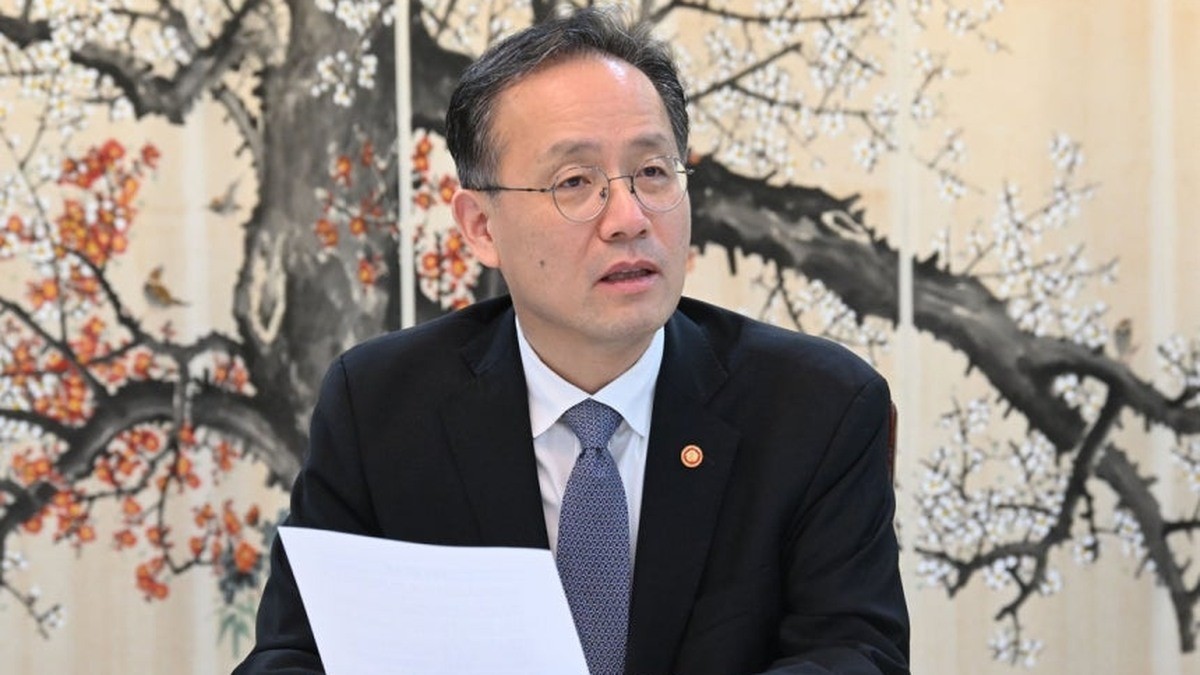
"We are closely watching excessive anxiety and lopsided flows, and if volatility widens further we will prepare additional measures to stabilize the market," Lee said, according to the ministry's account carried by Seoul Economic Daily.
The ruling Democratic Party held its own emergency meeting at the National Assembly the same afternoon. Party leader Kim Min-seok said artificial support for the market was not acceptable, but argued that instability in a market most citizens participate in weakens the financial system's foundations, and urged the government to act quickly and boldly. Floor leader Han Byung-do said the party and government would deploy every policy tool available. Korean outlets reported that a securities market stabilisation fund and a temporary short-selling ban were under discussion, while the Korea Economic Daily reported expectations that the government would prefer narrower, micro-level responses.
The Arithmetic Under the Waiver
The deleveraging the government is trying to slow has already happened. Margin loan balances stood at 28.6446 trillion won on 4 November, down 25.9 per cent from the 24 June peak of 38.6328 trillion won and 16.5 per cent lower in three weeks, according to the Korea Financial Investment Association.
The cash cushion behind that borrowing has thinned faster. Aju Press put investor deposits at 89.23 trillion won, down 34.7 per cent, and calculated that margin loans now equal 32.1 per cent of deposits, against 28.3 per cent at the June peak. Seoul Economic Daily, citing the same association, put the 4 November deposit figure at 88.53 trillion won, down 36.6 per cent from the 4 June peak of 139.69 trillion won. Both accounts point the same way: borrowing has shrunk, but the money available to absorb foreign selling has shrunk further.
The Precedent Is Not Encouraging
Seoul has done this before. The last time authorities suspended the collateral maintenance requirement was in July 2022, and the same measure was deployed during the COVID-19 shock in 2020, when large-scale forced selling arrived a week later anyway.
Critics describe the current version as a delay rather than a solution. One securities industry official told Seoul Economic Daily that a 10-point cut in the maintenance ratio creates a buffer able to withstand roughly another 7 per cent decline, but that the structure leaves brokers carrying the bad-debt risk voluntarily, so an aggressive response is unlikely.
JPMorgan estimated that Thursday's Wall Street plunge alone reduced exposure in leveraged exchange-traded funds by about $60 billion, or roughly 81 trillion won, suggesting the global unwinding was already far advanced before Seoul acted.
The Opposition Calls It Index Politics
The People Power Party demanded on Sunday that President Lee Jae-myung apologise and hold his economic team to account. "The administration pledged 'KOSPI 5000,' but the public received a 3,270 trillion won bill," senior spokesperson Choi Bo-yoon said in a commentary, putting the loss at about $2.44 trillion.
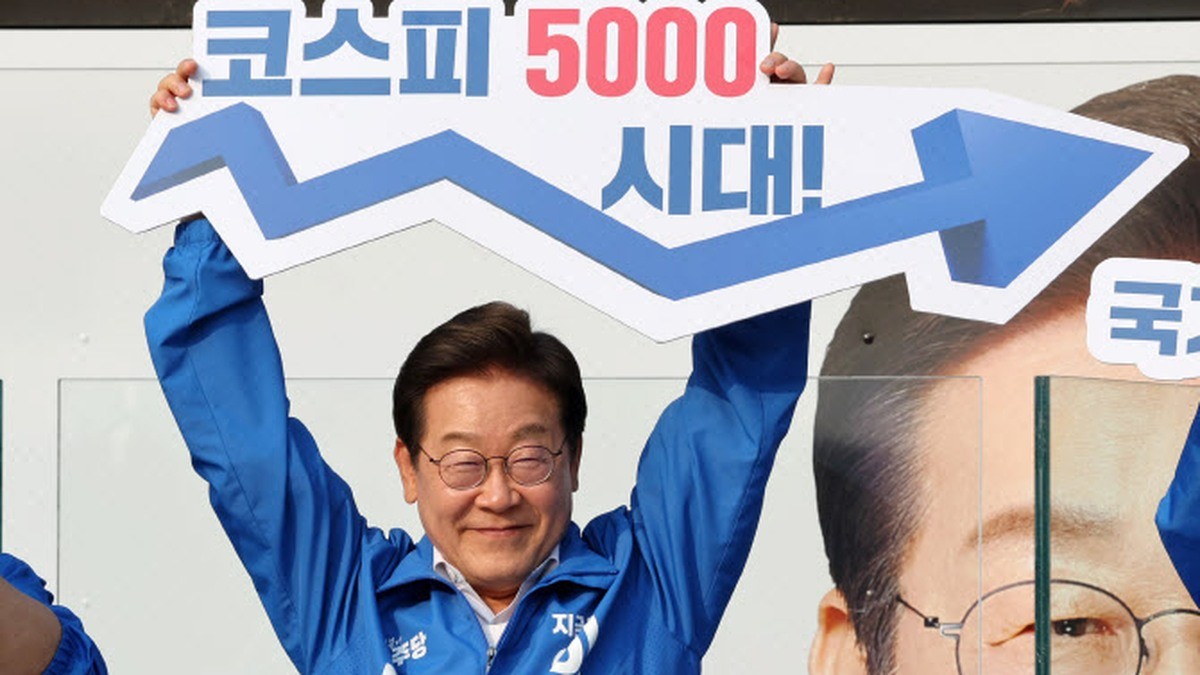
Choi conceded that "the US-driven AI regulation shock pulled the trigger," then argued: "It was this administration that turned a flu into pneumonia." He cited the president's description of a 5,000-point index as the normalisation of the abnormal, ruling-party talk of 7,000 and 8,000, and the National Pension Service's decision in May to raise its domestic equity target from 14.9 per cent to 20.8 per cent. He also mocked Regulatory Rationalization Committee chair Park Yong-jin for posting proof of a 10 million won share purchase during the rout: "A 10 million won proof shot cannot fill a 3,270 trillion won hole."
Who Sold, Who Bought
Foreign investors sold 2.63 trillion won of Korean shares on Friday, a sixth consecutive session of net selling, and 11.9961 trillion won over the six sessions from 30 October. Retail investors bought 4.5324 trillion won over the same stretch, and pension funds bought 1.7005 trillion won, the National Pension Service having regained room to buy as its domestic equity weighting slid from 25.8 per cent at the end of August, the top of its tactical band, toward an estimated 20 per cent.
Company insiders moved too. Noh Tae-moon, president of Samsung Electronics, bought 630 million won of his own company's stock during the selloff and called it responsible management, Newsis reported. Official data had not yet caught the wave: forced sales linked to unsettled stock purchases totalled just 3.9 billion won on 4 November, according to the Korea Financial Investment Association, a figure that predates both of last week's routs.
Where the Analysts Split
The market is split on whether Friday marked a bottom or a beginning. "If procedural constraints on data centres raise costs, the high expectations the market has priced in will be revised downward," said Jung Yong-taek of IBK Investment & Securities, warning that any rebound would likely be temporary. Lee Young-gon of Toss Securities argued that memory chipmakers take a direct hit if capital spending slows, and that the liquidity base has already been weakened by the July and October corrections.
On the other side, Park Yeon-joo of Mirae Asset Securities called this "a phase of undershooting relative to results," and Baek Young-chan of Sangsangin Securities said the essence of the plunge was hedge fund liquidation and forced selling rather than the AI industry itself. Goldman Sachs, in a note reported by Investing.com, put this week's fall at 12 per cent and described the drawdown as approaching the 52 per cent and 53 per cent troughs of the dot-com bust and the global financial crisis.
What Monday Will Show
Jun Kwang-woo, chairman of the Institute for Global Economics in Seoul, told Reuters: "It is time for correction, but we feel that there may be some overreaction to the outcome of the midterm election."
What Monday actually tests is narrower than any of those arguments. Brokers that deferred forced sales by a single day will face the same collateral arithmetic with the market open again, three months of regulatory cover will begin, and the government has said it will act again if volatility widens. The index needs to hold 5,000 on its own, without a 140 per cent rule underneath it and without a 20-minute halt to catch it.
By Jessica Ali, Staff Writer
This article was produced with AI-assisted research and editorial support. Sources: Reuters; Seoul Economic Daily; Chosunbiz; The Herald Business; MoneyToday; Aju Press; BusinessKorea; The Korea Economic Daily; Korea Economic TV; Newsis; the Korea Exchange and the Korea Financial Investment Association. Cover: Global 1 News editorial image. Photographs: Yonhap via Seoul Economic Daily; Ministry of Economy and Finance via Seoul Economic Daily; Newsis via The Herald Business.
What's Your Reaction?
 Like
0
 Dislike
0
 Love
0
 Funny
0
 Wow
0
 Sad
0
 Angry
0

Editor-in-Chief at Global1.News. Atlanta-based journalist who cuts through the BS and tells it like it is. Lead anchor, host, and the voice you hear when the spin stops and the truth starts.













Comments (0)