
Temascalcingo Fireworks Blast Kills at Least 10, Injures 64 at Patron Saint Festival
A fireworks explosion during a patron saint festival in Temascalcingo, Mexico, killed at least 10 people and injured 64. The blast occurred near a church, prompting an investigation amid Mexico's recurring history of deadly pyrotechnic accidents.
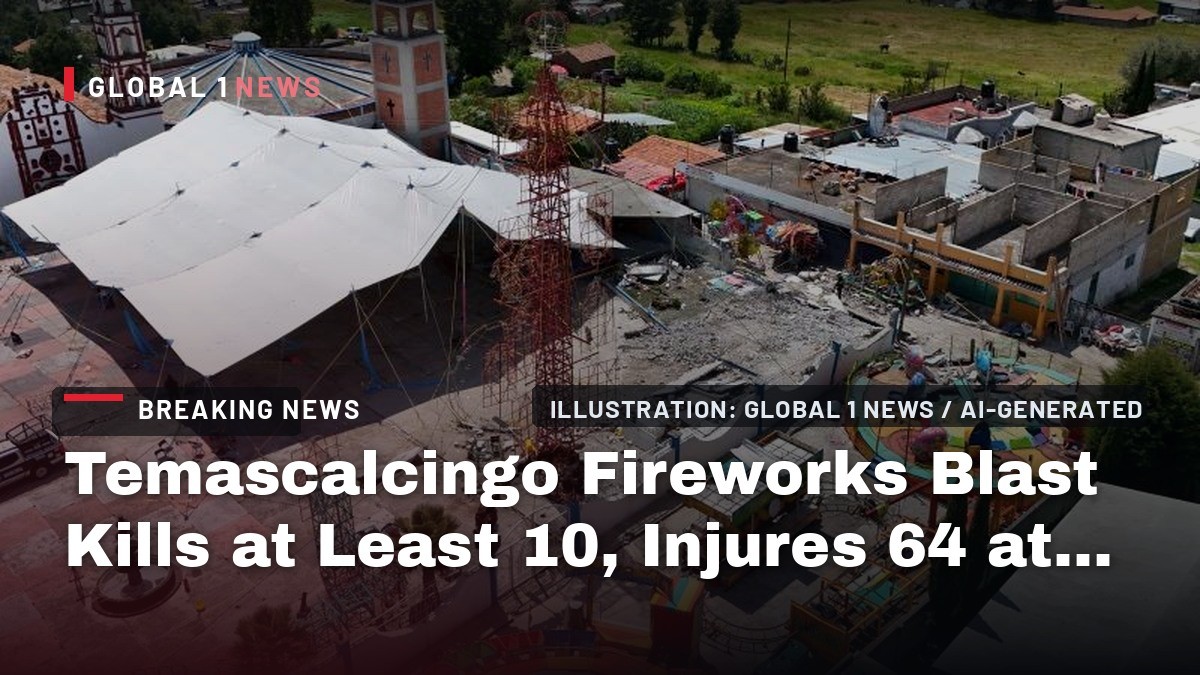
Deadly Blast Strikes During Religious Celebration
A pyrotechnic explosion tore through a storeroom adjacent to the Nuestra Señora de la Luz church in Temascalcingo, Mexico, on Saturday night, collapsing a wall and killing at least 10 people while injuring another 64, according to Mexican authorities. The blast occurred at approximately 9:30 p.m. local time as hundreds of residents had gathered to watch a fireworks display marking the feast of Our Lady of Light.
The State of Mexico government confirmed that eight people died at the scene, with the injured transported to nearby hospitals. Among the wounded, a local bishop confirmed that two priests were receiving medical attention, though their conditions have not been publicly detailed. The municipality of Temascalcingo sits roughly 160 kilometers (about 100 miles) northwest of Mexico City and has a population of approximately 66,000 residents.
This is a developing story, and the casualty figures may be revised as authorities continue search and rescue operations.
Investigation Underway Into Premature Detonation
The Mexico State Attorney General's Office has launched a formal investigation, focusing on why stored pyrotechnic materials ignited during festival preparations. Authorities have confirmed that the explosion originated in a storeroom next to the church, where fireworks were apparently being kept ahead of the scheduled display, but they have not yet determined what sparked the initial detonation.
Investigators are expected to examine whether the fireworks were properly licensed and stored according to federal regulations. The State of Mexico Pyrotechnics Institute, which issues permits for the making, storing, and selling of fireworks and conducts inspections of workshops, has not publicly stated whether the materials involved were authorized. Neither the institute nor the state prosecutor's office has commented on the licensing status of the stored fireworks.
Mexico's Recurring Fireworks Tragedy Pattern
Saturday's explosion is the latest in a long and deadly series of fireworks accidents that have plagued Mexico for decades, despite federal laws requiring permits for the making, storing, and selling of fireworks. Enforcement is often weak in rural areas where the trade is deeply embedded in local tradition and serves as a vital source of income for thousands of families.
The pattern is strikingly consistent: a religious festival, stored pyrotechnics, and a catastrophic failure that claims lives. The "torito," or straw bull, a frame loaded with fireworks that is paraded through streets at Mexican festivals, remains a common sight, underscoring how deeply pyrotechnics are woven into the cultural fabric.
Experts and safety advocates have long pointed to the gap between regulation and reality. While permits exist and inspections are mandated, rural workshops often operate outside formal oversight, and economic pressures on families who depend on the trade create powerful incentives to cut corners on safety. The result is a cycle of tragedy that repeats with grim regularity, each incident prompting calls for reform that rarely translate into lasting change.
San Pablito 2016: A Market Destroyed, Promises Unfulfilled
The most notorious recent disaster occurred on December 20, 2016, when an explosion leveled the San Pablito fireworks market in Tultepec, a municipality of about 130,000 people just outside Mexico City. At least 35 people were killed in that blast, which struck as the market was crowded with holiday shoppers. The scene was one of utter devastation, with stalls reduced to rubble and bodies recovered from beneath the debris for days afterward.
Tultepec is the center of Mexico's fireworks trade, famed for its small workshops that produce many of the pyrotechnics used on holidays throughout the region.
The 2016 explosion led to renewed calls for tighter safety rules, but enforcement remains inconsistent, and the market was rebuilt without comprehensively addressing the overcrowding and storage practices behind the disaster. For residents of fireworks-producing areas, the trade is a way of life, with skills passed down through generations, which makes safety rules that threaten livelihoods hard to impose.
July 2018 Tultepec Blasts Claim 24 Lives
Just 19 months after the San Pablito disaster, Tultepec was again the scene of tragedy when a series of explosions in July 2018 killed a total of 24 people. The incident began with a first blast that drew firefighters, police officers, and civil defense workers to the scene, only for three subsequent explosions to claim their lives. Four of the dead were among the seven emergency responders killed in the cascading blasts.
Authorities investigated whether an attempt to douse burning fireworks with water triggered the further blasts, a reminder of how unpredictable pyrotechnic materials can be — and of the dangers first responders face when they rush toward the flames.
Tultepec firefighter Jose Luis Juarez, who has responded to numerous such incidents, estimated that about three-quarters of the fireworks accidents he has seen happened in clandestine, unlicensed workshops, usually from inexperience or mishandling of pyrotechnic material. The most dangerous operations, in other words, are the ones operating entirely outside the regulatory system.
A History of Deadly Explosions Across Mexico
The Temascalcingo blast is part of a broader history of fireworks disasters stretching back decades. In 1988, a fireworks blast in Mexico City's enormous La Merced market killed at least 68 people, prompting a prohibition on the sale of fireworks in the capital that has been generally ignored. The disaster exposed the dangers of storing large quantities of explosive material in densely populated urban areas.
In 1999, 63 people died when an explosion of illegally stored fireworks destroyed part of the city of Celaya in Guanajuato state. That incident underscored the risks posed by unlicensed storage, which often occurs in residential areas where a single spark can trigger a catastrophic chain reaction. The Celaya disaster remains one of the deadliest fireworks accidents in Mexican history, yet it did not lead to fundamental changes in how the trade is regulated or enforced.
More recently, in 2013, a truck loaded with fireworks exploded during a religious procession in Jesus Tepactepec, killing at least 11 people and injuring about 70 others. Each of these disasters has followed a similar pattern, suggesting that weak enforcement, economic dependence, and cultural centrality remain largely unaddressed.
The Economics and Tradition of Mexico's Fireworks Trade
The fireworks trade keeps thousands of Mexican families afloat, and residents of producing communities describe it as a job with tradition. In Tultepec and other centers of production, workshops are often family-run operations passed down through generations, with children learning the craft from parents and grandparents. The work is dangerous, but it provides income in regions where formal employment opportunities are limited.
This economic reality creates a powerful tension between safety and survival. Stricter enforcement could reduce accidents, but it could also push more production into clandestine workshops, where oversight is nonexistent and risks are even greater. The Tultepec firefighter's estimate that three-quarters of accidents occur in unlicensed operations suggests that prohibition alone is not a viable solution.
The cultural dimension cannot be overlooked. Fireworks are integral to Mexican religious festivals, from patron saint celebrations to national holidays, and the "torito" and other displays are deeply tied to communal identity and faith. Any effort to regulate the trade must contend with that significance, which makes blanket restrictions politically difficult — and leaves balancing tradition, economics, and safety an unresolved challenge for Mexican authorities.
What Happens Next in Temascalcingo
In the immediate aftermath of Saturday's blast, the focus is on caring for the wounded and supporting the families of those killed. The 64 injured have been taken to nearby hospitals, where medical teams are working to treat a range of injuries, from burns to trauma caused by the collapsing wall. The two priests among the injured are receiving treatment, and their recovery will be closely watched by the local Catholic community.
The Mexico State Attorney General's Office investigation will proceed in the coming weeks, with officials examining physical evidence, interviewing witnesses, and reviewing any available surveillance footage. The State of Mexico Pyrotechnics Institute will likely face questions about its inspection and permitting practices, particularly whether the fireworks involved were properly licensed. Public statements from these agencies are expected as the investigation progresses.
For the residents of Temascalcingo, the road ahead will be difficult: the loss of at least 10 community members in a single moment is a profound blow, and the injured face uncertain recoveries. A church at the heart of the community's spiritual life is now linked with tragedy, and a festival meant to celebrate has become a scene of mourning.
The broader question for Mexico remains unresolved: how to honor traditions that bring communities together while protecting the lives of those who participate in them. Saturday's explosion is the latest reminder that this balance has not yet been struck, and that without meaningful change, more communities will face the same grief.
By Jessica Ali, Staff Writer
This article was produced with AI-assisted research and editorial support. Sources: AP, CNN, Rio Times.
What's Your Reaction?
 Like
0
Like
0
 Dislike
0
Dislike
0
 Love
0
Love
0
 Funny
0
Funny
0
 Wow
0
Wow
0
 Sad
0
Sad
0
 Angry
0
Angry
0

Editor-in-Chief at Global1.News. Atlanta-based journalist who cuts through the BS and tells it like it is. Lead anchor, host, and the voice you hear when the spin stops and the truth starts.










Comments (0)