
JetBlue Guarantee Row and Delta's Exit Leave St Vincent's Airlift Hanging by a Thread
Kingstown is buzzing with more than the usual political heat this week. As the final Delta Air Lines flight from Atlanta touched down at Argyle International Airport on 5 September — ending a brief but highly symbolic 37-week experiment — the government and Opposition in St Vincent and the...
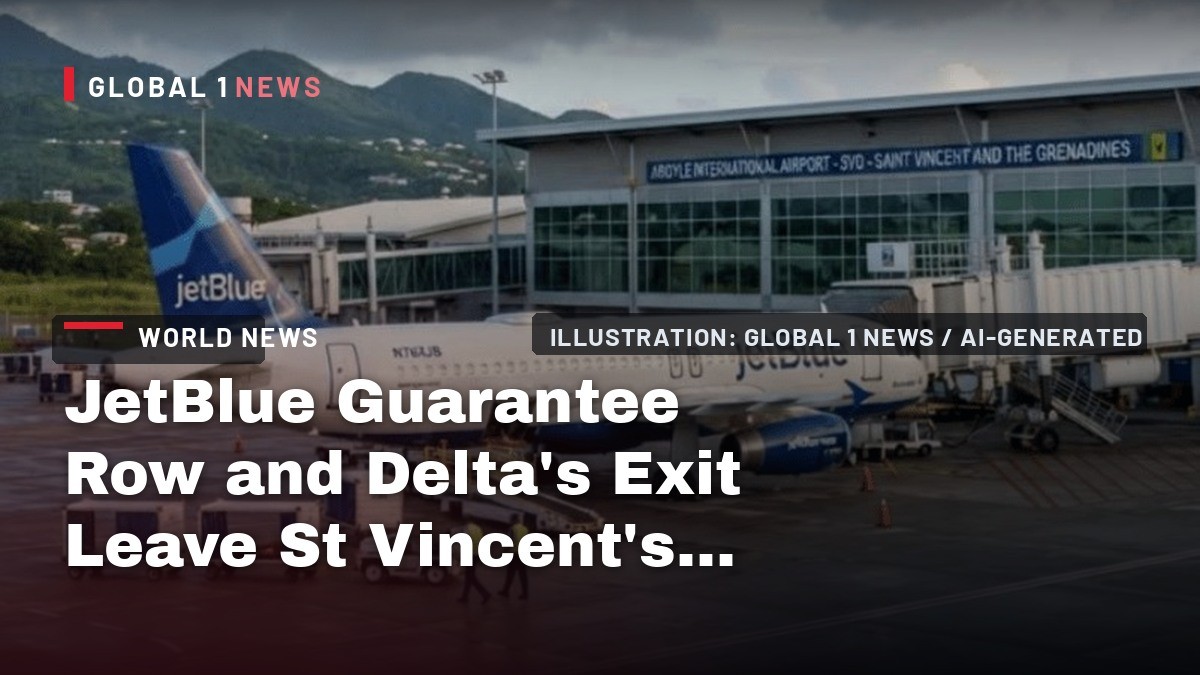
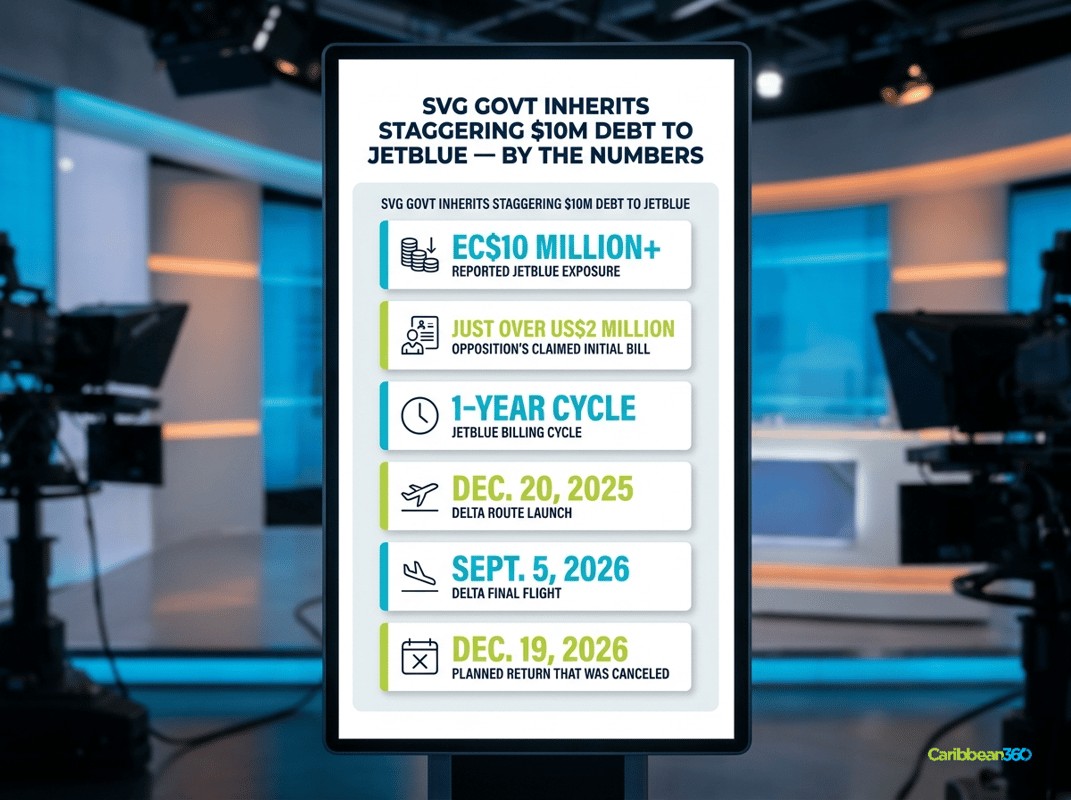
Kingstown is buzzing with more than the usual political heat this week. As the final Delta Air Lines flight from Atlanta touched down at Argyle International Airport on 5 September — ending a brief but highly symbolic 37-week experiment — the government and Opposition in St Vincent and the Grenadines are locked in a bitter parliamentary war of words over who is to blame for the island’s thinning US air links. At the centre of the storm is a disputed JetBlue revenue-guarantee arrangement that Tourism Minister Dr Kishore Shallow claims represents an inherited exposure of over EC$10 million (approximately US$3.7 million), a figure Opposition Leader Ralph Gonsalves dismisses as a misleading ceiling rather than an actual debt. With the island’s tourism economy now leaning on just two US carriers, the fallout from this spat is not merely political theatre — it is a matter of survival for a destination still chasing the route density that Argyle’s gleaming runway was built to attract.
A Parliamentary Clash Over EC$10 Million
The dispute erupted during a heated sitting of Parliament on 27 August, when Dr Shallow, a member of the governing New Democratic Party (NDP), laid out the government’s case. He told lawmakers that the revenue-guarantee arrangement with JetBlue, negotiated by the previous Unity Labour Party (ULP) administration, represents a financial exposure of over EC$10 million. Shallow framed this as an actual obligation left unpaid by the ULP from 2024 through the end of its term, criticising the agreement as one negotiated without what he called “professional oversight.” The minister’s language was pointed, signalling that the current administration intends to renegotiate the contract’s terms with JetBlue before the next billing cycle arrives.
But Gonsalves, the veteran Opposition Leader and former Prime Minister, was having none of it. In a radio appearance that has since ricocheted across Caribbean media, he insisted the EC$10 million figure reflects a maximum contractual ceiling, not an accrued, billed debt. He argued that JetBlue bills on an annual cycle and that the initial revenue-guarantee claim, which arose around the time of the November 2025 election, was just over US$2 million — well below the figure Shallow cited. His words were blunt and unapologetic: “It is a lie. We had always said that there’s a revenue guarantee, but they haven’t paid it. And October is coming now, and we’ll see what is the other bill. The money would have been up to $10 million, but that is not what had been incurred.”
Gonsalves accepts that a revenue-guarantee arrangement exists and that total exposure could approach EC$10 million over time. But he argues the actual initial claim was just over US$2 million, and he accuses Shallow of using the JetBlue figure as a smokescreen to distract from the Delta route loss that occurred on the NDP’s watch. It is a classic Caribbean political tussle — but the stakes here are far higher than party point-scoring.
Delta’s Departure: A Route That Never Quite Took Off
The parliamentary clash unfolded against the backdrop of Delta’s separate and painful decision to permanently end its Atlanta–Argyle International Airport service. The carrier launched its nonstop Atlanta–St Vincent route on 20 December 2025 with considerable fanfare, promising to open the US Southeast to Vincentian tourism and diaspora travel alike. But after approximately 37 weeks of operation, Delta operated its final flight on 5 September 2026, confirming the route will not return as previously planned on 19 December 2026.
Dr Shallow told Parliament that SVG government officials held two meetings with Delta — on 19 May and 31 July 2026 — before the airline announced it was ending the service. The carrier cited passenger demand below projections, elevated fuel costs, and weaker premium-travel demand as the reasons for its exit. The numbers tell a story of partial progress: Delta’s average arriving passenger load rose from 64 passengers in its first three months of service to 117 over the most recent three-month period. That is real growth, but it still fell short of the airline’s projections for the route, and in the unforgiving economics of international aviation, shortfalls of that kind are rarely tolerated for long.
For St Vincent and the Grenadines, the loss is significant. With Delta’s Atlanta service gone, JetBlue and American Airlines now represent the island’s primary US air links. Argyle International Airport, which opened in 2017 at considerable national cost, is still chasing the US route density that would justify its existence. Every route lost makes that chase harder.
How Revenue Guarantees Work — and Why This One Became Exposed
For readers in Trinidad and Tobago and across the Caribbean, the concept of airline revenue guarantees is not new — it is, in fact, standard practice across the region. Barbados, Grenada and St Lucia all lean on the same mechanism to coax carriers into thin markets that might otherwise be deemed unprofitable. The logic is simple: an airline agrees to fly a route, and the government agrees to make up the difference if passenger revenue falls below an agreed threshold. It is a form of insurance that de-risks the carrier’s entry into a market that lacks proven demand.
St Vincent has used this tool before, and successfully. A similar arrangement with American Airlines cost the government nothing because load factors held. But JetBlue’s 2024 New York route was the harder bet. That year saw record 120,000 stay-over arrivals and a 75% surge in American visitors — impressive numbers on paper. Yet those visitors were not backed by the branded hotel inventory that carriers use to model forward demand. Airlines look at hotel room supply as a proxy for future passenger volumes; if there are not enough rooms, they assume there will not be enough passengers.
That structural vulnerability is now laid bare. The government has acknowledged that airlines have flagged insufficient hotel-room inventory as a second vulnerability beyond the debt dispute. In other words, even if the JetBlue money issue is resolved, the island still faces the deeper problem of not having enough quality accommodation to convince carriers that routes will fill.
What It Means for Travellers and the Diaspora
For the Vincentian diaspora in New York, Toronto and now Atlanta, the loss of Delta’s route is a personal blow. Many families had begun to plan Christmas travel around the new nonstop option, and the confirmation that the route will not return in December has forced a scramble for alternatives. JetBlue’s New York–Argyle flights, by all accounts, consistently fill seats — frequent visitors point to a marketing and promotion deficit in newer markets like Atlanta rather than airlift capacity alone as the deeper challenge. The seats were there, the argument goes; the passengers just did not know about them.
This is a familiar story across the region. Just this month, Caribbean Airlines (CAL) ended its direct Trinidad–Barbados service, part of wider regional airlift retreats affecting smaller Caribbean markets. For Trinidadians, the parallel is uncomfortable: we know what it feels like when a route that seemed secure suddenly disappears, leaving travellers to piece together connections through hubs like Miami, Panama or Piarco. The cost of air travel for Caribbean people is already punishing; every lost route pushes fares higher and makes family visits, business trips and holidays more difficult.
The tourism economy is equally exposed. Jobs in hotels, restaurants, tour operations and transport all depend on a steady flow of visitors. When a major US carrier pulls out, the ripple effects are felt far beyond the airport terminal. For St Vincent, which has worked hard to position itself as a premium eco-tourism destination, the timing could not be worse.
What Happens Next: Renegotiation, Winter Return, and a New CEO
The immediate question is whether the NDP government and JetBlue can reach a restructured agreement before the airline’s next annual billing cycle, which falls around October. Dr Shallow has made clear his intention to renegotiate the contract’s terms, and the government is positioning itself as a tougher negotiator than its predecessor. Whether JetBlue is willing to bend remains to be seen — the carrier holds the cards, and it knows that St Vincent needs its New York service far more than JetBlue needs St Vincent.
There is also Delta’s stated willingness to consider restoring “some level of service” for the next winter season, ahead of the December 2026 schedule window. That is not a commitment, but it is a door left ajar. The government will need to demonstrate that the structural issues — hotel inventory, marketing reach, passenger demand — are being addressed if it hopes to lure Delta back.
On that front, there are signs of movement. The government has pledged to secure at least five major brand-name hotels within its first two five-year terms, which airline partners have identified as a precondition for expanding service. The SVG Tourism Authority is being restructured, including the appointment of Shafia London as CEO, and the government says it is in discussions with two potential new airline carriers. These are positive steps, but they will take time — and time is a luxury St Vincent does not have.
For the wider Caribbean, the lesson is sobering. Airlift is the lifeblood of our tourism economies, and it is increasingly fragile. Whether it is CAL pulling out of Barbados, Delta leaving St Vincent, or JetBlue demanding guarantees to stay, the message is the same: small islands must work harder than ever to prove their worth to airlines that have no loyalty beyond the bottom line. The revenue-guarantee mechanism is a necessary tool, but it is a double-edged sword — one that can secure a route or, if mismanaged, become a political football and a fiscal burden.
As October approaches and the next JetBlue bill looms, all eyes will be on Kingstown. The government says it is cleaning up a mess it inherited; the Opposition says the mess is being exaggerated to hide its own failures. In the meantime, the people of St Vincent and the Grenadines — and the diaspora that loves them — are left to wonder which flights will still be there next year. That uncertainty, more than any political argument, is the real cost of this dispute.
By Sharon Sahatoo, Staff Writer
This article was produced with AI-assisted research and editorial support. Sources: Caribbean360, iWitness News.
What's Your Reaction?
 Like
0
Like
0
 Dislike
0
Dislike
0
 Love
0
Love
0
 Funny
0
Funny
0
 Wow
0
Wow
0
 Sad
0
Sad
0
 Angry
0
Angry
0

Caribbean Correspondent at Global1.News. Based in Port of Spain, Trinidad, covering Caribbean politics, economy, energy, climate, and culture. Amplifying the voices and stories of the Caribbean region.













Comments (0)