
Dasara air show: Bad weather plays spoilsport
The Surya Kiran Aerobatic Team, the Indian Air Force’s premier display squadron, was forced to abort its scheduled performance over Mysuru’s Bannimantap Grounds on 18 October 2026 because of adverse weather.
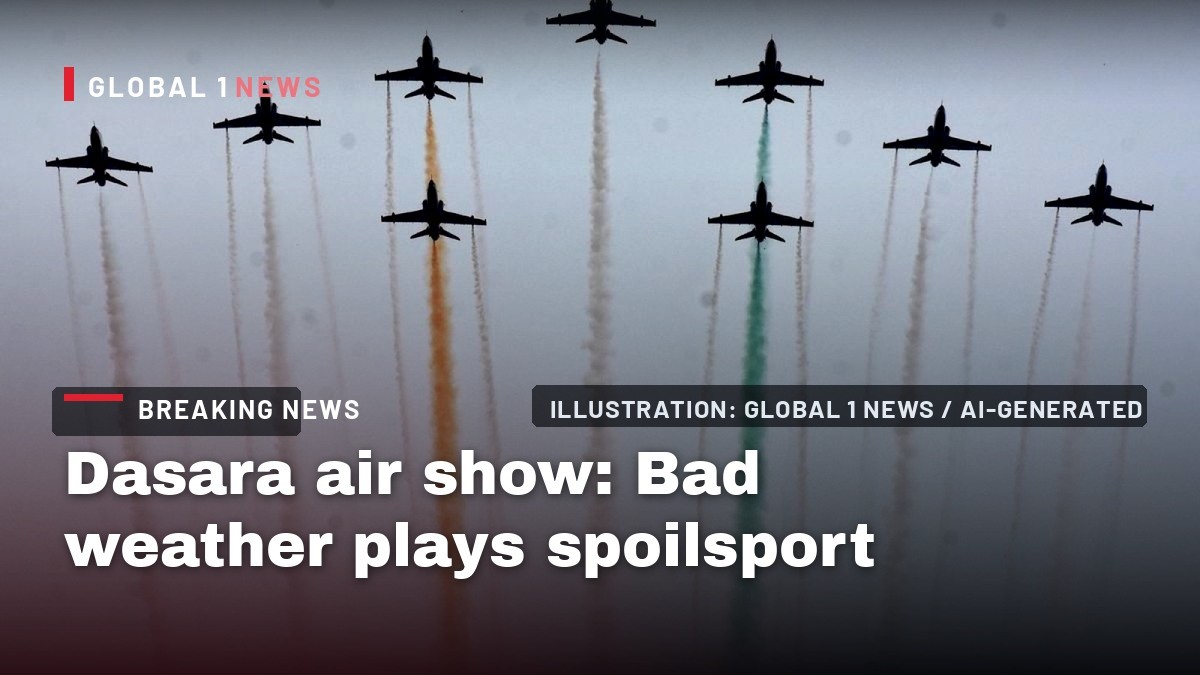
The Surya Kiran Aerobatic Team, the Indian Air Force’s premier display squadron, was forced to abort its scheduled performance over Mysuru’s Bannimantap Grounds on 18 October 2026 because of adverse weather. The nine‑aircraft formation, which flies the Hawk Mk 132 trainer, had taken off from Air Force Station Yelahanka but turned back after the pilots identified a cloud base that fell below the minimum altitude required for safe aerobatics. The decision, taken by the team’s commanding officer, Group Captain Ajay Dasarathi, underscores the tight safety margins that govern high‑speed aerial displays and highlights the operational constraints that Indian air show teams face when weather turns unfavourable.
Operational constraints and safety protocols
According to a statement from the Surya Kiran team, the cloud base on the day of the show was insufficient for the nine‑aircraft formation to execute its full display profile. Squadron Leader Tushar Sharma explained that the team could not “enter too close to the ground” because the manoeuvres demand a clear vertical space well above any low‑lying cloud cover. This is a standard safety protocol for aerobatic teams worldwide, where the minimum altitude is dictated by the need to recover from any unexpected loss of control.
The presence of terrain obstructions further complicated the situation. The Chamundi Hills, located roughly five kilometres from the Bannimantap Grounds, present a fixed obstacle that pilots must factor into their flight path. When weather conditions reduce visibility or lower cloud layers, the risk of inadvertent proximity to such terrain rises sharply, prompting the prudent decision to abort the sortie. The team’s adherence to these protocols reflects the IAF’s broader safety culture, which prioritises pilot and spectator safety over showmanship.
Impact on Dasara festivities and public expectations
Dasara, a ten‑day festival celebrated across Karnataka, draws massive crowds to Mysuru’s historic venues, including the Bannimantap Grounds where the air show was slated. The cancellation of the 18 October performance disappointed spectators who had gathered to witness the team’s signature loops, barrel rolls, inverted flying and the much‑anticipated “DNA” manoeuvre. The team’s statement that they would attempt a full display on 19 October, weather permitting, offered a glimmer of hope for those hoping to see the aerial tribute to Mysuru’s cultural heritage.
Beyond entertainment, the air show serves as a symbolic bridge between the armed forces and the civilian population. The team’s plan to depict the shape of the Mysuru palace in the sky—a special dedication to the city’s residents—illustrates how such events are leveraged for civic engagement. The abrupt cancellation, therefore, not only affected the festival’s programme but also momentarily disrupted a platform for public‑military interaction that the IAF has cultivated over decades.
Technical aspects of the Surya Kiran display
The Surya Kiran Aerobatic Team, established in 1996, operates the Hawk Mk 132, a two‑seat advanced trainer that has been adapted for precision aerobatics. Recent innovations in the team’s repertoire include new formations named “Gagnayaan,” “Bramhos” and “Akash,” as well as symbolic shapes representing India’s latest combat aircraft—Tejas, Sukhoi and Rafale. Squadron Leader Lalith Verma highlighted that these formations are “dedicated to the new inventory of the IAF,” signalling a deliberate alignment of the display with India’s ongoing modernization of its air fleet.
These formations are not merely aesthetic; they serve a communicative purpose, showcasing the agility and coordination of the Hawk platform while subtly promoting the capabilities of newer frontline fighters. By integrating representations of the Tejas, Sukhoi and Rafale, the team underscores the IAF’s strategic diversification and signals to both domestic and international observers the breadth of India’s aerospace assets.
Weather considerations and decision‑making hierarchy
The decision to abort the 18 October sortie rested with Group Captain Ajay Dasarathi, the commanding officer of the Surya Kiran team. In Indian military practice, the commanding officer holds ultimate authority over flight safety decisions, especially in public display contexts where the margin for error is minimal. Squadron Leader Sharma’s remarks that “the commanding officer took the call” reflect the chain‑of‑command discipline that permeates IAF operations.
Weather assessment for air shows involves real‑time monitoring of cloud base, visibility, wind shear and turbulence. The team’s reliance on a “certain cloud base” threshold demonstrates the application of these meteorological parameters. When the cloud base falls below the altitude required for safe maneuver execution, the risk of a sudden loss of visual reference for pilots increases, potentially leading to disorientation. The team’s pre‑emptive return to Yelahanka illustrates a risk‑averse approach consistent with IAF safety doctrine.
Strategic significance of aerobatic teams in Indian defence policy
Aerobatic teams like Surya Kiran play a nuanced role in India’s defence ecosystem. While their primary function is public outreach, they also serve as a platform for pilot proficiency, aircraft handling, and formation discipline—all critical competencies for combat readiness. The team’s use of the Hawk Mk 132, a trainer aircraft, underscores the dual‑use nature of such platforms: they are both instructional tools for pilot conversion and public display assets.
From a policy perspective, the Indian government has emphasized the importance of showcasing indigenous aerospace capabilities. By incorporating formations that honour the Tejas, a domestically developed fighter, the Surya Kiran team aligns its public displays with the “Make in India” narrative. This synergy reinforces national pride in homegrown technology while also providing a subtle diplomatic signal of self‑reliance in defence manufacturing.
Implications for future air shows and contingency planning
The weather‑induced cancellation at Mysuru highlights the need for robust contingency frameworks for public air displays. Organisers must factor in regional climatic patterns, especially in monsoon‑prone zones, and develop alternate schedules or backup venues. The Surya Kiran team’s statement that they would attempt a full display on 19 October, contingent on favourable conditions, demonstrates an adaptive approach, yet also underscores the inherent uncertainty of outdoor events.
Future air shows could benefit from enhanced forecasting tools, such as high‑resolution satellite‑derived cloud‑base data and real‑time wind profiling. Integrating these technologies into the decision‑making process would allow commanders to make more granular assessments and possibly adjust manoeuvre profiles rather than aborting entirely. Such procedural refinements would align with the IAF’s broader push towards data‑driven operational planning.
Broader cultural resonance and the way forward
Beyond the immediate operational and safety dimensions, the Surya Kiran display holds cultural resonance for Mysuru’s residents. The team’s intent to trace the silhouette of the Mysuru palace in the sky reflects a deep-rooted tradition of linking military spectacle with regional heritage. This gesture not only enriches the festive atmosphere but also reinforces a narrative of national unity, where the armed forces celebrate local identities.
As the Dasara celebrations continue, the IAF’s commitment to returning for a full performance on 19 October, weather permitting, will be closely watched. A successful display will restore the festive momentum and reaffirm the symbiotic relationship between India’s air power and its citizenry. In the meantime, the measured decision to prioritize safety over spectacle serves as a reminder that even the most dazzling aerial feats are grounded in disciplined risk management—a principle that underpins the very ethos of the Indian Air Force.
This article was produced with AI-assisted research and editorial support. Reporting is based on the source material cited below. Sources: The Hindu; thehindu.com; Global1.News (19 October 2026).
By Dr. Raj Patel, Staff Writer
What's Your Reaction?
 Like
0
 Dislike
0
 Love
0
 Funny
0
 Wow
0
 Sad
0
 Angry
0

India/South Asia Correspondent at Global1.News. Analytical voice with a background in science and health journalism. Based in New Delhi, covering Indian politics, education, healthcare, technology, and policy. Breaks down complex data into clear, actionable reporting.















Comments (0)