
Meta Releases Muse Spark Open: 816B Open-Weight MoE With 1M Context
Meta’s latest open‑weight offering, Muse Spark Open, is the kind of announcement that makes most hyperscaler‑centric folks salivate while independent hosting operators roll their eyes.
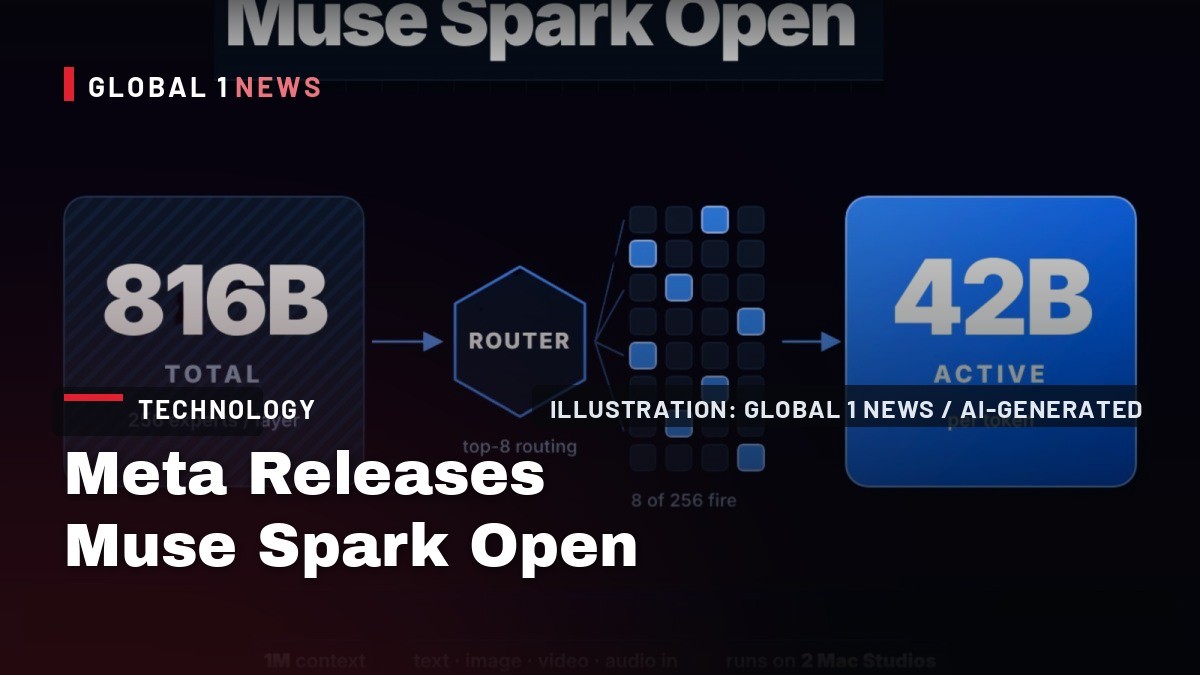
Meta’s latest open‑weight offering, Muse Spark Open, is the kind of announcement that makes most hyperscaler‑centric folks salivate while independent hosting operators roll their eyes. On paper it’s an 816‑billion‑parameter Mixture‑of‑Experts (MoE) behemoth that only activates 42 billion parameters per token, supports text, image, video and audio, and boasts a 1 million‑token context window. Meta claims it’s the most capable US‑based open‑weight model to date. The real kicker for us in the trenches, however, is the deployment story: the NVFP4‑quantized build runs on two Apple M5 Ultra Mac Studios, while the full‑precision BF16 version needs a multi‑TB VRAM rig. That hardware footprint, licensing nuance, and the model’s actual performance profile raise a host of practical questions for anyone running production services outside the cloud‑giant playground.
What Muse Spark Open actually is
The model is a native multimodal MoE with 62 layers and a hidden dimension of 8 192. Each MoE layer contains 256 experts, and the routing mechanism activates eight of them per token. Attention is grouped‑query, featuring 128 query heads and 16 key/value heads. A separate 1.8‑billion‑parameter perception encoder handles visual inputs, and the vocabulary spans just over 202 000 tokens, covering more than 100 languages. In practice, the model can ingest text, images, video and audio, and spits out text, making it a versatile tool for long‑horizon agentic work and coding assistance.
Weights are shipped in two formats: BF16 (about 1.6 TB) and NVFP4, a quantization that shrinks the active expert portion to roughly 530 GB. Meta recommends at least 700 GB of VRAM for the NVFP4 build and 2 TB for BF16. The NVFP4 variant can be run on a desktop setup of two M5 Ultra Mac Studios (each with 512 GB memory) linked via Thunderbolt 5 with RDMA, or on a data‑center rig of four Blackwell Ultra GPUs or eight H200s. For tighter memory budgets, Unsloth’s 2‑bit GGUF format can squeeze the model into about 300 GB of combined memory.
Performance on the real world: strengths and blind spots
Meta’s own benchmark suite paints a mixed picture. Muse Spark Open leads its own US‑open‑weight table on tool use and knowledge reliability, scoring 89.2 on MCP‑Atlas and 61.8 on JobBench, edging out competitors like Qwen 3.8 and GLM 5.3 in those categories. It also tops the “AA Omniscience” metric at 25. However, its coding chops lag behind. On Terminal‑Bench 2.1, a coding‑focused benchmark, it scores 76.4, trailing Kimi K3 (85.0), GLM 5.3 (83.9) and Qwen 3.8 (82.0). Its Artificial Analysis Intelligence Index sits at 39, again behind the Chinese open models that sit in the mid‑40s.
What this means for production is that Muse Spark Open shines when you need long‑context reasoning, multimodal ingestion, or tool‑use orchestration, but you shouldn’t expect it to replace a dedicated coding model for heavy‑duty code generation. The “xhigh” default reasoning effort setting can boost quality but also adds latency, a factor to weigh when you’re serving real‑time APIs.
Hardware realities for independent providers
The hardware story is where the rubber meets the road for anyone not sitting on a hyperscaler’s petabyte‑scale GPU farm. Running the NVFP4 build on two M5 Ultra Mac Studios is feasible for a small‑scale lab, but the requirement of 700 GB VRAM per machine pushes the cost of entry into the high‑five‑figures for a dedicated server rack. Scaling beyond a single request will need multi‑node tensor parallelism via MLX, which adds network overhead and operational complexity.
Data‑center deployments using four Blackwell Ultra GPUs or eight H200s are more in line with what a mid‑size hosting provider might consider, yet the capital outlay and power draw are non‑trivial. The 530 GB NVFP4 footprint is modest compared to a full BF16 model, but you still need to allocate roughly a terabyte of storage for the model files and another half‑terabyte for the perception encoder and tokeniser assets. For providers already wrestling with storage‑bound workloads, this is a significant addition.
Licensing: a hidden cost for high‑revenue MaaS players
Meta’s Muse Model License is permissive on the surface: it allows use, fine‑tuning, distillation and redistribution. The catch is the revenue clause. Any Model‑as‑a‑Service (MaaS) provider with annual revenue above $20 million must negotiate a separate agreement with Meta. Internal use, research and powering your own product features are exempt, but if you plan to monetize an API offering built on Muse Spark Open, you’ll need to factor in legal overhead and potential royalty negotiations.
For most independent hosting firms, the exemption means you can experiment and even offer limited‑scale services without a deal, but the clause creates a ceiling. Once you cross that $20 million mark—a realistic target for a successful AI‑powered SaaS—you’ll face a licensing hurdle that many hyperscalers can sidestep with their own in‑house models.
Developer ecosystem: engines, APIs and cost considerations
Meta has done the heavy lifting on the software side. Day‑one engines include SGLang, vLLM, TensorRT‑LLM, Hugging Face Transformers, MLX, llama.cpp and Unsloth, giving developers a choice of inference back‑ends. Hosted APIs are already live on platforms like Baseten, Fireworks AI, Groq, Modal, Nebius, OpenRouter and Together AI. OpenRouter’s pricing is $1.25 per million input tokens and $4.25 per million output tokens, which is competitive but still higher than many open‑source inference services that charge pennies per million tokens.
Meta also introduced two draft models to accelerate decoding: DFlash V2 for SGLang and DSpark for vLLM. They claim a 3.7× throughput boost on a single request when running on an AMD MI355X. Fine‑tuning is supported via TorchTitan, Hugging Face TRL and NVIDIA NeMo AutoModel, meaning you can adapt the model to niche domains without rebuilding from scratch.
Strategic takeaways for independent hosting operators
From a risk‑management perspective, Muse Spark Open offers a compelling mix of multimodal capability and long‑context reasoning that can differentiate a boutique AI service. However, the hardware footprint, licensing ceiling, and modest coding performance mean it’s not a blanket replacement for existing models. Operators should map the model’s strengths to high‑value use cases—such as multimodal document analysis, long‑form summarisation, or tool‑driven agentic workflows—while keeping a separate, more coding‑focused model in the stack for developer‑centric workloads.
Practically, start with the NVFP4 variant on a dual‑Mac‑Studio testbed to gauge latency and throughput under realistic loads. Measure VRAM utilisation, network latency between the two nodes, and token‑per‑second throughput using the DFlash V2 acceleration path. If the numbers hold up, consider scaling to a Blackwell‑GPU cluster for production, but keep an eye on the $20 million revenue threshold that would trigger a licensing renegotiation.
Actionable steps for founders and engineers
1. **Benchmark early** – Deploy the NVFP4 build on the recommended Mac Studio setup, run a suite of representative queries (multimodal ingestion, long‑context reasoning, tool use) and record latency. Compare against your current model stack to quantify the performance delta.
2. **Plan hardware budgets** – Allocate at least 700 GB VRAM per node for NVFP4, plus additional storage for model artefacts. Factor in the cost of high‑speed interconnects (Thunderbolt 5 with RDMA) if you stick with the desktop topology.
3. **Audit revenue exposure** – Project your API revenue trajectory. If you’re approaching the $20 million mark, start dialogue with Meta’s licensing team now to avoid a surprise compliance hit later.
4. **Hybrid model strategy** – Pair Muse Spark Open with a specialised coding model (e.g., a smaller open‑source LLM fine‑tuned for code) to cover the Terminal‑Bench gap. This layered approach mitigates risk and keeps costs in check.
5. **Leverage the ecosystem** – Use the provided engines (SGLang, vLLM, etc.) to experiment with different inference back‑ends. The DFlash V2 acceleration can shave latency dramatically, but test it on your target hardware to ensure the claimed 3.7× boost materialises in your workload.
6. **Monitor licensing** – Keep a log of any commercial API usage built on Muse Spark Open. Should you cross the revenue threshold, be ready to negotiate or pivot to a fully open‑source alternative to stay clear of unexpected legal fees.
In short, Muse Spark Open is a powerful new tool in the AI toolbox, but it’s not a silver bullet. Treat it as a specialised component for multimodal, long‑context tasks, and balance it with pragmatic hardware and licensing considerations. That’s the only way independent hosting firms can stay competitive without getting swallowed by the hyperscaler hype.
— Allan Ali, Founder
This article was produced with AI-assisted research and editorial support. Reporting is based on the source material cited below. Sources: MarkTechPost; marktechpost.com; Global1.News (18 October 2026).
By Allan Ali, Global1.News
What's Your Reaction?
 Like
0
Like
0
 Dislike
0
Dislike
0
 Love
0
Love
0
 Funny
0
Funny
0
 Wow
0
Wow
0
 Sad
0
Sad
0
 Angry
0
Angry
0

Publisher of Global1.News. Automation architect, systems builder, and the guy making sure the truth gets published.










Comments (0)