
St. Petersburg Bans Migrant Workers From Gym, Hair Salon and Retail Work
The St. Petersburg administration has issued a new decree that bars foreign citizens holding temporary work patents from employment in retail, healthcare, beauty salons and fitness centres.
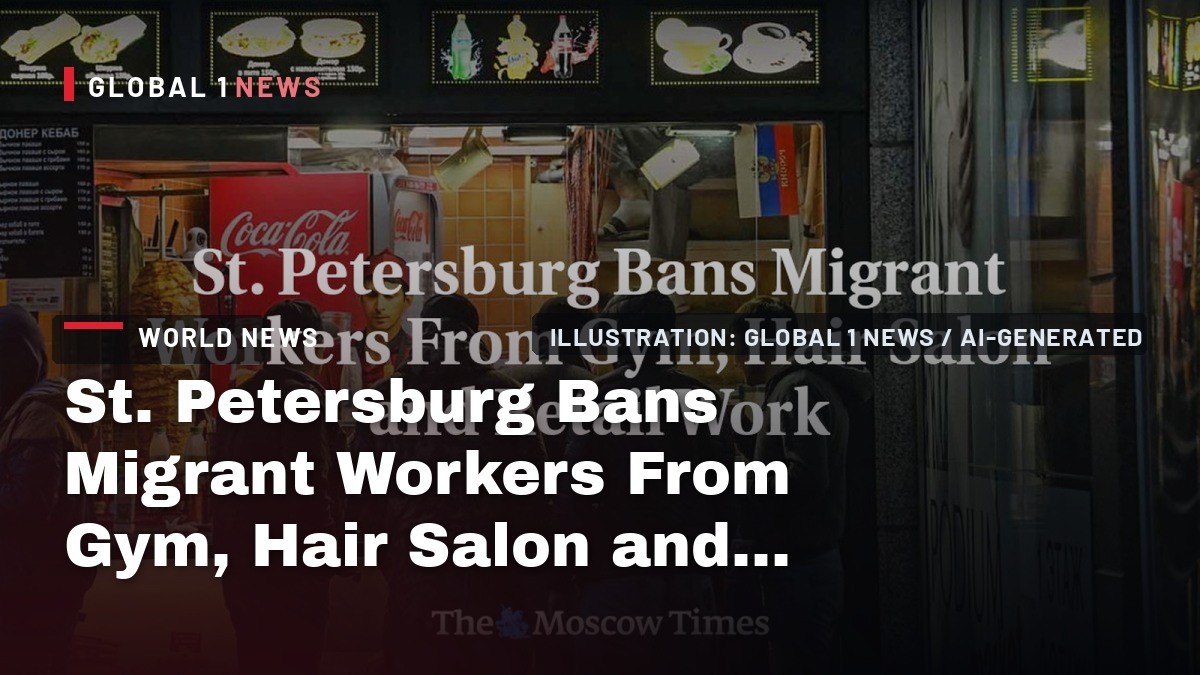
The St. Petersburg administration has issued a new decree that bars foreign citizens holding temporary work patents from employment in retail, healthcare, beauty salons and fitness centres. The move, announced on 16 October 2026, expands the city’s earlier restrictions that prohibited patent‑holders from driving taxis and delivering food. By extending the ban to a broader swathe of low‑skill occupations, the regional government signals a renewed drive to curtail “shadow employment” and to prioritize Russian workers in sectors traditionally dependent on migrant labour.
Scope of the new ban
According to the decree signed by Governor Alexander Beglov, the prohibition applies specifically to foreign nationals who possess a work patent – a temporary visa that permits low‑skill work in Russia. The ban covers jobs in retail outlets, health‑care facilities, beauty salons and fitness centres. Employers in St. Petersburg have been given a deadline of 15 December 2026 to adjust their staffing arrangements and bring their operations into compliance with the new rule.
The decree explicitly excludes highly qualified specialists, foreigners who hold standard work permits, and citizens of the Commonwealth of Independent States members Armenia, Belarus, Kazakhstan and Kyrgyzstan. It also leaves untouched workers from other visa‑free countries that are eligible for a work patent, such as Azerbaijan, Moldova, Tajikistan and Uzbekistan.
Official rationale
Local media outlet Fontanka reported that the authorities framed the measure as a fight against “shadow employment” – informal, unregistered work that allegedly undermines tax revenues and labour standards. The decree is also presented as a means to lessen Russia’s economic reliance on low‑skilled foreign labour, a narrative echoed by regional officials who argue that the policy will create a “transparent, regulated labour market where jobs are generated for Russian citizens, including young people and students.”
These statements align with a broader federal initiative launched after the March 2024 Crocus City Hall terrorist attack. In the wake of that incident, Russian lawmakers introduced a series of migration restrictions aimed primarily at Central Asian workers, seeking to tighten control over the flow of low‑skill migrants into the country.
Regional and occupied‑territory parallels
The St. Petersburg decree is not an isolated case. Dozens of other Russian regions have adopted similar targeted bans on foreign labour, extending the restrictions to various sectors deemed non‑essential or prone to informal employment practices. Moreover, authorities in occupied Ukrainian territories have introduced comparable measures, indicating a coordinated approach across the Russian‑controlled space to limit the presence of migrant workers in certain economic niches.
These parallel policies suggest a concerted effort by the Kremlin‑aligned regional administrations to reshape the labour market in line with a nationalist agenda that privileges Russian citizens and a limited pool of highly qualified foreigners over the broader migrant workforce.
Implications for the migrant workforce
The ban will directly affect thousands of migrant workers who rely on low‑skill jobs in retail, health‑care and personal services to support families both in Russia and abroad. While the decree does not provide precise figures, the sectors targeted are traditionally among the largest employers of migrant labour in St. Petersburg, implying a substantial reduction in employment opportunities for this demographic.
Workers holding work patents from countries such as Azerbaijan, Moldova, Tajikistan and Uzbekistan will now face a narrowed set of permissible occupations, limited to those not covered by the new restrictions. The policy may force many to seek alternative employment, return to their home countries, or risk operating in the informal economy, thereby potentially increasing the very “shadow employment” the decree purports to combat.
Economic and social consequences
By removing a segment of low‑skill labour from the market, the decree could generate short‑term labour shortages in the affected sectors, especially in retail and personal services that rely heavily on migrant staff. Employers may need to raise wages or invest in training to attract Russian citizens and students, a demographic that historically shows limited interest in low‑skill, low‑pay positions.
In the longer term, the policy may contribute to higher consumer prices in retail and service sectors, as businesses pass on increased labour costs to customers. Socially, the ban may exacerbate tensions between migrant communities and local residents, particularly if the reduction in migrant workers leads to perceived declines in service quality or availability.
Legal and administrative enforcement
The decree grants local authorities the power to monitor compliance and to penalise employers who fail to adjust their staffing by the 15 December deadline. While the source material does not detail specific penalties, the enforcement framework is likely to involve inspections and possible fines, mirroring the mechanisms used in previous migration‑related restrictions.
Given the Kremlin’s broader crackdown on independent media – illustrated by the Prosecutor General’s Office designating The Moscow Times as an “undesirable” organization – the enforcement of the labour ban may be accompanied by heightened scrutiny of any dissenting voices that question the policy’s efficacy or fairness.
Broader geopolitical context
The St. Petersburg ban must be understood within the larger tapestry of Russia’s post‑2024 security and migration policies. The Crocus City Hall attack triggered a wave of legislative activity aimed at tightening border controls and limiting the presence of foreign nationals deemed “low‑skill.” By extending the restrictions to additional sectors, regional leaders like Governor Beglov are aligning local policy with the federal narrative that frames migrant labour as a security and economic vulnerability.
These measures also serve a symbolic function: they demonstrate the Kremlin’s commitment to a nationalist labour agenda that prioritises Russian citizens, while signalling to domestic audiences that the government is taking decisive action against perceived external threats. At the same time, the exclusion of highly qualified specialists and citizens of select CIS states reflects a calibrated approach that seeks to retain valuable technical expertise while shedding the “shadow” workforce.
This article was produced with AI-assisted research and editorial support. Reporting is based on the source material cited below. Sources: The Moscow Times; themoscowtimes.com; Global1.News (18 October 2026).
By Irina Volkov, Staff Writer
What's Your Reaction?
 Like
0
Like
0
 Dislike
0
Dislike
0
 Love
0
Love
0
 Funny
0
Funny
0
 Wow
0
Wow
0
 Sad
0
Sad
0
 Angry
0
Angry
0

Russia/Eastern Europe Correspondent at Global1.News. Covering Russian politics, energy, security, and the shifting dynamics of the post-Soviet space. Provides clear-eyed analysis on one of the world's most opaque regions.













Comments (0)