
Southern Yemeni leader calls for 'mobilization’ against Houthis as war escalates
In a televised address that marked his first public appearance since the Southern Transitional Council (STC) lost its foothold in the south earlier this year, Aidarous al‑Zubaidi called for a “popular mobilization” against the Iran‑backed Houthi movement.
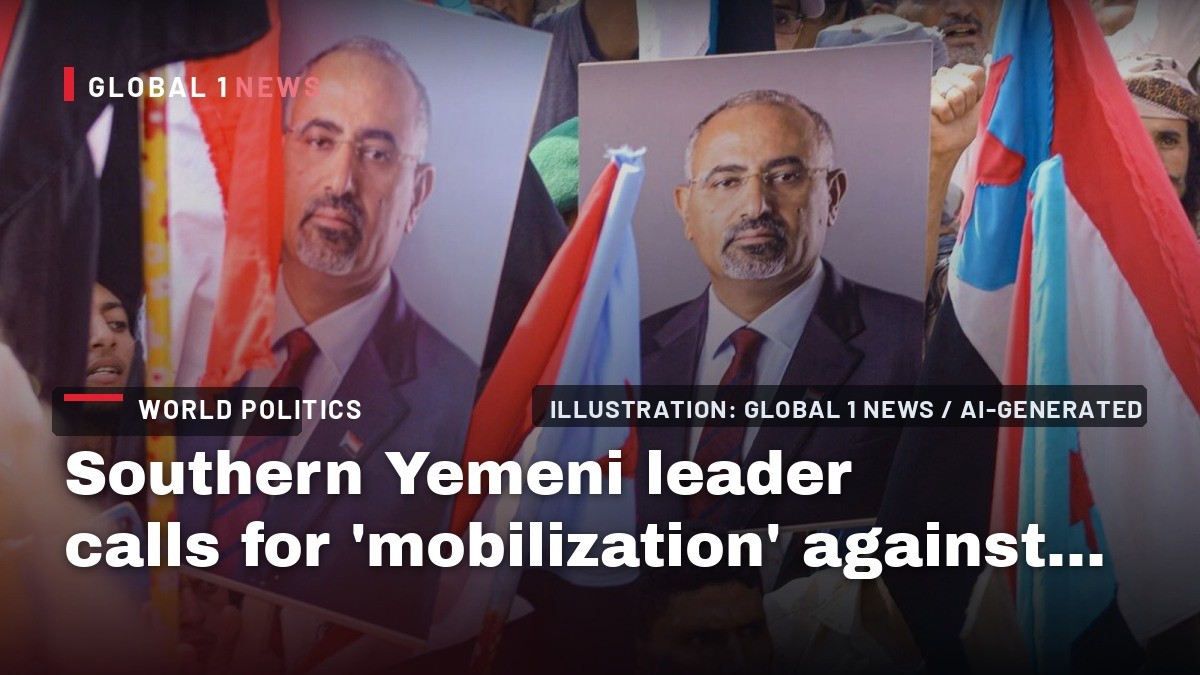
In a televised address that marked his first public appearance since the Southern Transitional Council (STC) lost its foothold in the south earlier this year, Aidarous al‑Zubaidi called for a “popular mobilization” against the Iran‑backed Houthi movement. The appeal, delivered on Tuesday, underscores the deepening fissures within Yemen’s already fragmented political landscape and signals a renewed push by the UAE‑backed separatist faction to rally southern Yemenis around the historic notion of autonomy that predates the 1990 unification of the Arab Republic of Yemen.
Context of the call for mobilization
Al‑Zubaidi’s speech came at a moment when Saudi‑backed government forces, bolstered by former STC affiliates and other southern militias, are intensifying operations along the Red Sea coast. These forces aim to reverse recent territorial gains made by the Houthi rebels, who have expanded their control over key maritime routes and coastal towns. The timing of the address suggests that the STC seeks to re‑position itself as a pivotal actor in the broader anti‑Houthi coalition, even as its own territorial influence wanes.
By invoking the era of South Yemen’s independence from 1967 to 1990, al‑Zubaidi framed his mobilization plea within a historical narrative that resonates with many southerners who view the 1990 unification as a loss of political agency. This rhetorical strategy is designed to tap into lingering regional identities and to present the current conflict as a continuation of the “national liberation project” that once defined the southern state.
Implications for the Saudi‑UAE partnership
The call for a popular mobilization aligns with the broader strategic interests of the United Arab Emirates, which has long supported the STC as a counterweight to both the Houthi movement and the central government in Sana’a. While Saudi Arabia leads the coalition against the Houthis, the UAE’s backing of the STC reflects a nuanced approach that seeks to shape the post‑conflict political order in the south.
Al‑Zubaidi’s emphasis on defending “the political entity” of the south and confronting “Iranian expansionist” ambitions dovetails with Riyadh’s narrative of countering Iranian influence in the region. However, the STC’s independent mobilization call could also complicate coordination between Saudi and Emirati forces, especially if the STC seeks to assert its own agenda separate from the coalition’s central command.
Potential impact on the ground in southern Yemen
For civilians in the south, the prospect of a renewed “popular mobilization” raises concerns about further militarization of daily life. The call to arms may encourage local militias and community groups to take up weapons, potentially leading to an escalation of clashes in already volatile districts. This development could exacerbate humanitarian challenges, as displacement and access to basic services have already been strained by years of conflict.
Moreover, the STC’s appeal may resonate with segments of the population that feel marginalized by the central government’s policies. By framing the struggle as both a defense against Houthi aggression and a fight for southern autonomy, al‑Zubaidi is seeking to broaden the base of support beyond traditional STC loyalists, potentially drawing in new volunteers motivated by regional identity and security concerns.
Regional diplomatic reverberations
The STC’s mobilization narrative is likely to be noted by regional actors beyond the Gulf coalition. Iran, which backs the Houthis, may view the appeal as an escalation that warrants a stronger proxy response, potentially deepening the proxy dimension of the Yemeni war. Conversely, other regional powers observing the conflict, such as Qatar and Oman, may see an opportunity to mediate or influence the evolving dynamics, especially if the STC’s call gains traction on the ground.
Internationally, the United Nations and humanitarian agencies have repeatedly warned that renewed fighting could jeopardize aid delivery to vulnerable populations. Al‑Zubaidi’s emphasis on defending “the Arab territories of the Arab Republic on the borders before May 22, 1990” underscores a narrative that could be leveraged in diplomatic forums to argue for a political settlement that respects historical borders, a stance that may find sympathetic ears among certain Arab states.
Strategic messaging and propaganda
Al‑Zubaidi’s address employed a blend of historical reference and contemporary security rhetoric. By invoking the “national liberation project” and denouncing “extremist groups” targeting the south, the speech seeks to cast the STC as a legitimate defender of both regional identity and broader Arab security interests. This dual framing serves to legitimize the call for mobilization in the eyes of both local supporters and external backers.
The language also underscores a clear anti‑Iranian stance, aligning the STC’s narrative with the broader Gulf coalition’s framing of the conflict as a battle against Iranian expansionism. This alignment may be intended to secure continued Emirati and Saudi support, positioning the STC as an indispensable partner in the anti‑Houthi effort.
Historical resonance of South Yemen’s independence
The reference to South Yemen’s pre‑1990 borders is a potent reminder of the region’s distinct political and cultural heritage. Between 1967 and 1990, the southern state operated under a separate government, fostering a sense of identity that persists among many southerners. By invoking this era, al‑Zubaidi taps into a collective memory that can be mobilized for political purposes, especially in times of crisis.
Such historical framing is not new in Yemeni politics; various factions have repeatedly used past eras to legitimize contemporary claims. In this instance, the appeal to the pre‑unification period serves to reinforce the STC’s core argument that the south’s autonomy remains a legitimate and enduring aspiration, one that should be defended against both internal and external threats.
Outlook for the STC and the broader conflict
While the immediate impact of al‑Zubaidi’s mobilization call remains uncertain, it signals the STC’s intent to remain an active player in Yemen’s evolving battlefield. The organization’s ability to translate rhetoric into tangible military or political gains will depend on several factors, including the willingness of southern communities to respond, the level of continued Emirati backing, and the broader coalition’s capacity to sustain pressure on the Houthis.
For observers, the speech underscores the layered complexity of Yemen’s war, where local, regional, and international interests intersect. As the Saudi‑backed forces push to reclaim Red Sea coastal territories, the STC’s call for a popular mobilization adds another dimension to the conflict, potentially reshaping alliances and influencing the trajectory of the war in the months ahead.
This article was produced with AI-assisted research and editorial support. Reporting is based on the source material cited below. Sources: Al-Monitor; al-monitor.com; Global1.News (14 October 2026).
By Hannah Berg, Staff Writer
What's Your Reaction?
 Like
0
Like
0
 Dislike
0
Dislike
0
 Love
0
Love
0
 Funny
0
Funny
0
 Wow
0
Wow
0
 Sad
0
Sad
0
 Angry
0
Angry
0

Israel Correspondent at Global1.News. Based in Tel Aviv, covering Israeli politics, security, technology, and society. Provides balanced, deeply-sourced reporting on one of the most closely-watched regions in the world.














Comments (0)