
Seoul Draws a Hard Line on Hormuz Troops
South Korea's president ruled out sending troops to the Strait of Hormuz in any form that would draw the country into the Middle East war, while leaving room for minimum maritime security activities.
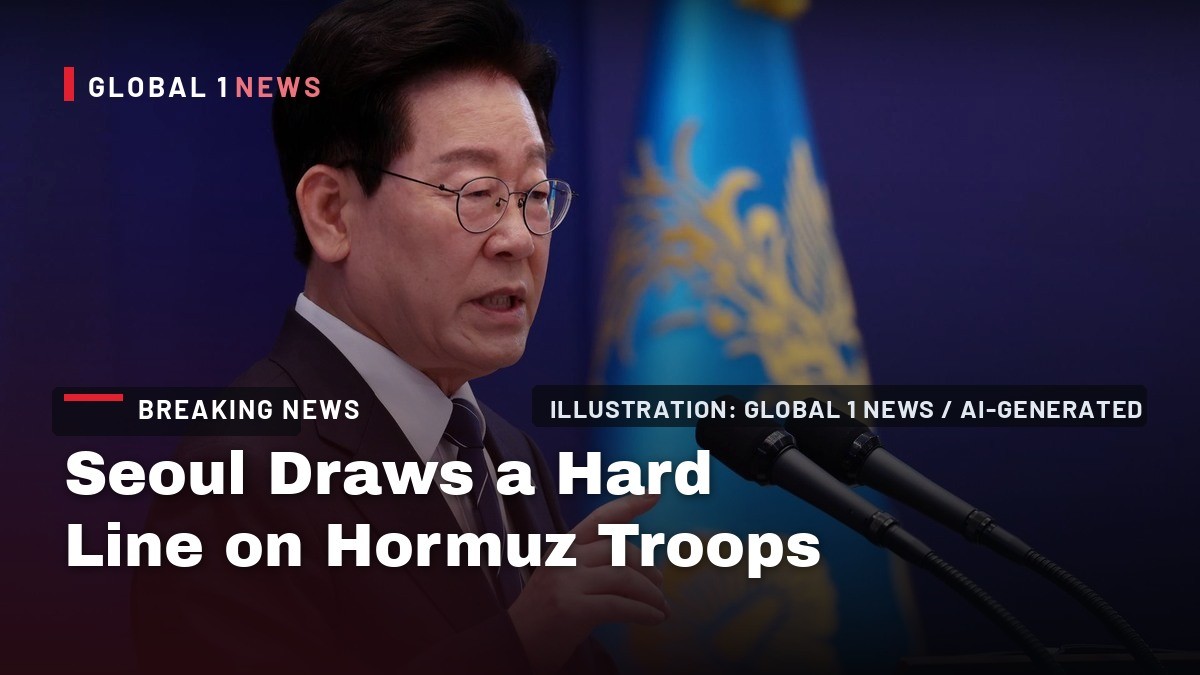
South Korea's president has ruled out sending troops to the Strait of Hormuz in any form that would draw the country into the Middle East war, repeating the commitment three times from Seoul. The declaration landed ahead of his foreign minister's first face-to-face meeting with the US secretary of state since the war began, where the same question was waiting.
Seoul Draws a Hard Line on Hormuz Troops
Seoul, South Korea — President Lee Jae Myung stood before cameras at the Blue House State Guest House on Friday morning and closed one door while deliberately leaving another ajar.
The Line He Drew, Three Times Over
Asked about deploying South Korean forces to the Strait of Hormuz, Lee said no dispatch would take place that involved the country in the conflict. It was the seventh press conference of his presidency since he took office in June 2025, and he used it to return to the same formulation again and again.
"Let it be clear. There will be no dispatch of troops that will lead to involvement in a conflict. There will be no engagement or involvement in war," Lee said, according to Yonhap.
"There won't be deployment that would involve or enter war. I can tell you that very clearly. We won't deploy military assets in any form to that end," he said. He restated it again — "We have upheld that principle until now. That principle will remain unchanged going forward" — and then once more, for the cameras: "To make it clear once again, there will be no deployment to the war."
What Lee did not do was close the file entirely. He said South Korea must carry out "at least the minimum level of activities" to safeguard its citizens, its ships and its crude-oil transportation route, "as other countries do." That carve-out is where the remaining ambiguity sits, and Lee acknowledged as much.
What Trump Actually Asked For
The pressure from Washington has been public and personal. President Donald Trump has criticised Seoul for what he called insufficient support for the Iran war, and this summer he scaled back major joint military drills between the two countries' armed forces.
In a Fox News interview late last month, Trump said Washington had received "very little help" from other countries and singled out South Korea. "I said, 'Would you like to participate?' And they all said, 'No, thank you.' And I said, 'I'm going to remember that to myself,'" Trump said, according to The Guardian.
Trump used Seoul's refusal to justify scaling back the allies' joint Ulchi Freedom Shield exercises in August, tying the decision to his own outreach to North Korean leader Kim Jong Un. He has repeatedly claimed Lee declined his request for help with the war against Iran, publicly pressing the ally and saying Washington should "remember" countries unwilling to help the United States.
South Korea's Foreign Ministry said in August that it could not confirm any such phone call took place in the terms Trump described. It is not established that a formal written request was ever made or rejected; what is documented is sustained public pressure from the American president.
Separately, Trump said in July 2026 that the United States would be "guardian angel of the strait" and demanded a 20 per cent toll fee. The United States stations about 28,500 troops in South Korea.
Seventy Per Cent of Korea's Oil
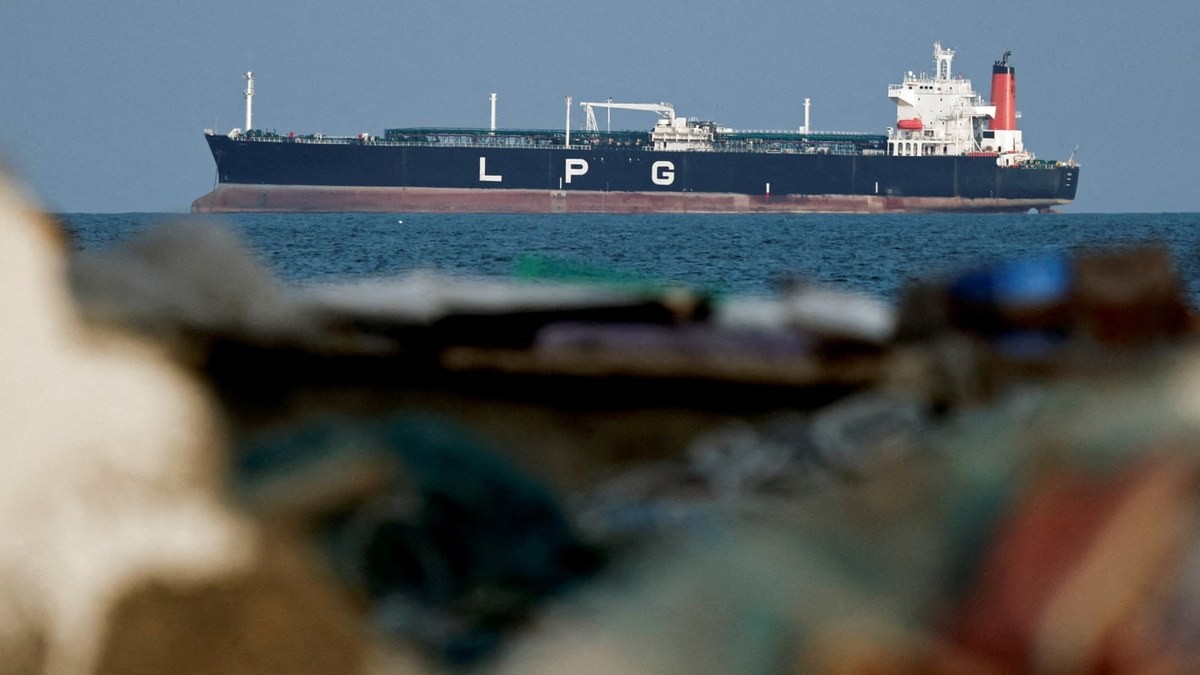
The strategic stakes are not abstract. About 70 per cent of South Korea's crude oil imports pass through the Strait of Hormuz, the narrow waterway that has been severely disrupted since the war began with a joint US-Israeli attack on Iran on 28 February 2026.
That dependence is why the deployment question reached Seoul's cabinet at all, and why Lee's carve-out language matters. The president framed the remaining mission as protective rather than belligerent.
"It is also clear that, like other countries, we need to undertake the minimum activities necessary to protect our merchant ships and crude oil shipping routes, as well as the lives and safety of our citizens," he said.
First Vice Minister of Foreign Affairs Park Yoonju, appearing before the National Assembly the previous day, described the approach in similar terms. "We are fundamentally approaching this issue in terms of maritime security, energy supply line safety, and the safety of local residents and nationals, rather than solely from the perspective of Korea-U.S. relations," Park told the Foreign Affairs and Unification Committee.
The Cheonghae Unit and the Blurred Line
The instrument Seoul is considering strengthening is the Cheonghae Unit, the Republic of Korea Navy's anti-piracy force, first dispatched to the Gulf of Aden in 2009. Its operational area was later expanded to include the Gulf of Oman and the Strait of Hormuz as Seoul sought to protect Korean ships and nationals in the region.
The unit "has expanded the scope of its mission to carry out relevant activities in the area," and Lee said "it is true that we are reviewing and thinking about ways to strengthen (measures) on this."
Lee was direct about the risk that the distinction collapses in practice. "People are concerned because the boundary could become unclear and the two could become mixed together," he said. He named the specific fears: that South Korean forces could end up "intervening in, becoming involved in or supporting the war," that Seoul might "send combat troops," or that it might "place our service members under foreign command and put them in harm's way."
Those are the outcomes his repeated formulation is designed to foreclose. Whether a strengthened anti-piracy mission can stay on the safe side of that line is the question his own remarks left open.
The Security Council Meeting That Never Happened
In Seoul, the machinery of national security decision-making did not convene as usual. The regular National Security Council Standing Committee meeting, typically held every Thursday, was not called this week.
Unification Minister Jeong Dongyoung, a standing committee member, told lawmaker Ahn Cheolsoo of the People Power Party in the Assembly that there were no plans to convene it before the Korea-US foreign ministers' meeting, according to The Korea Herald.
The omission drew attention because it landed in the same week the deployment question moved to the centre of public debate. A South Korean on-site investigation team had returned home the previous week from a mission to the United Arab Emirates to assess the Middle East safety situation.
No date has been set for a final government decision, and no formal decision has been announced. The government's final position is expected to be confirmed following domestic procedures after the diplomatic meeting in Washington.
His Own Party Objected First
The resistance to deployment did not begin with the opposition. It began inside Lee's own governing coalition, and it was on the record a day before the president spoke.
In a full session of the National Assembly Foreign Affairs and Unification Committee on 17 September, Woo Wonshik — a Democratic Party lawmaker and former Speaker of the National Assembly — drew a contrast with South Korea's past deployments. "When we sent troops to Iraq, the U.S. had been attacked in the 9/11 terrorist incident, which made the deployment justifiable in terms of the Korea-U.S. alliance and humanitarian grounds, but this time it is actually a war of aggression by the U.S.," Woo said.
Fellow Democratic Party lawmaker Lee Giheon was blunter. "I am absolutely opposed to directly participating in war," he said.
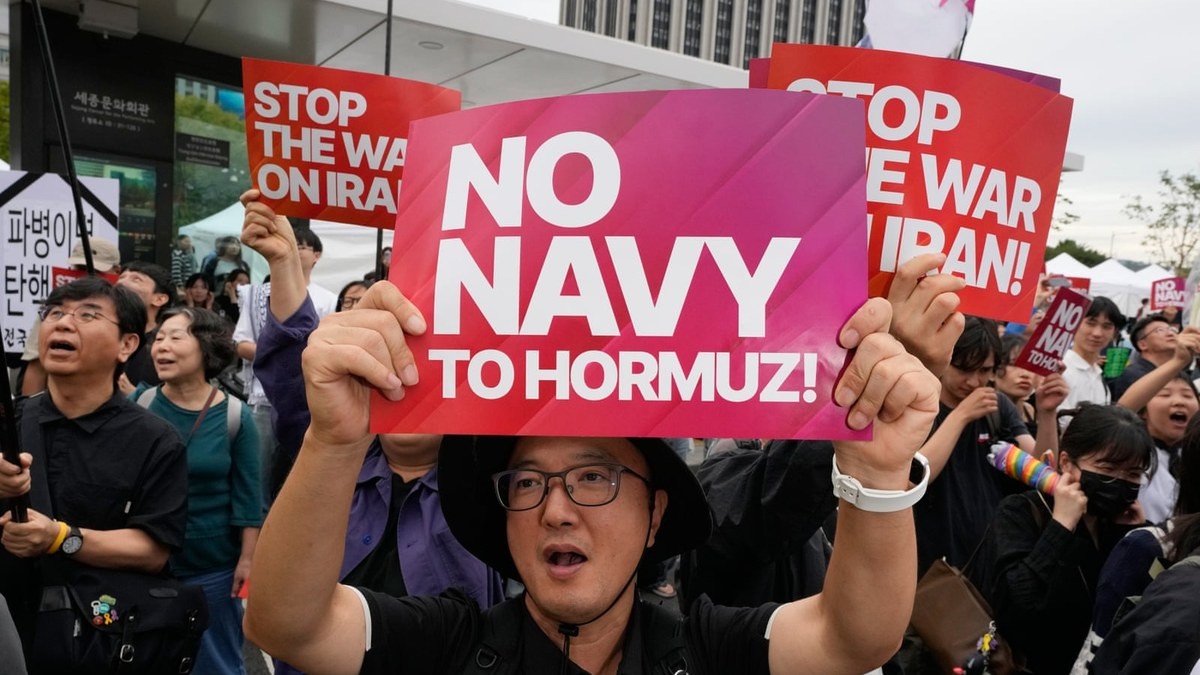
Lawmakers from four progressive parties — the Innovation Party, the Progressive Party, the Basic Income Party and the Social Democratic Party — held a picket protest in front of the plenary hall that afternoon, calling for the immediate passage of a resolution against the Hormuz deployment.
Public opinion has tilted the same way. Polls show broad opposition to sending South Korean troops or military assets to the strait, particularly among supporters of Lee's ruling Democratic Party. The idea became controversial after local media reported in early September that Seoul was considering deploying troops.
Cho in Washington, Rubio on Friday
Foreign Minister Cho Hyun left for Washington on 17 September for a three-day visit through Saturday, with a meeting with US Secretary of State Marco Rubio on Friday, US time. It is the first bilateral meeting between the two since the Middle East crisis began.
Before departing Incheon International Airport, Cho framed the agenda broadly. "We will have in-depth discussions on various pending issues between the two nations, as well as consultations on issues concerning the Korean Peninsula, regional affairs and the international situation," he said.
On Hormuz specifically, Cho held the government's line without closing it. "Our position remains that no decision has been made yet, and we are reviewing all relevant factors," he said. "In doing so, we will prioritize international cooperation while giving foremost consideration to the safety of our people and freedom of navigation through the Strait of Hormuz."
That formulation — no decision made, all factors under review — is the diplomatic counterpart to Lee's domestic declaration. The president ruled out war involvement. The foreign minister kept the protective mission on the table.
The $350 Billion Behind the Troops
The Hormuz question does not travel alone. It arrives in Washington alongside a much larger financial file that has its own unresolved terms.
South Korea committed last year to invest US$350 billion in US manufacturing in return for Washington lowering tariffs on Korean imports to 15 per cent. The pledge included $150 billion for shipbuilding cooperation. This week, Seoul postponed a parliamentary briefing on the investment plans; it is expected to take place next week instead.
Lee said the sticking point is "commercial reasonableness" — a principle Seoul fought to include in the strategic investment agreement signed with Washington in November 2025 and later enshrined in South Korean law.
"We only invest in projects that are commercially reasonable. The law also requires us to assess how commercially reasonable they are," Lee said. "I was told we were close to an agreement, but from what I saw in the details, there were some parts that were difficult to agree with, so we are still discussing them."
He described the weight of the decision in personal terms — "I have been giving this so much thought that it has kept me up at night. It carries enormous weight" — and drew a line around the principle itself. "National interests are extremely important. I do not think we should be swayed by any relationship, pressure or coercion. I am not saying that the US is doing that."
Cho said of the delayed briefing: "I understand the delay is aimed at clarifying domestic procedural issues, rather than reflecting differences between the two nations."
The Kim Card He Kept on the Table
On North Korea, Lee used the same press conference to keep a different door open — and to place himself at its threshold.
Asked about the possibility of resuming dialogue between Kim Jong Un and Trump, Lee said: "The possibility cannot be ruled out although it would be admittedly difficult." He went further: "It is clear that we should do our utmost to make the possibility come true."
Lee argued that the order of engagement matters. "The resumption of North Korea-U.S. dialogue would be far easier than resuming inter-Korean dialogue and help resume dialogue between the two Koreas," he said. "I am continuing to play my role as a preliminary mediator to make North Korea-U.S. dialogue possible."
He was explicit about where he believes Trump stands. "It is clear that Trump wants dialogue, and I am also urging President Trump to engage in dialogue," Lee said. "I cannot say for certain how likely it is, but it is also clear that we must make every possible effort to turn that possibility into reality."
Trump said last month that he plans to meet Kim later this year, and said Pyongyang now had 57 "very powerful" nuclear weapons; Seoul says there are around 80 to 120. North Korean state media has so far remained largely silent on the repeated calls for such a meeting. Trump has been pushing aides for a meeting with Kim as soon as the autumn, the Wall Street Journal has reported.
What Happens Next
Lee delivered his Hormuz declaration at a moment of domestic weakness. His approval ratings have fallen to their lowest point, in the mid-30 per cent range in recent weeks, especially among young voters, mainly because of runaway housing prices and other political controversies.
He acknowledged as much, saying that through deliberations he had come to realise "the public is always right" and that all problems were due to his "own shortcomings." He reiterated his commitment to stabilising the housing market, pledging to take all necessary measures including promptly increasing supply, and admitted policy shortcomings over single-stock leveraged exchange-traded funds, launched in May, after criticism that they amplified stock market volatility.
On the constitutional question Lee was categorical. "My reelection through constitutional revision is constitutionally impossible," he said, describing the current Constitution as outdated and stressing the need to amend it through reasonable discussion and public consensus.
He also intervened in a pending bill, asking the National Assembly to delete provisions in a special-counsel bill that would effectively allow the special counsel to nullify his indictments. The ruling Democratic Party submitted the bill earlier this year, accusing prosecutors under the previous Yoon Suk Yeol government of indicting Lee on fabricated charges in a real-estate development corruption case. Opposition parties accuse Lee of seeking to have his own indictments cancelled. Lee still supported the need for a special counsel investigation into the suspected fabrication of charges against him.
On the waterway itself, the position remains where Lee left it: no involvement in the war, and a protective mission still under review. The Cheonghae Unit's role may be strengthened. The final government decision is expected after Cho's meeting with Rubio and the domestic procedures that follow. No date has been set, and no decision has been announced.
By Jessica Ali, Staff Writer
This article was produced with AI-assisted research and editorial support. Sources: Yonhap News Agency, The Guardian, The Korea Herald, The Korea Times, The Asia Business Daily, Dawn, The Hindu and The Deep Dive.
What's Your Reaction?
 Like
0
Like
0
 Dislike
0
Dislike
0
 Love
0
Love
0
 Funny
0
Funny
0
 Wow
0
Wow
0
 Sad
0
Sad
0
 Angry
0
Angry
0

Editor-in-Chief at Global1.News. Atlanta-based journalist who cuts through the BS and tells it like it is. Lead anchor, host, and the voice you hear when the spin stops and the truth starts.









Comments (0)