
The FAA Rebooted America's Skies, Then Warned It Will Happen Again
The FAA lifted its nationwide ground stop at 8:15 p.m. Eastern after more than four hours, blaming overloaded analog switches and routers. Officials ruled out a cyberattack, said the disruption touched thousands of flights, and asked Congress for $50 billion to rebuild the system.
For four hours and a quarter on Friday, the most expensive aviation system on earth could not launch an aeroplane, and the reason turned out to be a phone network built in the 1980s. The Federal Aviation Administration reopened United States airspace at 8:15 p.m. Eastern, announced from the White House by Transportation Secretary Sean Duffy, and then spent the rest of the briefing explaining that the thing that failed is old enough to have outlived the Soviet Union.
The FAA Rebooted America's Skies, Then Warned It Will Happen Again
Washington, D.C. — The order that stopped the country arrived as a terse agency statement, and the order that restarted it arrived as a press conference.
Eight Fifteen, and the Sky Reopened
Duffy gave the time himself, twice, and the phrasing was not the phrasing of a man declaring victory. "We've got our centres and our trachons operational right now, and so at 8:15 tonight Eastern time, we've opened up the airspace," he told reporters at the White House. CNBC recorded the same moment as the cancellation of the ground stop after it had run "for more than four hours." The FAA, in a post on X shortly after 10 p.m., said it had cleared nothing until it was satisfied the system would hold: "Before clearing flights to resume, we thoroughly tested our systems to confirm they were stable and that operations remain reliable." Trackers put the lift a few minutes after the official time — 8:19 and 8:25 both appear in live coverage — which is what happens when a country of this size is restarted one facility at a time. Reopening the airspace, Duffy made clear, was the easy half.
What Broke: Analog Routers and 1980s Copper
The mechanism, in Duffy's own words, is almost antique. "So we have TDM, telecom. So this is analog telecom," he said. "Our switches, are routers actually got overloaded with data and they went down and, I shouldn't say they went down. They started to give us inconsistency in the data, from those, from those routers. And because of that, we shut the system down." Speaking to the Los Angeles Times he was blunter still: "We have old, old switches, old routers, we use 1980s little copper lines. It's an old system that went down and went down everywhere." The Los Angeles Times identified the failing layer as TDM — time-division multiplexing — "a dated, still mostly copper-wire technology." To DW he compressed it: "It was a legacy network problem." Aviation Week reported the instability began around 3:36 p.m. Eastern, affecting radar and communications at centers and tracons nationwide.
The Cause the Government Gave, and What It Ruled Out
Homeland Security Secretary Markwayne Mullin used the briefing to close doors rather than open them. "We have seen zero evidence that this is a cyberattack or an SI attack," he said, in the account released by his own department. He elaborated for reporters: "There's no chatter, we haven't seen any footprints, as you would say, or identifications of people that got into the system. It appears that this was mechanically driven. However, we're still looking, so we're not going to roll that out." The BBC's live coverage recorded a further exclusion — that Mullin saw no link to a Microsoft outage the previous day — and a reassurance that "no one was ever at risk." The Associated Press put the safety ledger at more than 3,000 flights landed safely. Duffy, asked whether it could happen again, would not promise otherwise: he "could not guarantee it wouldn't happen again."
The Two Accounts That Do Not Quite Agree
There is a seam in the government's explanation, and it runs between the two men who gave it. The Associated Press characterised the administration's account as one in which "new technology being added to the nation's air traffic control system overloaded antiquated parts of it." Mullin supplied the sentence that supports that reading: the FAA was installing "new equipment, new technology" and "it was overwhelming the older system." Duffy, at the same briefing, said something narrower. He ruled out the agency's new AI tool entirely, saying the problems were not linked to it "because that isn't connected to what failed on Friday," and added: "This is all the old legacy equipment. All of the new equipment that has been deployed did not go down." Both statements can be true — more data pushed through old routers by new systems, with the new systems themselves intact — but only one of them is an explanation, and the public was given both.
What It Cost, With the Timestamps Attached
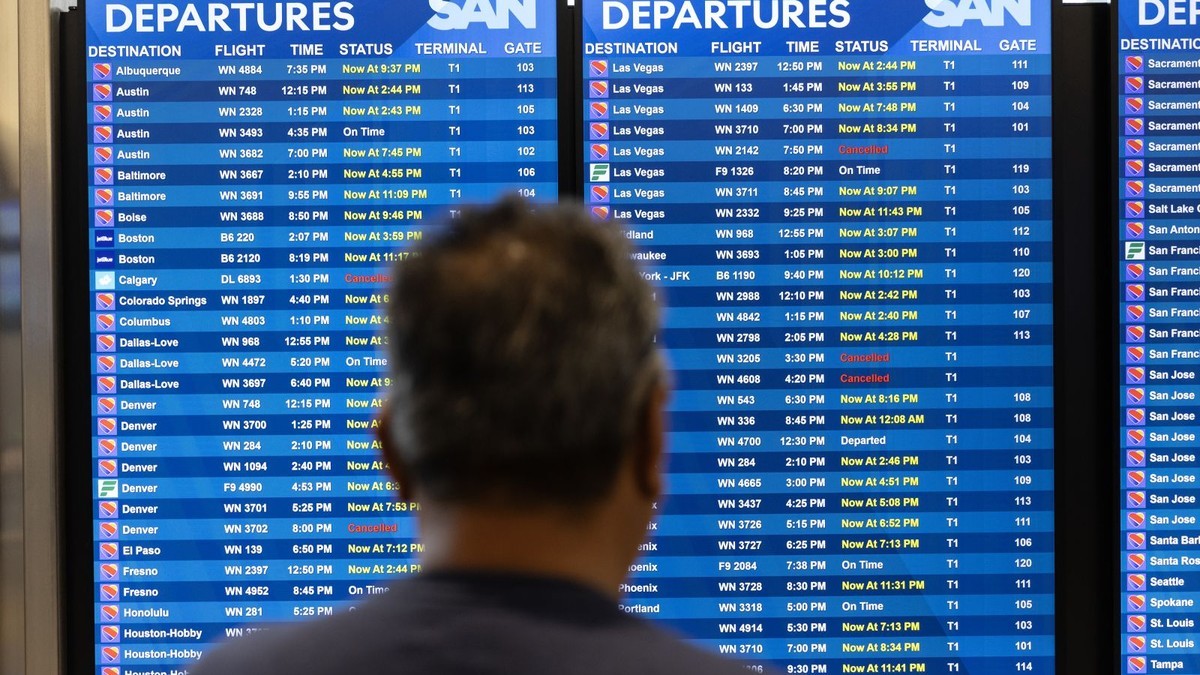
The totals do not agree, and the disagreement is not fraud, it is arithmetic taken at different hours by different counters. FlightAware, as read by CNN shortly before midnight Eastern, had more than 7,700 flights within, into or out of the United States cancelled on Friday, more than 8,000 delayed, and more than 2,000 already cancelled for Saturday. FlightRadar24, through the Associated Press, had more than 6,600 cancelled, 8,600 delayed, and another 1,500 cancelled for Sunday. Reuters put the combined figure at "around 15,000 flights delayed or canceled." CNBC said more than 10,000 were disrupted. Cirium told CNBC that 11,000 flights had been scheduled to depart American airports after 4 p.m. Friday, carrying 1.5 million passengers. Diversions split the same way: Cirium figures carried by the AP had at least 827, of which 670 returned to their origin and 157 were sent elsewhere, while CNBC's reading of Cirium was about 600, with 104 diverted to a different airport.
Four Hours Against Twenty-Five Years
Comparisons matter here because they measure how far the margin has worn. The Associated Press called it the longest nationwide ground stop in 25 years, the first since January 2023 — when a key FAA computer system that sends notices to pilots malfunctioned — and only the second since the aftermath of the September 11, 2001 attacks. The Hill recorded the 2023 stoppage at "approximately 90 minutes," attributed to a contractor outage. Friday's ran past four hours. The recent record is not reassuring either. In September, hundreds of flights into Newark and Philadelphia were cancelled, delayed or diverted after a Verizon fibre cable was cut during construction in New Jersey, severing a backup feed of key data for controllers. In 2025, controllers lost contact with aircraft heading to and from Newark Liberty International Airport. Duffy's summary of the infrastructure was blunt: "It's going to continue to fail."
Duffy's Fifty Billion
The briefing turned, quickly, into a budget hearing. "What we have is an incredibly old air traffic control system," Duffy said, and then named his number: "I want $50 billion." He framed it against the alternative of another patch: "Let's not do a patchwork, a fix to a system that's critical for every single family," adding, "Let's finish this job: new hardware, new software, new telecommunication." The Hill reported that Duffy asked Congress for $30 billion in late September, and that President Donald Trump had sought $30 billion previously. Mullin matched his colleague's figure and called for a "complete overhaul of the system, which we estimate to be about $50 billion." Duffy's closing argument was aimed squarely at the Capitol: "By doing nothing, you inject way more risk into the system." His chamber-by-chamber appeal was plainer still — every American, he said, would tell members to "give President Trump — give Duffy the money," so that "we don't have to do a press conference at 8:30 at night ever again."
The Airplanes Still Out of Position
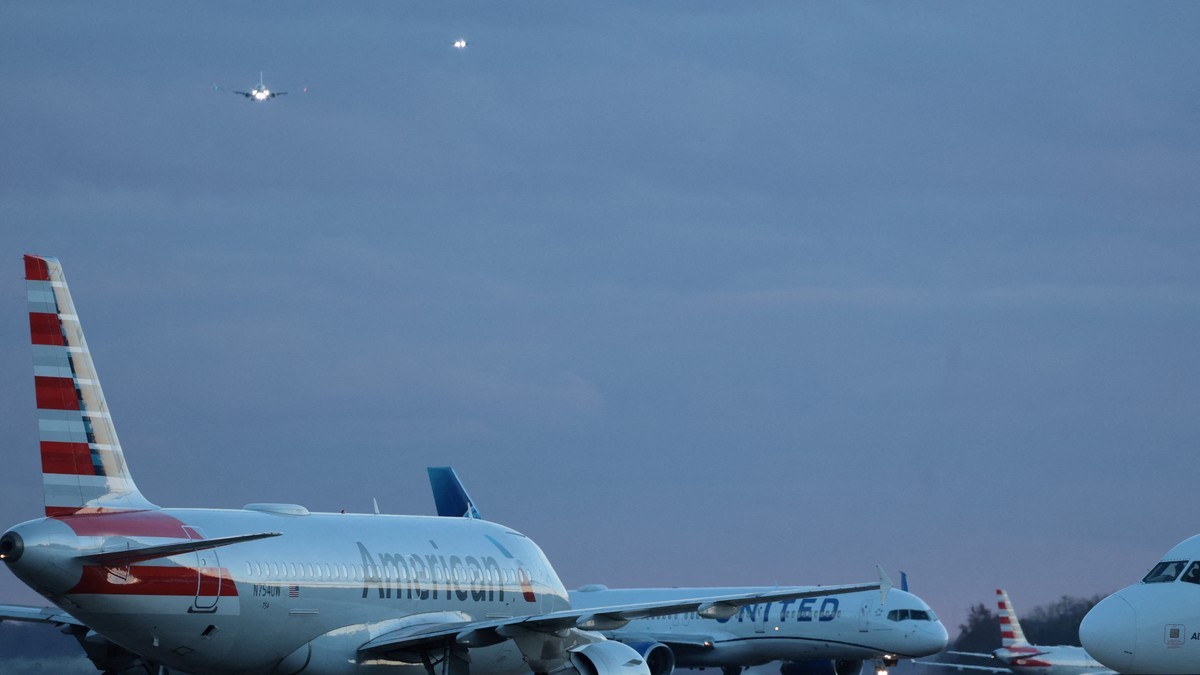
Reopening airspace does not put aircraft where they were supposed to be, and by late Friday the airlines were saying so in unison. Delta "has resumed all scheduled flights," according to CNN's live coverage, while warning of disruption into the weekend. United resumed "some Friday night flights" and issued a travel waiver, saying diversions had occurred "due to the number of airplanes on the ground at our hubs." American said it was "operating as many remaining flights as possible this evening while positioning the airline for the strongest possible recovery in the days ahead," and opened free changes through its travel alert page. JetBlue took the harder line, cancelling the remainder of Friday's flying except its European routes, plus some Saturday services, to get crews and aircraft into place; its own alert page says it "plans to resume flights on Saturday morning." LiveNOW from FOX reported that Europe had suspended all United States-bound flights. Duffy said larger aircraft were being prioritised over "smaller movements."
The Question Thanksgiving Will Answer
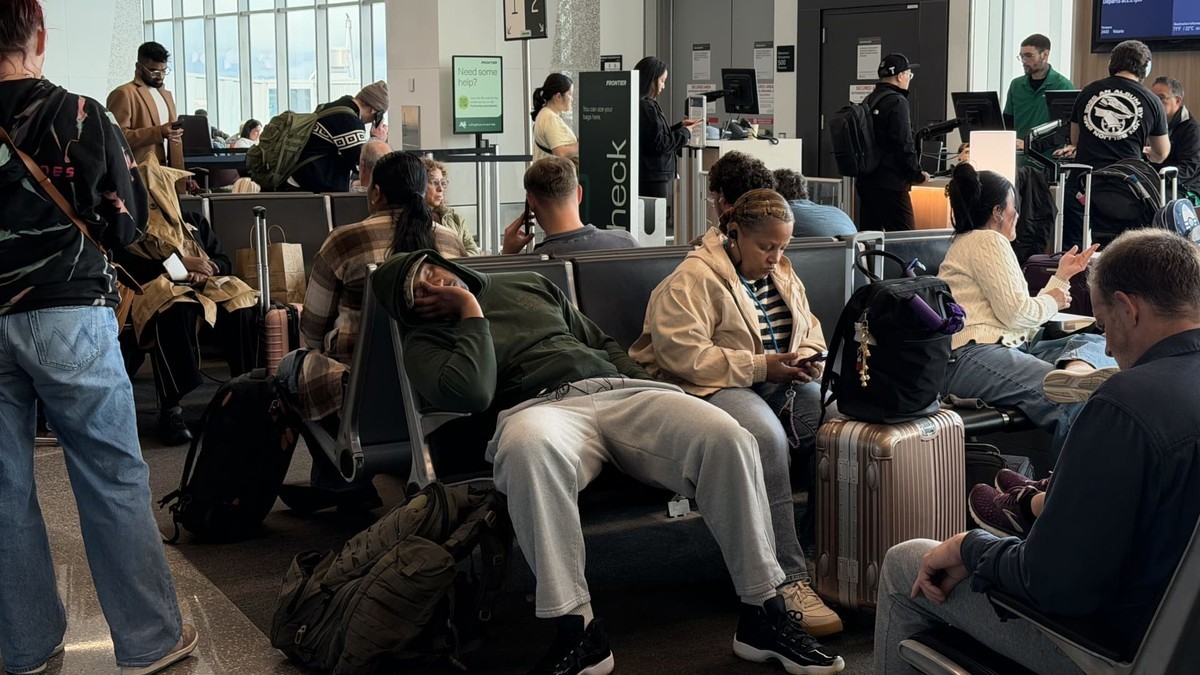
Thanksgiving falls on November 26 this year — thirteen days after the shutdown and twelve days out — and it is the single busiest test the system faces. Duffy was asked directly whether the outage would reach it. His answer was a prediction, not a guarantee. "It's going to take us some time to get back to capacity and then get people who were disrupted over the course of the last eight hours, to get them back to their destination," he said. "I would imagine a lot of, my kids are flying next Friday back from college, I imagine that's what a lot of kids are flying and everyone starts their Thanksgiving travel ... I think we're going to be back up and operational as we come in to the heat of travel during Thanksgiving." The arithmetic he is betting against is not small: Cirium counted 1.5 million passengers on Friday afternoon's schedule alone, and the backlog from a four-hour national stop does not clear in a night.
What Still Has Not Been Explained
Four questions survived the briefing. No facility has been named — not the centre where the instability started, not the tracons that followed it. No vendor has been named, and no explanation offered for how a network carrying the country's air traffic control data could be saturated by its own traffic without an earlier alarm. No redundancy has been described: not what backup path existed, and not why it did not carry the load once the primary began returning inconsistent data. And no repair has been dated. The FAA's own statement still carries the line "This information is preliminary and subject to change" — appropriate for a fault under investigation, less so for a system that Duffy has said will fail again and that Mullin says needs "a complete overhaul." Duffy put that part more memorably than any reporter could: "We didn't think we would have this kind of outage. We did."
By Jessica Ali, Staff Writer
This article was produced with AI-assisted research and editorial support. Sources: Federal Aviation Administration statement on the nationwide ground stop (13 November 2026) and FAA posts on X; Department of Homeland Security release of remarks by Secretary Markwayne Mullin and Secretary Sean Duffy; Associated Press; Reuters; CNBC; BBC News live coverage; CNN live coverage; The Hill; Aviation Week; Los Angeles Times; DW; LiveNOW from FOX; Al Jazeera live coverage; FlightAware and FlightRadar24 figures as carried by those outlets; Cirium figures as carried by the Associated Press and CNBC; airline statements from Delta, United, American and JetBlue. Cover: Global 1 News editorial image. Photographs: Jonathan Ernst/Reuters via DW; Getty Images via CNN; CNBC.
What's Your Reaction?
 Like
0
 Dislike
0
 Love
0
 Funny
0
 Wow
0
 Sad
0
 Angry
0

Editor-in-Chief at Global1.News. Atlanta-based journalist who cuts through the BS and tells it like it is. Lead anchor, host, and the voice you hear when the spin stops and the truth starts.













Comments (0)