
Russian Missile Crashes in Poland Amid Ukraine Assault
A Russian Kh-101 cruise missile crashed in eastern Poland during an overnight assault on Ukraine, leaving a 10-meter crater near Tarnawa-Kolonia. Prime Minister Donald Tusk confirmed the weapon was Russian, and NATO scrambled jets and pledged to take all necessary measures to defend allies.
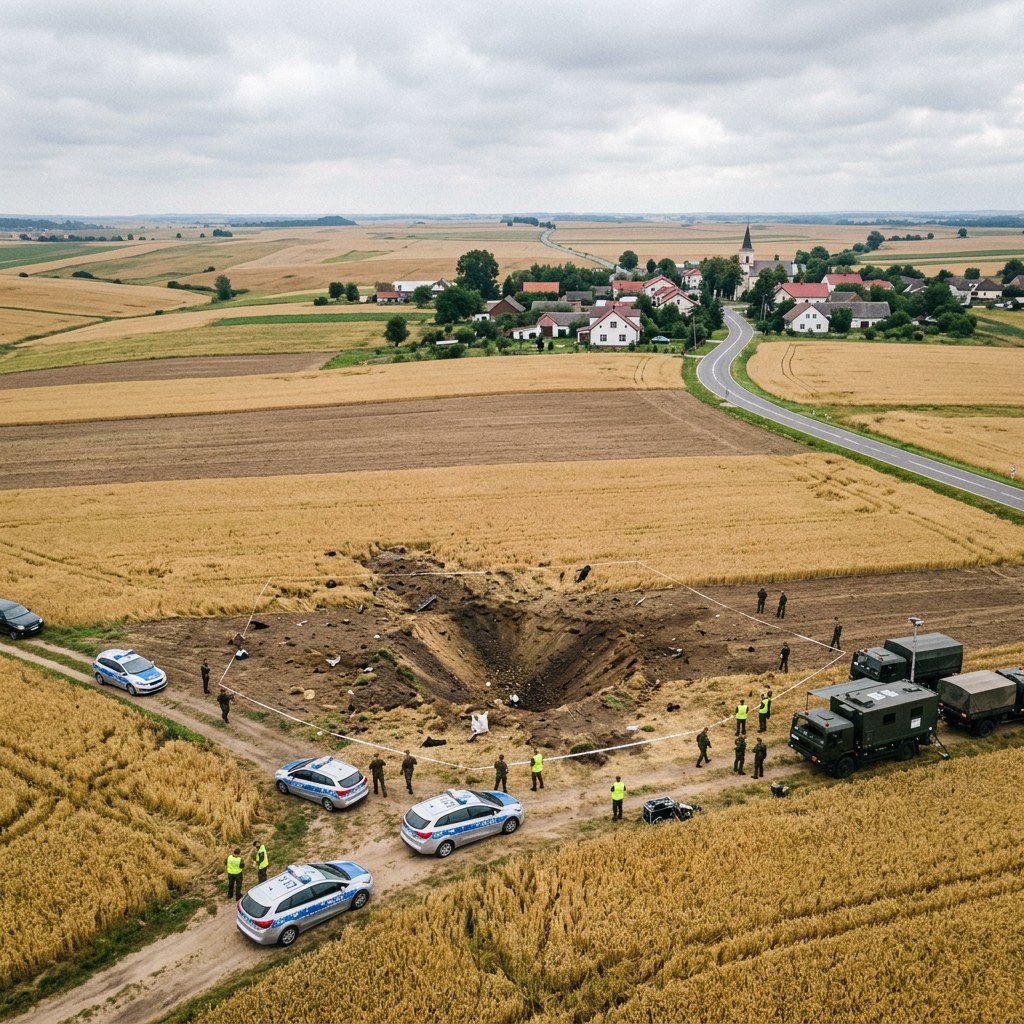
A Russian Kh-101 cruise missile crashed in a field in eastern Poland overnight during a mass Russian air assault on neighboring Ukraine, NATO and Polish officials said Thursday. The weapon came down near the village of Tarnawa-Kolonia in Lublin province, leaving a crater about 10 meters wide roughly 2 kilometers from residential buildings. Polish Prime Minister Donald Tusk confirmed the missile was Russian and said Warsaw was ready to destroy it had it continued its flight.
Russian Missile Crashes in Poland Amid Ukraine Assault
Warsaw, Poland – Thursday — A Russian missile struck NATO territory this week in the latest known Russian missile to cross into Polish airspace since the full-scale invasion of Ukraine began — and the first confirmed to have crashed on NATO soil. The missile landed in a sparsely populated corner of eastern Poland during an overnight barrage that killed at least eight people in western Ukraine, triggering an emergency response from Polish and NATO fighter jets, high-level military consultations, and new questions about the alliance's ability to protect its eastern flank.
The Crash in Tarnawa-Kolonia
The first indication of trouble came before dawn. The operational command of Poland's armed forces said on X that "an unidentified object moving westward was detected in Polish airspace," adding that it disappeared from radars soon after it was seen at 3:40 a.m. local time. A Mi-24 helicopter that went to the object's last location to verify the radar data identified the probable crash site in an undeveloped area near the village of Tarnawa-Kolonia in Lublin province.
The interior ministry said the object left a crater about 10 meters (33 feet) wide. According to local authorities, the site was farmland about 2 kilometers (1.2 miles) from residential buildings. Police in the Lublin region said they received a report of a loud bang in Bilgoraj county, between the villages of Tarnawa-Kolonia and Biskupice, and officers discovered "a crater and scattered debris from an unidentified object in a field located about 2 kilometers from the nearest buildings." Sirens sounded in Lublin for a few minutes to warn against possible strikes, media reported. Tusk later rushed to the site of the incident.
'All Indications' Point to a Kh-101
Speaking at an emergency meeting, Prime Minister Donald Tusk said all indications pointed to a Russian Kh-101. "We want to be 100% certain about the type of missile and who launched it," he said. "There was no direct threat because the missile landed in an uninhabited area. We were ready to shoot it down had it continued its flight."
Ukraine's Foreign Minister Andrii Sybiha said earlier in a post on X that a Russian Kh-101 cruise missile had crossed into Poland. Poland's defense minister separately confirmed that a missile had fallen on Polish territory and said "it looks like" it was a Russian Kh-101. Tusk later confirmed the missile was Russian and said he was in touch with European Union and U.S. leaders. The Kh-101 is an air-launched cruise missile carried by Tu-95 strategic bombers and used in long-range strikes against Ukraine; it flies at subsonic speed.
A Night of Strikes Across Ukraine
The crash came during a Russian air assault that extended as far west as the city of Lviv. At least eight people were killed in Ukraine in the strikes, according to Ukrainian authorities. Warsaw said Ukrainian jets attempted to destroy Russian missiles before any of them crossed into Poland. According to a NATO official cited by Business Insider, the missile flew for six minutes before crashing roughly 60 miles deep into Polish territory — significantly farther than any previous Russian missile breach.
The overnight attack appeared to be part of a broader pattern of long-range strikes that have become a near-daily feature of the war. The strike on Lviv, in particular, underscored the reach of Russia's campaign and the proximity of the fighting to NATO's border.
NATO's Response
NATO quickly moved to reassure allies and demonstrate readiness. A NATO spokesperson said the alliance "will take all necessary measures" to defend allies. NATO members, including Poland, launched F-16 fighter jets, an aerial refueling aircraft, and an airborne early warning plane in response to the sighting of the missile, the spokesperson said.
NATO said that Supreme Allied Commander Gen. Alexus G. Grynkewich spoke with Poland's Chief of the General Staff Gen. Wiesław Kukuła on Thursday to discuss the response to the incident. Prime Minister Tusk, meanwhile, spoke with European Union and U.S. leaders. The consultations reflected the gravity of a situation in which a Russian weapon entered and detonated on NATO territory.
Russia's Silence
The Russian Embassy in Warsaw did not respond to an emailed request for comment, and the Kremlin remained silent hours after the missile was identified. In the past, Moscow has dismissed Polish reports of airspace violations as anti-Russian provocation, and state media have generally avoided detailed coverage of such incidents.
For analysts, the silence is part of a familiar pattern in which Russian officials decline to engage with incidents that complicate the Kremlin's narrative of the war. Any admission that a Russian missile struck NATO territory would undercut Kremlin claims that the invasion carries no direct risk for the West. Analysts suggest Russian state media may present the crash as a Polish provocation or a Ukrainian attempt to drag NATO into the conflict, echoing the Kremlin's line that Western support for Ukraine makes the alliance a de facto party to the war.
Echoes of Przewodow
Poland has experienced this kind of incident before, though with a different outcome. In November 2022, a Ukrainian S-300 air defense missile struck the village of Przewodow near the Ukrainian border, killing two people during a Russian barrage. Kyiv initially blamed Russia, but a Polish investigation concluded the weapon was a stray Ukrainian anti-air missile — the first foreign missile to hit NATO territory during the war. NATO did not invoke Article 5, its collective defense clause, and the incident faded after several weeks of diplomatic friction.
In late December 2023, a Russian missile briefly entered Polish airspace during a mass strike on Ukraine before turning back. Warsaw demanded an explanation from Moscow at the time; no satisfactory response was given. This week's crash, however, involved a Russian missile flying deep into NATO territory before hitting the ground — a scenario that alliance planners have long feared.
Tensions on NATO's Eastern Flank
Poland has spent much of the past decade preparing for such an incident. Last year, it added deployments to its air defenses in response to the threat, and Polish authorities have regularly detected Russian missiles and drones in or near Polish airspace during strikes on Ukraine. The country shares borders with Ukraine, Belarus, and Russia's Kaliningrad exclave, making it one of NATO's most exposed members.
NATO has reinforced its eastern flank since Russia's annexation of Crimea in 2014 and, after the February 2022 invasion, deployed additional battlegroups and air defense assets to allies bordering Russia and Ukraine. The alliance's integrated air defense system, however, remains challenged by cruise missiles, which fly at low altitudes and can maneuver. Thursday's incident could accelerate Polish and allied investments in lower-tier air defense and electronic warfare systems.
Analysis and Implications
Analysts suggest the incident could mark a new phase in the war's direct risks to NATO territory. A Russian missile that flies 60 miles into a member state's airspace and detonates on farmland is precisely the kind of accident that could escalate into a broader confrontation.
The question for NATO is how to respond without escalating. Alliances by design avoid showing weakness; they also avoid direct combat with a nuclear-armed adversary. "All necessary measures" is a deliberate phrase that leaves room for interpretation, but officials on Thursday emphasized readiness and resolve rather than immediate retaliation.
For ordinary Russians, the war remains a distant but costly reality, and this incident is unlikely to change that at home. State media may present the crash as a Polish provocation or a Ukrainian attempt to drag NATO into the war. But the geopolitical effect will be felt across Europe, where the incident reinforces the consensus that NATO's eastern flank must be reinforced further.
The coming days will show how far the alliance is prepared to go. Poland will likely press for an official explanation from Moscow, though none is expected. What is clear is that the war in Ukraine no longer stops at the Polish border; it has, at least once, landed on it.
By Irina Volkov, Staff Writer
This article was produced with AI-assisted research and editorial support. Reporting is based on sources cited in the article.
What's Your Reaction?
 Like
0
Like
0
 Dislike
0
Dislike
0
 Love
0
Love
0
 Funny
0
Funny
0
 Wow
0
Wow
0
 Sad
0
Sad
0
 Angry
0
Angry
0

Russia/Eastern Europe Correspondent at Global1.News. Covering Russian politics, energy, security, and the shifting dynamics of the post-Soviet space. Provides clear-eyed analysis on one of the world's most opaque regions.














Comments (0)