
Russia Extends Fuel Export Ban Through January 2027
Russia extends gasoline and diesel export ban through January 2027 as Ukrainian drone strikes cripple refineries, with fuel prices surging 18 percent and two-thirds of regions reporting supply shortages amid a deepening economic crisis.
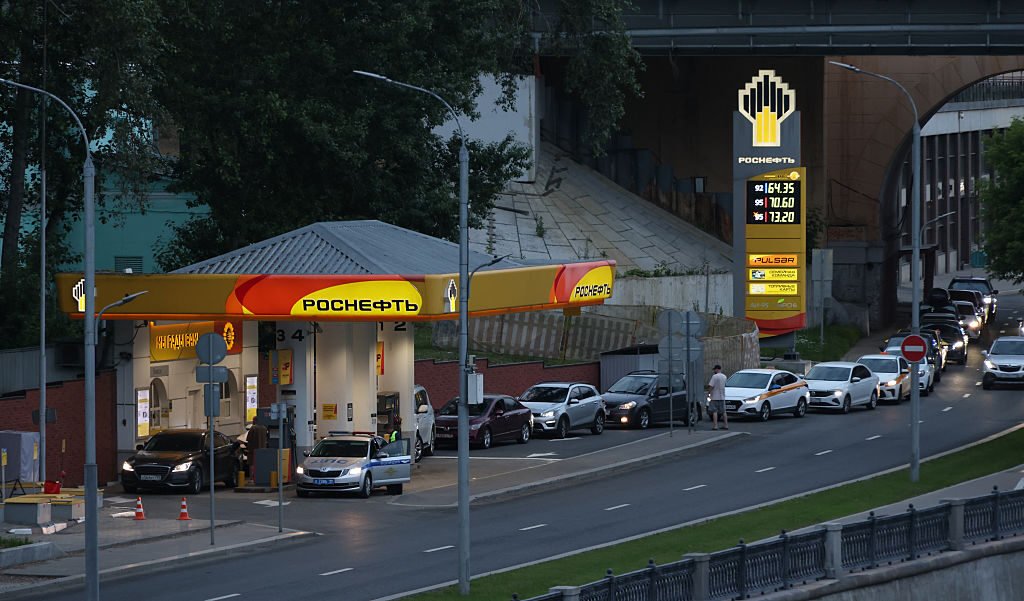
Russia has extended its ban on gasoline and diesel exports through January 31, 2027, in the latest sign that the Kremlin's fuel crisis is far from over. The decree, signed by Prime Minister Mikhail Mishustin's cabinet on Thursday, takes effect August 1 and comes as the country's refining sector reels from sustained Ukrainian drone strikes that have knocked out a quarter of processing capacity.
Russia Extends Fuel Export Ban as Drone Campaign Cripples Refining Sector
Moscow, Russia — The Russian government announced Thursday that it will extend its ban on gasoline and diesel exports through January 2027, acknowledging that the country's deepening domestic fuel crisis shows no signs of abating. The new restrictions, set to take effect August 1, replace an earlier ban that was set to expire at the end of July.
New Decree and Its Exceptions
The decree, reported by state news agency TASS on July 30, imposes a temporary export ban on fuels from August 1, 2026, through January 31, 2027. However, starting September 1, the restrictions will ease for direct producers — refineries will be permitted to export diesel, marine fuel, and gas oils, while retailers remain barred from exporting.
This carve-out represents a deliberate policy choice: Moscow wants to keep retail prices under control while allowing its state-aligned energy giants to continue generating hard currency from refined product sales. Russia earlier banned exports of jet fuel in a separate decree that expires in November, further squeezing the country's aviation sector.
Deputy Prime Minister Alexander Novak, the Kremlin's point man on energy policy, has been the public face of the government's response. Novak stated earlier this month that the export restrictions are necessary "to stabilize the fuel situation and meet domestic market needs," according to TASS. He also noted that a number of resellers were "using the situation to cash in by raising prices."
Ukraine's Drone Campaign: The Root Cause
The fuel crisis traces its origins to August 2025, when Ukraine dramatically escalated its campaign of long-range drone strikes against Russian oil infrastructure. What began as targeted attacks has evolved into a systematic campaign that has taken an estimated 25 percent or more of Russia's refining capacity offline, according to energy analysts cited by Fortune.
This week alone, Ukraine's military struck two major refineries. On July 29, Ukrainian forces hit the Lukoil-Permnefteorgsintez refinery in the city of Perm, one of Russia's largest processing facilities. The same day, a drone strike targeted the Ryazan refinery, pushing Russia's crude processing to a 21-year low of 3.91 million barrels per day.
The scale of the disruption is historic. The independent outlet The Insider reported that in 2026, Ukraine's military managed not only to scale up its campaign against Russian oil refining across all of European Russia but also to expand the strike zone to Siberia. Politico reported that two-thirds of Russia's regions are now reporting fuel supply issues, affecting millions of Russians.
Impact on Ordinary Russians
For the average Russian, the crisis has become impossible to ignore. The retail price of gasoline hit a record 72.50 rubles per liter on July 20, according to GlobalPetrolPrices.com — an increase of 18.3 percent since January. Diesel prices have surged even more sharply, rising 20.2 percent over the same period.
Lines of cars stretching for kilometers have become a common sight at gas stations in affected regions. In Kaliningrad, the Russian exclave on the Baltic Sea, fuel shortages have left motorists waiting hours to fill their tanks. Crimea, the peninsula annexed from Ukraine in 2014, declared a state of emergency over fuel shortages in June 2026.
Fortune magazine reported this month on the human toll: a mother and her baby stranded without fuel, unable to reach medical care. The shortages are hitting provincial Russia hardest — areas far from Moscow and St. Petersburg where alternatives are scarce and the state's distribution networks are stretched thin by wartime logistics demands.
Economic Stagflation: The Broader Picture
The fuel crisis is compounding a broader economic deterioration that economists are increasingly describing as stagflation. The Central Bank of Russia cut its key interest rate by 25 basis points to 14 percent on July 24 — a symbolic reduction that masks deeper structural problems.
In its accompanying statement, the central bank warned that "pro-inflationary risks prevail" over the forecast horizon. It raised its 2026 inflation forecast to a range of 6.0 to 7.0 percent, up sharply from the previous projection of 4.5 to 5.5 percent. The bank attributed this shift primarily to the surge in fuel prices.
At the same time, Russia's GDP growth forecast has been slashed to between 0.0 and 1.0 percent — near zero — a dramatic collapse from the 4.1 percent rebound Russia recorded in 2023. The combination of rising prices and stagnant output is the classic definition of stagflation, a condition Russia has not faced since the turbulent 1990s.
The central bank maintained that inflation is expected to return to its 4 percent target in 2027, but analysts are skeptical. Commerzbank described the rate cut as raising "credibility risks" for the central bank, noting that cutting rates while inflation is accelerating is an unusual policy choice that signals the Kremlin is prioritizing political stability over monetary discipline.
Russia's Energy Export Dilemma
The export ban creates a fundamental tension in Russia's wartime economy. Russia is the world's second-largest diesel exporter after the United States, with average diesel exports of roughly 805,000 barrels per day in 2025. The revenue from these exports is critical for funding the war in Ukraine.
By banning exports, Moscow is sacrificing hard-currency revenue to keep its domestic population from revolting over fuel prices. It is a classic wartime trade-off: the Kremlin needs its citizens to endure the war economically, but pushing fuel prices too high risks triggering the kind of domestic unrest that could destabilize the regime.
The carve-out allowing refineries to export diesel starting September suggests Moscow is trying to have it both ways — maintaining some export revenue while signaling to domestic consumers that the state is acting to control prices. Whether this balancing act can hold through the winter heating season remains an open question.
Kremlin's Political Calculus
For the Kremlin, the fuel crisis presents a delicate political challenge. President Vladimir Putin has built his legitimacy on two pillars: restoring Russia's great-power status and delivering rising living standards. The war in Ukraine has already eroded the second pillar through sanctions, inflation, and labor shortages. The fuel crisis threatens to shatter it entirely.
The decision to extend the export ban through January suggests the government expects the crisis to persist through the winter — a politically sensitive period when heating fuel demand peaks and public tolerance for shortages typically diminishes. Analysts suggest the Kremlin is betting that the combination of export controls and price caps will be enough to prevent the kind of protests that toppled other post-Soviet governments during fuel price spikes.
Deputy Prime Minister Novak's pointed criticism of resellers "cashing in" on the crisis signals that the Kremlin is also preparing a narrative that blames middlemen and speculators rather than acknowledging the structural damage from Ukraine's drone campaign. This is a familiar playbook: when the state cannot solve a problem, it finds someone to blame.
Analysis and Implications
The extension of the fuel export ban through January 2027 is, in effect, an admission that Russia's refining sector cannot recover on any foreseeable timeline. Each Ukrainian drone strike resets the clock on recovery, and Ukraine has shown no sign of relenting in its campaign against Russian energy infrastructure.
The broader implication is that Russia's war economy is entering a new phase of structural degradation. The fuel crisis is not a temporary disruption — it is a consequence of the war itself, and it will persist as long as the war does. Every sector of the Russian economy, from agriculture to aviation to logistics, depends on affordable fuel. As the crisis deepens, its effects will ripple outward, accelerating the stagflationary spiral that now grips the Russian economy.
What comes next depends on two variables: Ukraine's willingness and ability to sustain its drone campaign against Russian refineries, and the Kremlin's capacity to maintain social stability in the face of rising prices and persistent shortages. On both fronts, the outlook for the remainder of 2026 is grim.
The export ban extension buys Moscow time but not a solution. Without a ceasefire that halts the drone strikes — or a technological breakthrough that protects refineries — Russia's fuel crisis will deepen as winter approaches, testing the resilience of both the Russian economy and the political system that depends on it.
By Irina Volkov, Staff Writer
This article was produced with AI-assisted research and editorial support. Reporting is based on sources cited in the article.
What's Your Reaction?
 Like
0
Like
0
 Dislike
0
Dislike
0
 Love
0
Love
0
 Funny
0
Funny
0
 Wow
0
Wow
0
 Sad
0
Sad
0
 Angry
0
Angry
0

Russia/Eastern Europe Correspondent at Global1.News. Covering Russian politics, energy, security, and the shifting dynamics of the post-Soviet space. Provides clear-eyed analysis on one of the world's most opaque regions.











Comments (0)