
Rewilding Patagonia: How Chile's Boldest Conservation Gamble Is Paying Off
In the far south of the American continent, where the Andes crumble into fjords and the wind never fully rests, a quiet revolution is unfolding. It is a revolution measured not in political victories but in the return of pumas to valleys they once ruled, in the slow regrowth of ancient grasslands, and in the fragile first steps of a huemul fawn born inside a brand-new rescue center. This is the story of how a pair of visionary entrepreneurs spent $345 million of their own...
In the far south of the American continent, where the Andes crumble into fjords and the wind never fully rests, a quiet revolution is unfolding. It is a revolution measured not in political victories but in the return of pumas to valleys they once ruled, in the slow regrowth of ancient grasslands, and in the fragile first steps of a huemul fawn born inside a brand-new rescue center. This is the story of how a pair of visionary entrepreneurs spent $345 million of their own fortune to buy back some of the most inhospitable land on Earth—and then gave it all away. It is also a story with urgent global stakes: three-quarters of all land on Earth is now significantly affected by human activity, and 60 percent of the world's animals have been wiped out since the 1970s. Against that grim backdrop, Chile's Patagonia has become the world's most ambitious counterargument—a living proof that ecosystems, given the chance, can heal themselves.
Rewilding Patagonia: How Chile's Boldest Conservation Gamble Is Paying Off
Coyhaique, Aysén Region – Chile, August 12, 2026 — Fresh milestones keep arriving from Chile's Aysén Region: a world-first huemul rescue center opened beside Cerro Castillo National Park in October 2025, three Andean condors were released over Patagonia National Park in January 2026, and 16 guanacos began a breeding program in the Central Andes the same fall.
The World's Boldest Rewilding Experiment
When Kris McDivitt Tompkins, the former CEO of the clothing brand Patagonia, and her late husband Doug Tompkins—the founder of Esprit and The North Face—began buying vast tracts of Chilean land in the 1990s, they were dismissed as eccentric billionaires with a quixotic dream. Critics called it a land grab, a foreign intrusion, a folly. But the Tompkins had a different vision: not to own the land for themselves, but to restore it to a state of wildness it had not known for over a century, and then hand it over to the Chilean people. That vision culminated in what is now recognized as the biggest land donation in history. The Tompkins handed 400,000 hectares to the Chilean state to be run as a national park, alongside four million hectares contributed by the state, creating a total 4.5-million-hectare park network. It was a gamble of staggering proportions—a bet that conservation could be a national economic engine, not a cost. Today, that bet is paying off. Rewilding Chile, the organization formerly known as Tompkins Conservation's Chile arm (renamed in 2021), has overseen the creation of seven national parks, the expansion of three more, and the donation of over 1.2 million acres of land. In total, more than 11 million acres are now under protection, with eight species actively monitored. The vision, crafted in 2014, is the Route of Parks of Chilean Patagonia—a corridor of protected areas designed to make conservation-based tourism the region's primary economic driver.
Fences Down, Ecosystems Reborn: How Rewilding Works
Rewilding is not simply about planting trees or protecting a single charismatic animal. It is a holistic science, a restoration of an entire ecosystem to its natural state by removing foreign species while reintroducing and protecting native ones. The logic is elegant and cascading. Removing livestock lets vegetation flourish, which brings back insects, which attract birds, which support small predators. Removing fences allows the return of herbivores like guanacos, and when herbivores return, apex predators multiply. The result is a self-sustaining wilderness that requires minimal human intervention. Kris McDivitt Tompkins explains the core principle with characteristic clarity: "Predators have been systematically persecuted for decades and decades, so their numbers get precariously low... if you take out the very top predator, everything cascades down from that, and comes out of order." The physical act of removing fences is almost symbolic in its power. "When you take the fences down you see wildlife coming back in, because for 80 years it's been excluded from the best grasses," she says. "It's very exciting to see the grasslands and the forests begin to restore themselves." In Patagonia National Park, the results are visible on the ground: pumas, guanacos, and foxes are returning to territories where they were hunted to near-extinction. The grasslands are thickening, the forests are regenerating, and the entire food web is knitting itself back together.
The Huemul: Chile's National Symbol on the Brink
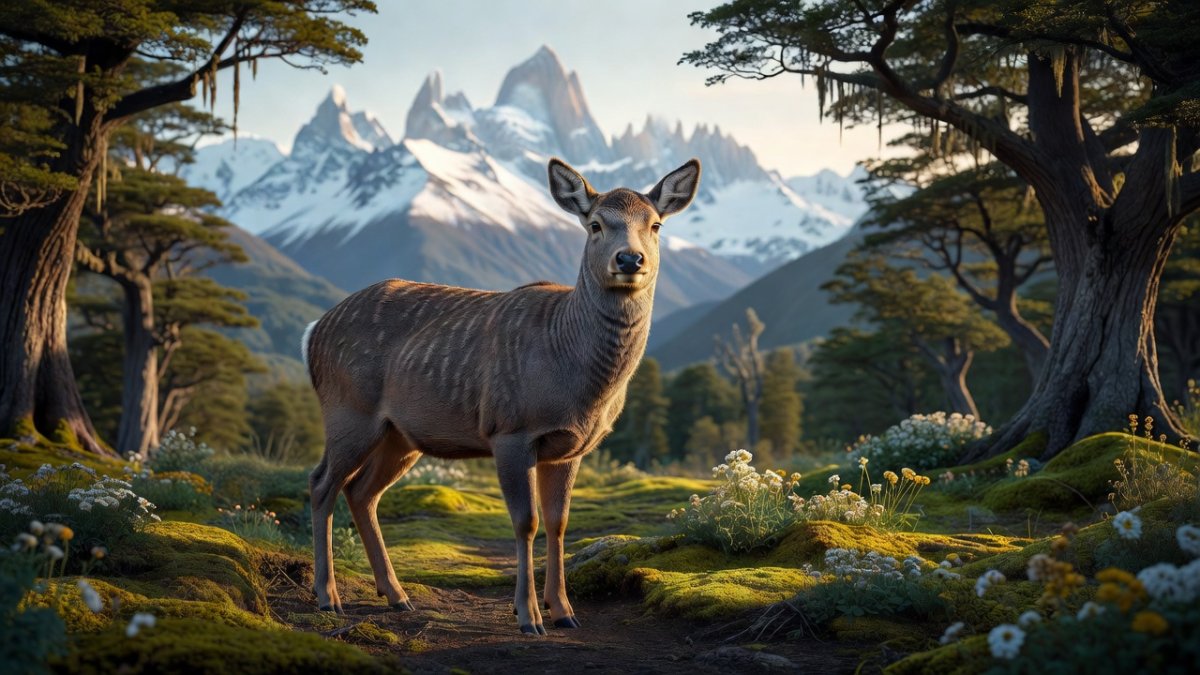
No species embodies the stakes of rewilding more than the huemul (Hippocamelus bisulcus), the South Andean deer that appears on Chile's coat of arms. This is not a symbolic honor—it is a desperate plea. Only about 1,500 huemuls remain, scattered in fragmented populations across Patagonia, having lost 99 percent of their historic population. They are among the world's most endangered mammals, threatened by habitat loss, hunting, livestock-transmitted disease, road accidents, dog attacks, and displacement by exotic species like wild boar and red deer. In 2022, the journal Ecography identified the huemul as one of 20 crucial species to lead global ecosystem restoration—a recognition that saving this deer means saving an entire landscape. In October 2025, Rewilding Chile inaugurated the world's first Huemul Rescue and Rehabilitation Center, adjacent to Cerro Castillo National Park, which is home to 10 percent of the remnant population. The 12-acre site includes a clinic, quarantine area, pre-release pens, and housing for wildlife rangers. Its first priority is treating caseous lymphadenitis (Corynebacterium pseudotuberculosis), a livestock-transmitted disease that has devastated huemul populations. Kristine Tompkins, speaking at the inauguration, framed the mission in moral terms: "We must never give up on the most vulnerable. In this case, the huemul deer is not only a symbol of Chile, but a key player in the restoration of its ecosystems." Since 2023, the Huemul Corridor—a large-scale conservation strategy led by Rewilding Chile with the Ministry of Agriculture, CONAF, and SAG—has been working to connect these fragmented populations.
Condors Return to Patagonian Skies
If the huemul is the symbol of Chile's fragility, the Andean condor is its symbol of wild majesty. And for the first time in decades, condors are reclaiming Patagonian skies. Project Manku, led by Fundación Rewilding Chile (FRC), Filantropía Cortés Solari (FCS), and Aves Chile (UNORCH) via the Raptor Rehabilitation Center (CRAR), has been running since the first condor release in 2014. Supported by the National Zoo, SAG, CONAF, Bioamérica Consultores, and LATAM airlines, the project has released 24 Andean condors in total, 20 of them fitted with satellite transmitters. Nearly all have integrated into local condor populations across Chilean and Argentine territory. In January 2026, three more young condors were released in Patagonia National Park in the Aysén Region. "Carmen," a female born in captivity in 2023, was joined by "Auquinco," a male rescued from Lago Ranco, and "Farellón," a male rescued from the mountains of the Metropolitan Region. Transported in October 2025 via the LATAM Solidarity Flight Program, they spent three months in acclimatization before their release, each carrying satellite and radio transmitters. Eduardo Pavez, Project Manku Director, notes the difference between Patagonia and central Chile conditions—the vast, open landscapes of the south offer a more forgiving environment for young condors learning to soar. Cristián Saucedo, Wildlife Director of Rewilding Chile, puts it simply: "Condors play a key role in nature. They are the scavengers of the Andes..." Francisca Cortés Solari, Executive President of FCS, points to the satellite monitoring that has tracked these birds since 2019, providing unprecedented data on their movements and survival.
Guanacos: Restoring a Keystone Across the Andes
The guanaco, Chile's largest terrestrial mammal, is the keystone of the Patagonian steppe. Pre-Columbian populations numbered 30 to 50 million across a range stretching from northern Peru to Tierra del Fuego. Today, fewer than 600,000 remain in all of South America—nearly 90 percent of them in Argentina, with only about 66,000 in Chile, mainly in Magallanes. In Chile's Central Andes, the situation is catastrophic: only about 300 guanacos remain. In October 2025, Rewilding Chile took a decisive step to change that. Sixteen guanacos were relocated from a private estate in the Valparaiso Region to three nature sanctuaries—San Francisco de Lagunillas, Quillayal, and Cascada de las Ánimas in San José de Maipo, plus El Plomo in Lo Barnechea—to create guanaco breeding centers for eventual release in the Central Andes. The goal is nothing less than the restoration of a binational biological corridor: half a million acres of continuous territory connecting Chile's San José de Maipo and Lo Barnechea with Argentina's protected areas Volcán Tupungato and Laguna del Diamante. The project is a coalition of partners, including the University of Chile, the Metropolitan Region Sanctuaries Network (13 sanctuaries protecting 7 percent of the Metropolitan Region), the Santiago Regional Government (providing two years of funding), CONAF, the Ministry of Environment, and SAG. Sara Larraín, President of the Metropolitan Region Sanctuaries Network, calls it "a decisive step to prevent the local extinction of guanacos in central Chile... restore their role as a keystone species in the regeneration of wetlands, high-Andean meadows, and prairies, as well as in the conservation of emblematic species such as the puma and the condor."
What This Means for Latin America
The implications of Chile's rewilding experiment extend far beyond its borders. For Latin America—a region that holds a disproportionate share of the world's biodiversity but also faces intense pressure from agriculture, mining, and infrastructure—Patagonia offers a proof of concept. It demonstrates that conservation is not a luxury of wealthy nations but a strategic investment with measurable returns. The Route of Parks of Chilean Patagonia is already attracting tourists from around the world, creating jobs in communities that once depended on sheep ranching and logging. The model is being watched closely by other countries in the region, from Argentina's own rewilding efforts in Iberá to Brazil's Atlantic Forest restoration projects. But the challenges remain immense. The new Cape Froward National Park, at the southernmost point of the continent, 62 kilometers southwest of Punta Arenas, is a testament to the ambition—Chile has signed a protocol to create it, with Rewilding Chile donating the property. And after more than 20 years of land conservation, the organization is expanding into a Marine Program, creating new marine protected areas for ecological continuity. The logic is the same as on land: protect the whole, not just the parts. The huemul, the condor, and the guanaco are not isolated species; they are threads in a tapestry that includes the ocean, the mountains, and the sky. If Patagonia can be restored, so can other landscapes across the continent.
The Bottom Line — A Blueprint for the Continent
The data is unambiguous. When predators are protected, ecosystems rebalance. When fences come down, wildlife returns. When land is given back to nature, it does not become a wasteland—it becomes a thriving, self-sustaining wilderness that supports both biodiversity and human communities. Chile's boldest conservation gamble has paid off, not just in hectares protected or species saved, but in a fundamental shift in how we understand our relationship with the natural world. The Tompkins' $345 million investment has been leveraged into a 4.5-million-hectare park network, the largest land donation in history. Rewilding Chile has created seven national parks, expanded three more, and protected over 11 million acres. The huemul, once on the brink of extinction, now has a dedicated rescue center and a corridor strategy. The condor, once persecuted and poisoned, is soaring again over Patagonia. The guanaco, once reduced to a fraction of its historic range, is being reintroduced to the Central Andes. None of this was inevitable. It required vision, capital, political will, and an unshakeable belief that nature, given the chance, will heal itself. For Latin America—and for the world—Patagonia is not just a place. It is a blueprint. A demonstration that rewilding is not a dream but a practical, scalable solution to the biodiversity crisis. The fences are down. The predators are back. And the wilderness is returning.
This article was produced with AI-assisted research and editorial support. Sources: Al Jazeera English earthrise, Fundación Rewilding Chile, Tompkins Conservation.
By Elena Vasquez, Staff Writer
What's Your Reaction?
 Like
0
Like
0
 Dislike
0
Dislike
0
 Love
0
Love
0
 Funny
0
Funny
0
 Wow
0
Wow
0
 Sad
0
Sad
0
 Angry
0
Angry
0

Latin America Correspondent at Global1.News. Based in Mexico City, covering politics, economics, energy, and culture across the region. Brings an on-the-ground perspective to stories spanning from the Rio Grande to Patagonia.















Comments (0)