
Odisha Floods: 2.37 Lakh Evacuated as Baitarani River Threatens Double-Peak Disaster
Odisha floods: 2.37 lakh evacuated as Baitarani River threatens a double-peak disaster. Five lakh affected across five northern districts as IMD issues red warnings.
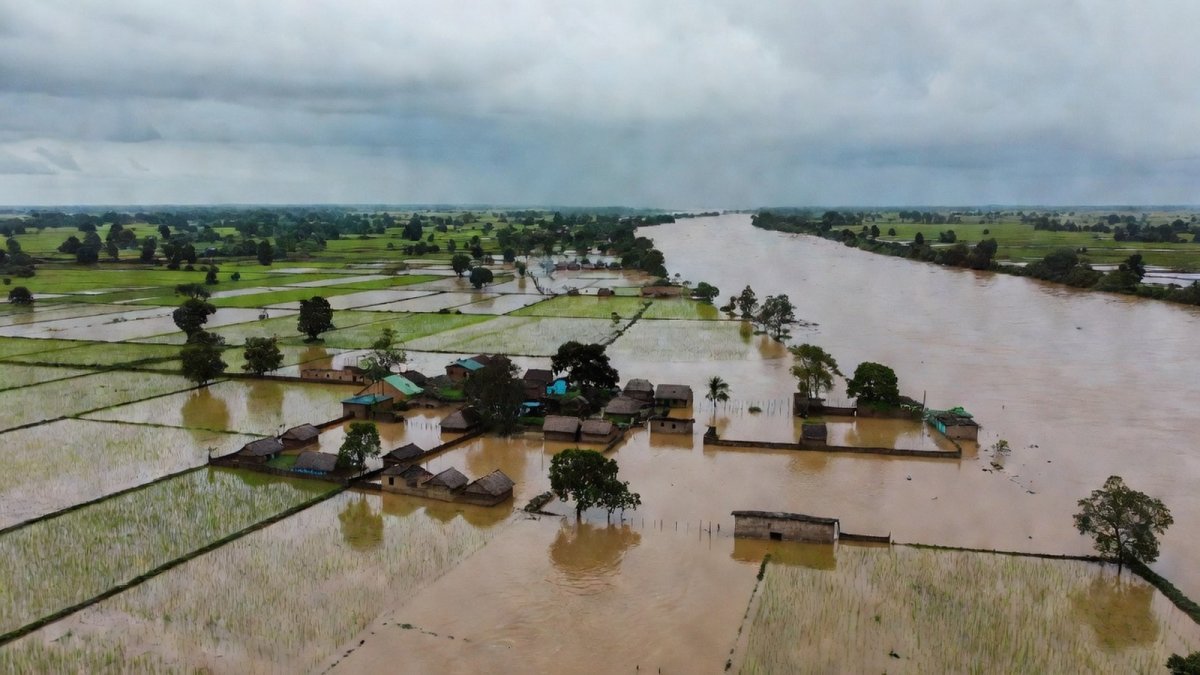
The flood sirens started wailing before dawn in Odisha's northern districts on Monday, and by first light, the scale of the disaster was already staggering: more than 500,000 people are now affected by rising rivers, and nearly a quarter-million have been pulled from their homes in a frantic overnight evacuation. The low-pressure system that had been churning over the Bay of Bengal intensified into a full depression by 5:30 a.m., and the India Meteorological Department is warning that the worst may still be ahead — with a second, potentially more dangerous peak on the Baitarani River projected to hit later this week.
Odisha Floods: 2.37 Lakh Evacuated as Baitarani River Threatens Double-Peak Disaster
BHUBANESWAR, Odisha - Monday, August 17, 2026
The flood situation in north Odisha remained grim Monday, with officials confirming that five lakh (500,000) people are now affected across 947 villages, 331 gram panchayats, 49 blocks, and five urban areas. The numbers, released by Chief Secretary Anu Garg, paint a picture of a region under siege from water - and the worst is not over yet.
Flood Waters Spread Across Five Northern Districts
The worst-hit districts are Balasore, Bhadrak, Jajpur, Mayurbhanj, and Keonjhar, where the Baitarani, Brahmani, Salandi, Jalaka, and Budhabalanga rivers - along with their tributaries - have inundated vast stretches of farmland and villages. Fresh flooding has affected around 5.15 lakh people in these areas, according to The New Indian Express, citing Chief Secretary Anu Garg.
The India Meteorological Department (IMD) has issued a red warning - the highest alert level, meaning "take action" - for very heavy to extremely heavy rainfall in Balasore, Keonjhar, and Mayurbhanj districts. An orange warning, meaning "be prepared," has been issued for Bhadrak, Jajpur, Kendrapara, Jagatsinghpur, Cuttack, Sundergarh, Jharsuguda, Sambalpur, Deogarh, Angul, and Dhenkanal. A yellow warning, meaning "be aware," covers Bargarh, Subarnapur, Boudh, Puri, Khordha, and Nayagarh.
Balasore town alone received 93.1 mm of rain until 5:30 a.m. Monday, according to IMD bulletins. The meteorological department has forecast heavy to very heavy rainfall for three consecutive days - August 16, 17, and 18. Chief Secretary Garg underscored the urgency: "These three days are crucial for the north Odisha districts."
The depression, which formed from a well-marked low-pressure area over the northwest Bay of Bengal and adjoining West Bengal-north Odisha coasts, was located about 80 km west-southwest of Satkhira in Bangladesh, 160 km southeast of Bankura in West Bengal, and 180 km northeast of Balasore in Odisha. The system is likely to move northwestwards toward Jharkhand across Gangetic West Bengal during the next 24 hours, the IMD said. A depression is stronger than a low-pressure system but less powerful than a tropical cyclone - yet its impact on the ground has already been severe.
Mass Evacuation Underway as Relief Camps Fill
More than 2.37 lakh (237,000) people have been evacuated to safety, according to The Hindu, with nearly 300 relief camps set up on river embankments and in schools. The New Indian Express puts the number of camps at 293. The discrepancy is minor; the human cost is not. Families have been moved from low-lying villages to higher ground, many carrying little more than documents and a few belongings.
Around 100 rescue teams have been deployed in vulnerable pockets of north Odisha, Chief Secretary Garg told The Hindu. The New Indian Express specifies the breakdown: 36 Odisha Disaster Rapid Action Force (ODRAF) teams, 7 National Disaster Response Force (NDRF) teams, and 47 Fire Services teams. Senior engineers from the Water Resources Department have been rushed to protect embankments, and three senior officers have been dispatched to Bhadrak, Jajpur, and Balasore to oversee operations.
The state government has cancelled leave for all employees, and district collectors have been put on high alert. The message from the top is clear: this is an all-hands-on-deck moment.
Chief Minister Mohan Charan Majhi is scheduled to visit the worst-hit Bhadrak and Jajpur districts Monday for an on-the-spot assessment. In a post on X, he wrote: "Ensuring swift assistance reaches the affected people and their safety is our topmost priority. Tomorrow morning, I will visit the flood-affected areas to directly assess the situation. Please follow the administration's directives and stay safe; the government is always with you."
A Second, More Dangerous Peak Is Coming
Perhaps the most alarming projection comes from the Central Water Commission (CWC), as reported by Argus English. Hydrological data indicates a double-peak flood pattern on the Baitarani River - the first crossing the danger mark around August 14-16, and a second, potentially more dangerous rise projected around August 19-21. This second peak would arrive after embankments, roads, homes, and fields are already waterlogged, leaving little room for absorption.
The Baitarani's danger level at Akhuapada in Bhadrak is 18.33 metres, and the river is already flowing above the danger mark at Anandapur in Keonjhar. The Subarnarekha River, by contrast, receded Sunday morning and was flowing below its danger level of 10.36 metres at Rajghat in Jaleswar, offering a sliver of relief in one area.
The double-peak scenario is a nightmare for disaster management officials. The first wave has already saturated the ground and weakened embankments. A second, stronger surge could breach defences that are already compromised. The CWC's projections suggest that the Baitarani basin - a known flash-flood zone - is facing a prolonged crisis rather than a single, sharp event.
Schools Shut, Exams Postponed as Life Disrupted
The flood has brought daily life to a standstill across the affected districts. Schools and educational institutions have been closed Monday in Bhadrak, Mayurbhanj, Keonjhar, and Balasore districts, according to official notifications. The closures are a precautionary measure, but for many students, the disruption goes deeper.
Around 400 students of a government-run residential school in Kendrapara district are stranded at their hostel after floodwater from the Brahmani river inundated the area. Rescue teams are working to reach them, but the water has made access difficult. The students are safe, officials said, but the situation remains fluid.
Utkal University has postponed fourth-semester examinations scheduled for August 17 for UG (+3), BSc ITM, BSc Computer Science, and B.Ed (UDTE) courses. The university has not yet announced revised dates, leaving thousands of students in limbo.
Infrastructure has also taken a hit. A stretch of the newly constructed NH-53 caved in due to heavy rains in Kendrapara on August 16, according to a PTI photo caption. A truck lay overturned in a ditch at the site, a stark visual of the road's sudden collapse. The highway is a critical artery for the region, and its failure will complicate relief efforts.
The Human Toll
NDTV reported Monday that a two-year-old girl died as depression-induced rainfall lashed Odisha, with flood fears looming large over the Baitarani. Officials said several others have been affected, but a consolidated death toll for this wave has not yet been released in the primary coverage. The state's preliminary figures for the broader late-July/August flood season had reached five deaths, per Odisha.plus reporting, including wall-collapse incidents in Rayagada and Dhenkanal districts.
Beyond the immediate loss of life, the economic damage is mounting. Standing crops have been damaged over more than 24,000 hectares in the broader season, according to preliminary state estimates. For a region where agriculture is the primary livelihood, this is a blow that will be felt for months, even after the waters recede.
The human impact is not just in numbers. It is in the families huddled in relief camps on river embankments, watching the water rise. It is in the parents who cannot reach their children stranded in hostels. It is in the farmers who have lost their standing paddy to the deluge. The officials on the ground are working around the clock, but the scale of the disaster is testing the limits of the state's response.
Why Baitarani Floods Keep Coming
Odisha has faced repeated flood waves through the 2026 monsoon season. Earlier in August, the Mahanadi River triggered evacuations of 1.65 lakh people in the July 30 wave, according to India Today. The northern rivers - the Baitarani, Brahmani, Salandi, Jalaka, and Budhabalanga - drain the Eastern Ghats and respond quickly to Bay of Bengal weather systems. When a depression forms over the bay, as it did this weekend, the runoff is swift and violent.
The Baitarani basin, in particular, is a known flash-flood zone. Its riverbanks are lined with embankments that have been breached repeatedly in strong monsoon years. The river's course through Bhadrak and Keonjhar is prone to sudden rises, and the CWC's double-peak projection suggests that this year's monsoon is testing the limits of the region's defences.
Climate scientists have long warned that warming ocean temperatures in the Bay of Bengal are intensifying monsoon systems, making events like this more frequent and more severe. For the people of north Odisha, that warning is no longer theoretical - it is the water lapping at their doorsteps.
What to Watch
The next 72 hours will be critical. The IMD has forecast heavy to very heavy rainfall through Tuesday, and the depression is expected to move northwestwards toward Jharkhand. The CWC's projection of a second Baitarani peak around August 19-21 is the single biggest concern. If that peak materializes, embankments that have already been weakened by the first wave could fail, leading to more widespread inundation.
Chief Minister Majhi's visit to Bhadrak and Jajpur Monday will be closely watched for announcements of additional relief measures. The state government has already cancelled leave for all employees and deployed rescue teams, but the coming days will test the adequacy of those preparations.
For those in the affected areas, the advice from officials is simple: follow the administration's directives, move to higher ground if instructed, and stay safe. For those watching from outside, the focus should be on the CWC's river-level bulletins and IMD warnings. The Baitarani is not done yet - and neither is this flood season.
Global1.News will continue to monitor the situation and provide updates as the depression moves inland and the second peak approaches. Our thoughts are with the families in the relief camps, the stranded students, and the rescue workers who are risking their own safety to save others.
This article was produced with AI-assisted research and editorial support. Sources: The Hindu, The New Indian Express, NDTV, India Meteorological Department.
By Jessica Ali, Staff Writer
What's Your Reaction?
 Like
0
Like
0
 Dislike
0
Dislike
0
 Love
0
Love
0
 Funny
0
Funny
0
 Wow
0
Wow
0
 Sad
0
Sad
0
 Angry
0
Angry
0

Editor-in-Chief at Global1.News. Atlanta-based journalist who cuts through the BS and tells it like it is. Lead anchor, host, and the voice you hear when the spin stops and the truth starts.















Comments (0)