
Netanyahu Quietly Approves Rafah Reconstruction Project Amid Deep Divisions Over Gaza's Future
Netanyahu and Katz quietly approved reconstruction of “Green Rafah” in eastern Rafah, a leveled area under Israeli control, for a residential project for Palestinians outside Hamas control, per Army Radio. The PM’s Office called the report distorted, citing a UAE pilot initiative. Netanyahu publicly rejected Trump’s 15-point Gaza plan, demanding Hamas disarmament. Hamas reaffirmed commitment to the roadmap. Gaza death toll exceeds 73,000 since October 2023.

Netanyahu Quietly Approves Rafah Reconstruction Project Amid Deep Divisions Over Gaza’s Future
JERUSALEM — In a move that underscores the widening chasm between Israel’s stated war aims and the diplomatic track being pushed by Washington, Israeli Prime Minister Benjamin Netanyahu and Defense Minister Israel Katz have quietly approved the reconstruction of a residential area in eastern Rafah, according to Israeli media reports on Sunday. The decision, first reported by Army Radio and relayed by Anadolu, comes as Netanyahu simultaneously and publicly rejected a 15-point peace plan endorsed by the Trump administration’s Board of Peace, insisting that Israeli forces will not withdraw from the Gaza Strip until Hamas is fully disarmed.
The approval for what Israeli media calls “Green Rafah” — a zone under Israeli army control along the so-called Yellow Line that separates Israeli-occupied territory from areas where Palestinians are permitted to move — marks a rare instance of Israel authorizing construction inside the enclave. But the project’s opaque approval process, its proposed administration by a multinational force, and the Prime Minister’s Office’s swift denial of the report’s details raise critical questions about who is actually governing Gaza’s reconstruction and under what conditions.
What Is ‘Green Rafah’ and Why Does It Matter?
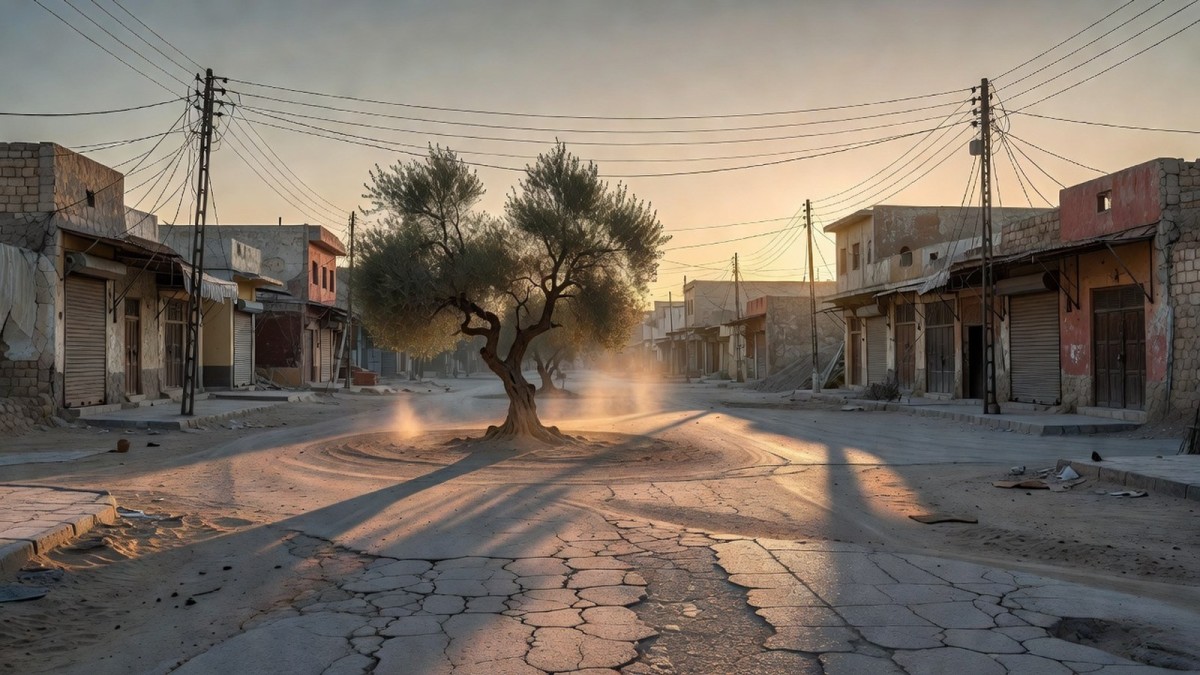
According to Army Radio, “Green Rafah” is a tract of land in eastern Rafah that has been “completely leveled and cleared and is currently empty.” The area sits within the Yellow Line buffer zone, a strip of territory that the Israeli military has effectively sealed off from the rest of the Gaza Strip. The radio report, citing Israeli security sources, said the infrastructure works approved by Netanyahu and Katz will allow contractors and workers to enter the area to carry out excavation and connect electricity, water, and sewage systems.
The significance of this location cannot be overstated. Rafah, the southernmost city in Gaza, has been the focal point of some of the most intense Israeli military operations since the ground offensive expanded in May 2024. The city’s eastern neighborhoods, including the border area with Egypt, have been systematically demolished, with the Israeli military carving out a wide buffer zone that has displaced tens of thousands of families. The approval of a residential project in this area — under Israeli military control — suggests a long-term Israeli footprint in a region that Palestinians and international mediators view as an integral part of a future Palestinian state.
The radio report stated that the area will be “under the control of a multinational force,” though it did not specify which countries or organizations would contribute to that force. This detail, if accurate, would represent a significant departure from previous arrangements in Gaza, where security control has been exclusively in Israeli hands since the 2005 disengagement.
Palestinian Contractors, Shin Bet Screening, and the Human Cost
Perhaps the most striking element of the Army Radio report is the claim that the contractors and workers who will operate in the area are Palestinians from Gaza. According to Israeli security sources cited by the outlet, these workers are currently undergoing security screening by the Shin Bet security agency to obtain approval to enter areas along the Yellow Line. They are expected to begin work within weeks, or shortly thereafter.
This detail paints a complex picture. On one hand, employing Palestinian workers from Gaza for reconstruction projects could provide much-needed income in an enclave where unemployment has reached catastrophic levels. On the other hand, the requirement for Shin Bet approval — an Israeli security agency that Palestinians widely view with suspicion and fear — underscores the extent to which any reconstruction effort remains under Israeli security control. The screening process itself, with no public criteria for approval or rejection, raises concerns about arbitrary exclusion and the weaponization of employment as a tool of control.
The Prime Minister’s Office, however, disputed key elements of the report. In a statement to Army Radio, Netanyahu’s office claimed the report “distorts the facts and republishes outdated information.” The office said the project is a UAE pilot initiative that has been underway for several months, and that the electricity, sewage, and water works will not be carried out by contractors from Gaza but will be supervised by the Israeli army.
The contradiction between the two accounts — one describing Palestinian contractors vetted by Shin Bet, the other describing direct Israeli army supervision — is not merely a matter of journalistic confusion. It reflects a deeper struggle over the narrative of who is rebuilding Gaza and under whose authority. The UAE’s involvement, first reported in various international outlets earlier this year, suggests that Gulf states are positioning themselves as key players in Gaza’s post-war reconstruction, even as the political framework for that reconstruction remains unresolved.
Netanyahu’s Public Rejection of the 15-Point Plan
The quiet approval of the Rafah project stands in stark contrast to Netanyahu’s public and emphatic rejection of the 15-point plan approved by the Board of Peace, a body established under US President Donald Trump’s framework for Gaza. In a video statement released Sunday after the start of a Cabinet meeting, Netanyahu declared: “Israel rejects the 15-point document published by the Board of Peace for Gaza. The Israeli army will not carry out any withdrawal until Hamas is disarmed.”
Netanyahu elaborated that disarmament must include “the heavy weapons, the less heavy weapons,” claiming that Israel wants “real disarmament, not fake disarmament.” He said Israel is holding talks with the US on the issue, adding that Washington has proposed several ideas, “some of them are acceptable to us and some are not acceptable to us.”
The rejection came after the Board of Peace released a draft agreement on 31 July outlining principles and implementation mechanisms for the next phase of Trump’s Gaza plan. The draft includes security, administrative, and transitional arrangements for the enclave, as well as a proposed political track, according to the Board of Peace.
The contradiction between Netanyahu’s public rejection of the broader plan and his quiet approval of a specific reconstruction project within an Israeli-controlled zone is telling. It suggests that Netanyahu is willing to engage with reconstruction efforts that do not require Israeli withdrawal or any concession on the disarmament question, while simultaneously refusing to commit to any framework that would cede Israeli control over the territory.
Hamas Reaffirms Commitment to the Roadmap
In a separate statement released Sunday, Hamas reaffirmed its commitment to a roadmap agreed with mediators and the Board of Peace to complete the second phase of Trump’s plan for Gaza. The movement said it remains serious about “responsibly engaging” on implementing the 15-point plan and establishing a clear timetable for it.
“The priority at this stage must be to ensure the implementation of all phases and obligations of the agreement,” Hamas said. The group added that the process should lead to a complete ceasefire, an end to Israeli attacks, the completion of Israel’s withdrawal, the reopening of crossings, the entry of humanitarian aid and shelter supplies, the start of reconstruction, and enabling the National Committee for the Administration of Gaza to begin its duties.
Hamas called on the mediators, guarantors, and the Board of Peace to “shoulder their responsibilities,” ensure that all parties comply with the agreement, and prevent violations that could obstruct its implementation or undermine the ceasefire. The group said it will continue to engage “positively and responsibly” with efforts aimed at completing the deal’s implementation, ending the suffering of Palestinians in Gaza, and “protecting their rights and national interests.”
The juxtaposition of Hamas’s stated willingness to engage with the plan and Netanyahu’s categorical rejection of it highlights the fundamental impasse. Hamas has indicated it is prepared to accept a framework that includes a complete ceasefire and Israeli withdrawal, even as it retains its weapons. Netanyahu, by contrast, has made disarmament a precondition for any withdrawal, a position that Hamas has consistently rejected.
The Human Reality on the Ground
A recent photograph captured by photographer Abdalhkem Abu Riash for Anadolu Agency in Beit Lahia, northern Gaza Strip, shows a boy on the road with his wheelchair as displaced Palestinian families try to survive under challenging conditions amidst the rubble of destroyed buildings. The photograph is a stark reminder that the debates over reconstruction plans and security arrangements are abstract concepts for the hundreds of thousands of Palestinians living in makeshift tents, amid the ruins of their homes, with limited access to clean water, electricity, and medical care.
The Israeli military offensive in Gaza, which began in October 2023, has killed more than 73,000 Palestinians and injured over 174,000, most of them women and children, according to figures cited by Anadolu. The offensive has devastated about 90% of the enclave’s infrastructure, according to the same reports. These figures, while staggering, cannot fully convey the scale of destruction or the depth of human suffering. Entire neighborhoods have been reduced to rubble. Hospitals have been bombed. Schools have been destroyed. The basic fabric of Palestinian society in Gaza has been systematically dismantled.
The boy in the wheelchair in Beit Lahia is not a statistic. He is a child who has survived a war that has killed thousands of children. He is a child who now navigates a landscape of rubble and ruin, his mobility further constrained by the destruction of roads and sidewalks. He is a child whose future — like the future of all Gaza’s children — depends on decisions being made in rooms he will never enter, by leaders who have never met him.
International Context and the UAE’s Role
The reported involvement of the UAE in the Rafah reconstruction project adds another layer of complexity to an already intricate geopolitical puzzle. The UAE, which normalized relations with Israel under the Abraham Accords in 2020, has positioned itself as a potential mediator and financier in Gaza’s reconstruction. However, the UAE has also been critical of Israel’s conduct in Gaza and has called for a two-state solution.
If the Prime Minister’s Office’s characterization of the project as a “UAE pilot initiative” is accurate, it would suggest that the UAE is willing to engage in reconstruction efforts even without a comprehensive political agreement. This pragmatic approach, focused on tangible improvements in living conditions rather than grand political settlements, may reflect a broader shift in Gulf policy toward Gaza — one that prioritizes humanitarian relief and economic recovery over political symbolism.
However, the fact that the project is being implemented in an area under Israeli military control, with workers screened by Shin Bet and the area administered by a multinational force, raises questions about the nature of Palestinian agency in this process. Are Palestinian workers merely laborers in a project designed and controlled by others? Or does their involvement represent a meaningful step toward Palestinian self-determination in reconstruction efforts? The answers to these questions will shape the political significance of the project, regardless of its physical outcomes.
What Comes Next?
The coming weeks will be critical in determining whether the Rafah project proceeds as described, and whether the broader peace plan can overcome the obstacles posed by Netanyahu’s rejection. The Prime Minister’s Office’s denial of the Army Radio report suggests that the Israeli government is sensitive to perceptions that it is engaging in reconstruction without a broader political framework. Yet, the very existence of the project — and its approval at the highest levels of the Israeli government — indicates that some within the Israeli establishment recognize the need to address the humanitarian catastrophe in Gaza, even as they refuse to make the political concessions that would enable a comprehensive settlement.
For Palestinians in Gaza, the distinction between these competing narratives is largely academic. What matters is whether the reconstruction will actually happen, whether it will be allowed to proceed without interruption, and whether it will lead to a genuine improvement in living conditions. The boy in the wheelchair in Beit Lahia does not care whether the project is called a “UAE pilot initiative” or an “Israeli-approved reconstruction scheme.” He cares about whether he will have a home to return to, a school to attend, and a future to look forward to.
The gap between the political maneuvering and the human reality on the ground remains vast. And until that gap is closed, the people of Gaza will continue to wait — in tents, in rubble, in uncertainty — for a future that remains as elusive as ever.
SUMMARY: Netanyahu and Katz quietly approved reconstruction of “Green Rafah” in eastern Rafah, a leveled area under Israeli control, for a residential project for Palestinians outside Hamas control, per Army Radio. The PM’s Office called the report distorted, citing a UAE pilot initiative. Netanyahu publicly rejected Trump’s 15-point Gaza plan, demanding Hamas disarmament. Hamas reaffirmed commitment to the roadmap. Gaza death toll exceeds 73,000 since October 2023.
This article was produced with AI-assisted research and editorial support. Sources: Middle East Monitor, Anadolu Agency, Army Radio, Yedioth Ahronoth.
By Fatima Al-Rashid, Staff Writer
What's Your Reaction?
 Like
0
Like
0
 Dislike
0
Dislike
0
 Love
0
Love
0
 Funny
0
Funny
0
 Wow
0
Wow
0
 Sad
0
Sad
0
 Angry
0
Angry
0

Gulf/MENA Correspondent at Global1.News. Based in Doha, covering Gulf politics, energy markets, diplomacy, and development across the Middle East and North Africa. Tracks the economic transformation of the Gulf states.











Comments (0)