
Economic Diplomacy Abroad and Restrictions at Home: Myanmar’s International Trade Dilemma
Myanmar’s foreign‑policy overtures in 2026 have been dominated by a series of high‑profile diplomatic trips by President Min Aung Hlaing, the former military junta chief who assumed the presidency after the contested elections of December 2025 and January 2026.
Myanmar’s foreign‑policy overtures in 2026 have been dominated by a series of high‑profile diplomatic trips by President Min Aung Hlaing, the former military junta chief who assumed the presidency after the contested elections of December 2025 and January 2026. Accompanied by senior executives from the country’s leading conglomerates, he visited China, Thailand and Malaysia to pitch trade, investment and infrastructure projects. Yet the same regime that is courting neighbours continues to enforce tight domestic controls on imports, foreign‑exchange and border trade, creating a stark contradiction that threatens to undermine any hope of an economic turnaround.
Economic diplomacy on the road: China, Thailand and Malaysia
From 15 to 19 June, Min Aung Hlaing travelled to Beijing where he met President Xi Jinping. The two leaders agreed to accelerate projects under the China–Myanmar Economic Corridor and to expand bilateral trade using yuan–kyat settlements, a move intended to reduce reliance on the U.S. dollar and ease currency‑risk for both sides.
In early August, the president visited Bangkok for a two‑day dialogue with Prime Minister Anutin Charnvirakul. Both sides announced a target of US$12 billion in bilateral trade, though no specific timeline was attached. The agreement also called for the easing of regulatory barriers and the facilitation of cross‑border commerce, signalling a willingness to deepen economic ties.
Later, on 7 October in Kuala Lumpur, Min Aung Hlaing addressed a Malaysia‑Myanmar economic dialogue, urging Malaysian firms to invest in food processing, manufacturing, logistics and special economic zones. The outreach was framed as a bid to attract foreign capital to rebuild a war‑torn economy and to diversify export markets beyond traditional partners.
Domestic controls that choke foreign‑exchange and imports
All three diplomatic overtures presuppose that Myanmar’s private sector can obtain foreign currency to purchase machinery, raw materials and technology from abroad. In practice, the regime continues to impose strict import licences and foreign‑exchange rationing, citing depleted reserves as the justification. The World Bank’s June 2026 Economic Monitor notes that the country’s foreign‑currency reserves remain under pressure, prompting the government to maintain “import restrictions to maintain depleted foreign currency reserves.”
These controls create a bottleneck for the very projects discussed in Beijing, Bangkok and Kuala Lumpur. Without predictable access to dollars or yuan, firms cannot finance the import of capital equipment, undermining the feasibility of the China–Myanmar Economic Corridor and the broader investment pledges made to Thailand and Malaysia.
Border trade restrictions: a paradox of policy
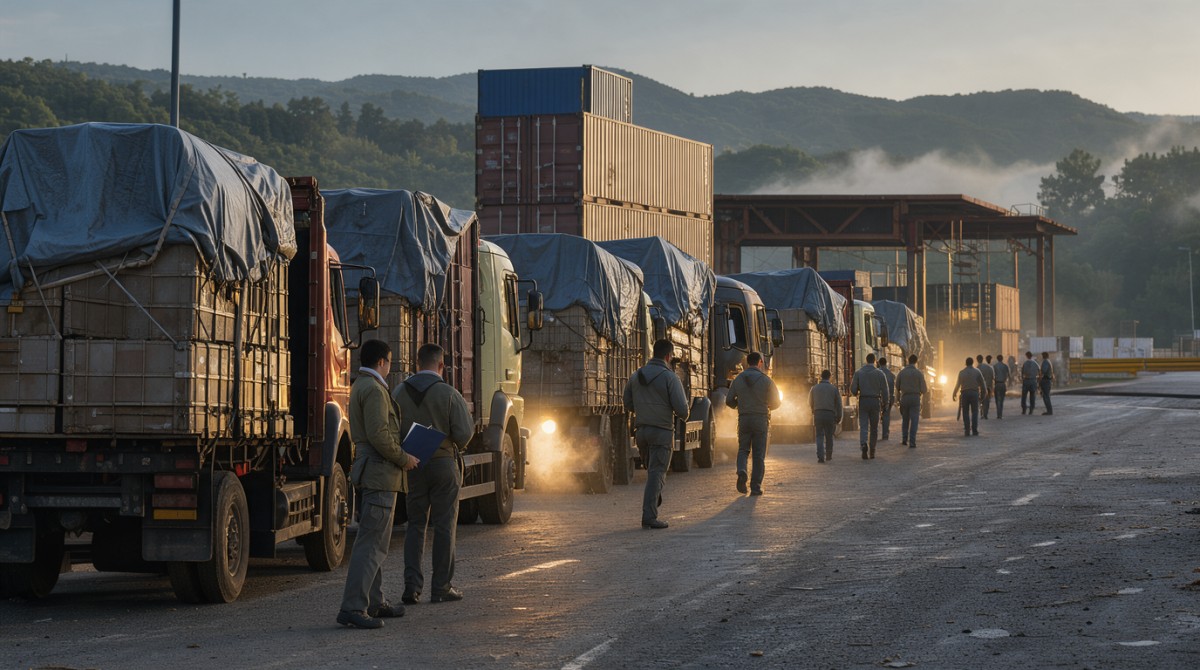
Myanmar’s commitment to smoother cross‑border trade is further complicated by unpredictable licensing at its borders. The U.S. International Trade Administration’s March 2026 commercial guide highlights “unpredictable import license approvals and non‑automatic licensing for border trade.” An example occurred on 21 September when authorities halted shipments of frozen food and other goods at the Tachilek‑Mae Sai crossing, citing standards checks and unpaid taxes. The stoppage caused congestion, traffic jams and stockpiling of commodities, illustrating how domestic enforcement can instantly derail bilateral agreements.
Similar friction has emerged on the China‑Myanmar frontier. Although China has recently eased restrictions at some crossings controlled by ethnic armed groups, the Myanmar military and associated departments have tightened controls since August, curbing informal imports that previously fed domestic markets. This tightening runs counter to the president’s pledge in Beijing to “enhance bilateral trade,” and signals a reluctance to allow market‑based flows that could empower rival power centres.
Political calculus behind trade curbs
Restrictions on border trade are not merely bureaucratic; they serve explicit political and military objectives. After “Operation 1027” – an offensive launched by ethnic armed groups in late 2023 – many border facilities fell under the control of those groups. On 28 October, Min Aung Hlaing publicly called for action against “informal border trade,” arguing that it finances armed opposition. By limiting informal flows, the regime seeks to deny revenue to ethnic militias while simultaneously preserving customs revenues for the central treasury.
This dual motive—revenue protection and counter‑insurgency—explains why the government continues to enforce strict import licences even as it promises trade liberalisation abroad. The regime’s domestic economic elite, which shares power with the military, also benefits from controlling foreign‑exchange allocations, ensuring that only favoured firms can access the limited pool of hard currency.
Macroeconomic backdrop: contraction, inflation and infrastructure woes
The broader economic context compounds the policy contradictions. The World Bank estimates a 2 percent contraction in Myanmar’s economy for the fiscal year ending 2026, a decline driven by conflict, sanctions and a collapse in investor confidence after the 2021 coup. Inflation surged to 24.6 percent in April 2026, eroding real incomes and consumer demand.
Even as some economic activity stabilises, businesses still grapple with chronic electricity shortages, weak domestic demand and rising production costs. The 2025 earthquake further damaged infrastructure, exacerbating logistics challenges. Under such conditions, firms prioritise survival over expansion, making them less likely to commit to new foreign‑direct investment projects without clear assurances of stable policy and reliable access to inputs.
Implications for foreign investors and regional partners
For neighbouring economies, Myanmar’s mixed signals present a risk‑reward calculus. Thailand’s ambition to reach a US$12 billion trade volume hinges on the ability of Myanmar’s importers to receive foreign currency and on the smooth operation of border crossings. Malaysia’s interest in food‑processing and logistics investments likewise depends on predictable customs procedures and stable electricity supplies.
Investors must therefore weigh the diplomatic goodwill demonstrated in recent visits against the entrenched domestic controls that have persisted since the coup. The likelihood of project delays, unexpected licensing hurdles and sudden border closures remains high, especially in sectors reliant on imported inputs. Until the regime aligns its internal economic policies with its external commitments, the promised boost in trade and investment will remain largely aspirational.
Prospects for reconciling overseas promises with domestic realities
Breaking the deadlock will require a recalibration of the power balance between the military, the domestic economic elite and the civilian bureaucracy that issues licences. The current coalition that controls trade and investment channels benefits from maintaining import restrictions, which preserve their leverage over scarce foreign‑exchange resources. Any meaningful liberalisation would therefore demand either a shift in internal power dynamics or external pressure that makes the cost of continued restrictions outweigh the perceived benefits.
Regional partners could play a constructive role by linking trade incentives to concrete policy reforms, such as transparent licensing mechanisms and guaranteed foreign‑exchange allocations for approved projects. However, without a credible commitment from Naypyidaw to curb the politicised use of trade controls, such conditionalities are unlikely to gain traction.
In sum, Myanmar’s 2026 diplomatic forays underscore a paradox: a regime eager to showcase openness to foreign investment while simultaneously tightening the very levers that enable that openness. Until the contradictions between overseas commitments and domestic restrictions are resolved, the country’s economic recovery will remain precarious, and its neighbours will continue to navigate a landscape of opportunity shadowed by uncertainty.
This article was produced with AI-assisted research and editorial support. Reporting is based on the source material cited below. Sources: The Diplomat; thediplomat.com; Global1.News (19 November 2026).
By Kenji Tanaka, Staff Writer
What's Your Reaction?
 Like
0
 Dislike
0
 Love
0
 Funny
0
 Wow
0
 Sad
0
 Angry
0

Japan Correspondent at Global1.News. Tokyo-based voice covering Japanese politics, technology, economy, and culture. Tracks the intersection of tradition and innovation in one of the world's most dynamic societies.













Comments (0)