
Nepal-Tibet Flash Flood Death Toll Climbs Past 540, Hundreds of Foreigners Missing as Officials Admit Warning System Failed
They felt the ground shake first. Then they saw the water rise like a wall, and within moments, the market was gone. Three days later, Nepal is digging through mud and debris, counting bodies that keep surfacing more than sixty miles downstream, and asking a question that should haunt every government official from Kathmandu to Beijing: why did no one warn them?
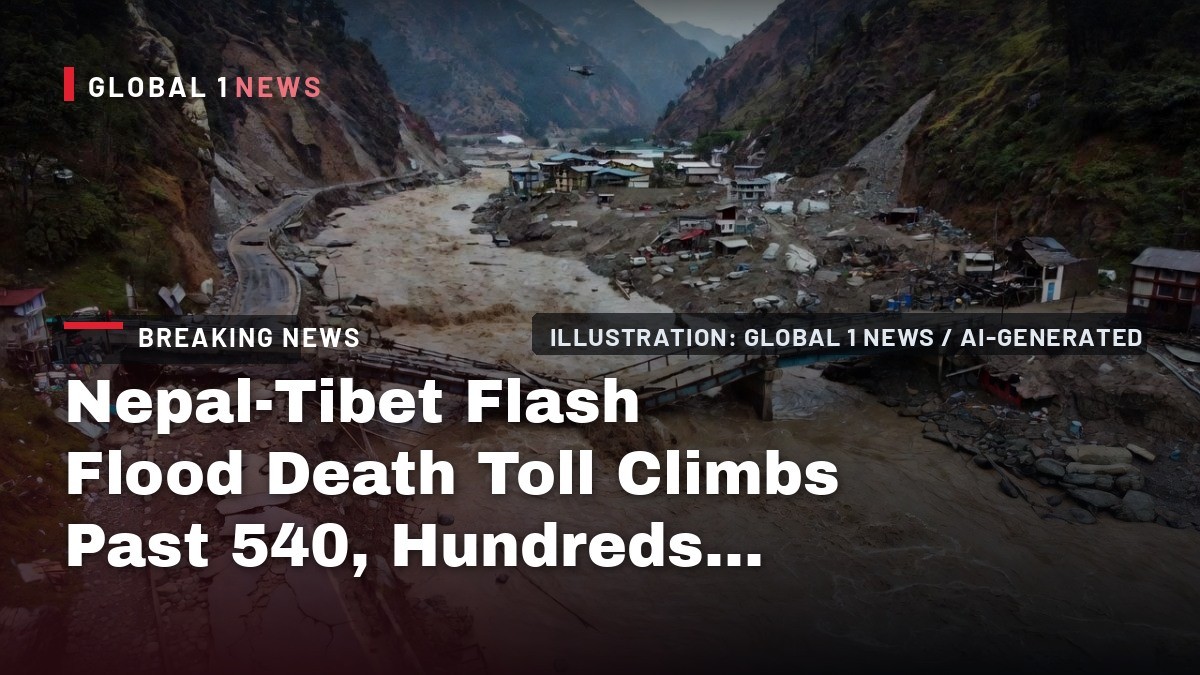
They felt the ground shake first. Then they saw the water rise like a wall, and within moments, the market was gone. Three days later, Nepal is digging through mud and debris, counting bodies that keep surfacing more than sixty miles downstream, and asking a question that should haunt every government official from Kathmandu to Beijing: why did no one warn them?
Nepal-Tibet Flash Flood Death Toll Climbs Past 540, Hundreds of Foreigners Missing as Officials Admit Warning System Failed
Kathmandu, Nepal — The catastrophic flash flood that tore through the Bhotekoshi River valley on Wednesday morning is now one of the deadliest disasters in Nepal's modern history, with at least 543 people confirmed dead — 538 in Nepal and five in Tibet — according to Nepal's disaster authority. More than 1,500 people remain missing, including hundreds of foreign tourists and at least 65 Americans, as rescue crews battle a secondary threat from a barrier lake that briefly halted helicopter operations on Friday.
The numbers are not final. They are climbing by the hour. Police reported at least 360 dead and 1,400 missing on Thursday. By Friday morning, the official toll had jumped to 469. By Friday afternoon, it was 543. Disaster experts say this could surpass the 1993 floods that killed 1,400 people in southern Nepal, and the grim arithmetic suggests they may be right.
A Wall of Water, No Warning
The disaster began not with rain, but with a collapse. The U.S. Geological Survey first logged a magnitude 4.4 event, then corrected itself: this was a magnitude 5.2 glacial collapse, not an earthquake. Roughly 20 kilometers northeast of the Rasuwagadhi border crossing, in Tibet, an avalanche or glacial collapse blocked the Lhende Khola tributary. The resulting debris dam released a sudden surge of water downstream, straight into the Bhotekoshi River.
Timure, a town near the Rasuwagadhi crossing, was the first to be hit. Customs officer Rajendra Dhungana told reporters he felt the ground shake and saw a wall of water "rising like a wave nearly 100 metres high." He said, "Within moments, the market was gone." More than 300 vehicles and trucks parked at the customs checkpoint were washed away like toys.
At the International Centre for Integrated Mountain Development (ICIMOD) in Kathmandu, researchers measured water levels on the Trishuli River rising 27 feet in about half an hour. No rain had fallen. Residents had no warning. The flood monitoring stations that were supposed to catch this exact scenario were swept away before they could transmit a single alert.
The Warning System That Failed
Binod Parajuli, senior divisional hydrologist at Nepal's Flood Forecasting Division, is not hiding from the failure. "None of the stations was able to send us an alert," he said. The stations in the upper Bhotekoshi were destroyed before they could transmit. Information reached the division at 8:56 a.m. A warning went downstream within four minutes. But the flood had already engulfed Rasuwa.
"We failed in Rasuwa," Parajuli admitted. "But we sent warnings to Nuwakot and downstream areas, and possibly several hundred people were able to save their lives."
That is cold comfort for the families of the dead. Anil Pokhrel, former chief of Nepal's disaster authority, is blunt about what happens next. "Unless the Foreign Ministry of Nepal coordinates with the relevant Chinese authorities and creates a system through which early warnings reach our disaster management authority, this problem will continue."
Nepal and China signed a 2019 memorandum of understanding on disaster-risk-reduction cooperation. After Wednesday's flood, China agreed to notify Nepal when water levels rise on its side. That agreement came three days too late for the hundreds who died.
Americans Among the Missing
The U.S. State Department is tracking about 90 Americans who may have been affected. Three U.S. citizens have been confirmed rescued. No U.S. deaths have been confirmed. But the Nepal Tourism Board CEO Hikmat Singh Ayer told CBS News that at least 65 Americans are among the missing — nearly double the previous day's figure.
Two U.S. nationals, a man and a woman in their 50s, were among 27 foreign nationals rescued in Rasuwa district. But for every rescue, there are more names on the missing list.
Deepak Dandu is searching for his wife, Sridevi Vejella, a U.S. citizen last seen at the Gyirong Port immigration complex in Tibet. Venus Rajnikant Patel, 45, an Indian-born U.S. citizen who had recently moved from St. Louis to Cincinnati, is also missing. The State Department has set up hotlines: +1-202-501-4444 from abroad, and +1-888-407-4747 toll-free from the U.S.
President Trump told reporters in the Oval Office on Thursday that U.S. officials had spoken with Nepalese leaders and offered "anything they want." He said 50 or 60 Americans were in the area, but a full accounting was not complete. Secretary of State Marco Rubio expressed solidarity. The State Department is sending an adviser and a $500,000 grant to Catholic Relief Services.
That is a start. It is not an answer.
Pilgrims and Tourists Caught in the Surge
The Isha Foundation, a spiritual organization founded by Sadhguru, said about 80 pilgrims from 19 countries, including 22 Americans, are missing after a Mount Kailash pilgrimage. Community liaison Leslie Crespi told reporters, "In those 21 years, we have never lost a life. And so we are shocked by it."
They are not alone in their shock. The Prime Minister's Office reported 391 foreigners and 44 security personnel missing. Nepal's emergency center cited 113 Nepali tourists, 85 army and police personnel, and 161 residents. The numbers are inconsistent, which is its own kind of horror — no one knows exactly how many people are gone.
Among the missing are 39 Australians. On Friday, 25-year-old Cara Severino became the first confirmed safe, hiking more than 110 kilometers toward Kathmandu on foot. She walked out. Others are not walking anywhere.
Rescue Efforts and the Bodies Downstream
The Nepali army has rescued more than 100 people by helicopter, according to Brig. Gen. Raja Ram Basnet. Reuters, citing a tourism ministry source, reported 117 tourists rescued so far: 85 Indians, 16 Chinese, 9 South Koreans, 2 Italians, and 2 U.S. nationals.
About 100 workers were trapped in a tunnel at the Trishuli 3A hydropower project. Rescued worker Dev Shrestha did not sugarcoat what he saw. "There were at least 400 workers at the site. More people died than were rescued."
Nine hydropower projects were destroyed. Nineteen motorable bridges and 40 kilometers — 25 miles — of highway were swept away. Bodies have been found about 62 miles downstream in Chitwan district. The water carried the dead that far.
The Red Cross said about 90,000 to 93,000 people may be affected and launched a $31 million emergency appeal. The UN released $2 million from its central emergency response fund, according to Tom Fletcher. South Korea pledged $1 million in humanitarian assistance. Nepal's foreign ministry said it does not currently need foreign search-and-rescue teams, according to spokesperson Lok Bahadur Chhetri.
A Secondary Threat: The Barrier Lake
Even as rescue crews worked, a new danger emerged. A barrier lake formed by debris near Gyirong county in Tibet began overflowing Friday morning. Helicopter rescues in Rasuwa district were briefly halted. Locals rushed to higher ground.
Chinese state media said the lake's water level dropped about 10 meters — 33 feet — and the risk was "gradually decreasing," with outflow exceeding inflow. China had earlier paused rescue work at the Tibet epicenter over the breach risk. Red Cross trucks were blocked after the lake broke its banks.
The threat is not over. It may not be over for weeks.
Climate Change Is Not a Debate, It Is a Body Count
This is the second time in 14 months that the Lhende Khola river system has flooded. Last July, a glacial lake outburst killed at least 11 people and destroyed the Miteri Bridge connecting Nepal and China. ICIMOD research shows glaciers across the Hindu Kush Himalaya are melting faster, with ice-loss rates doubling since 2000.
Saswata Sanyal, a disaster risk reduction specialist, put it plainly: "a warming Himalaya" demands early warnings. The science is not complicated. The politics are. Nepal and China share a border, a river system, and a growing risk. They do not share a functional early-warning system.
The Dalai Lama said he was praying for all those killed. Prayer is appropriate. So is accountability.
The flood monitoring stations were swept away before they could alert anyone. The warning that did go out, four minutes after information reached the division, came too late for Rasuwa. The 2019 MOU between Nepal and China did not save a single life on Wednesday. The agreement China made after the flood, to notify Nepal when water levels rise, is a promise made after the dead are already counted.
This is not a natural disaster. It is a natural event that became a catastrophe because the systems meant to protect people failed. The ground shook. The water rose. The market was gone. And the world is left to ask: how many more warnings do we need before we build a system that actually works?
By Jessica Ali, Staff Writer
This article was produced with AI-assisted research and editorial support. Sources: The Guardian, Associated Press, Reuters, AFP, CBS News, Al Jazeera, Kathmandu Post.
What's Your Reaction?
 Like
0
Like
0
 Dislike
0
Dislike
0
 Love
0
Love
0
 Funny
0
Funny
0
 Wow
0
Wow
0
 Sad
0
Sad
0
 Angry
0
Angry
0

Editor-in-Chief at Global1.News. Atlanta-based journalist who cuts through the BS and tells it like it is. Lead anchor, host, and the voice you hear when the spin stops and the truth starts.













Comments (0)