
A Supermarket Empire Just Dropped €5.6 Billion on a Data Center — Because Digital Sovereignty Isn't a Speech
Lidl's parent company Schwarz Group is investing up to €5.6 billion in a 240-megawatt data center near Rostock, Germany, to power cloud and AI services under German law. A hosting founder on why a supermarket empire just became Europe's unlikely champion of digital sovereignty.
A Supermarket Empire Just Dropped €5.6 Billion on a Data Center — Because Digital Sovereignty Isn't a Speech
Let me tell you something that's been sitting with me since Thursday morning. I run hosting infrastructure for a living — I've been doing it for over a decade — and I read a lot of data center news. But the announcement out of Mecklenburg-Vorpommern caught me off guard in a way the big hyperscaler capex numbers don't anymore.
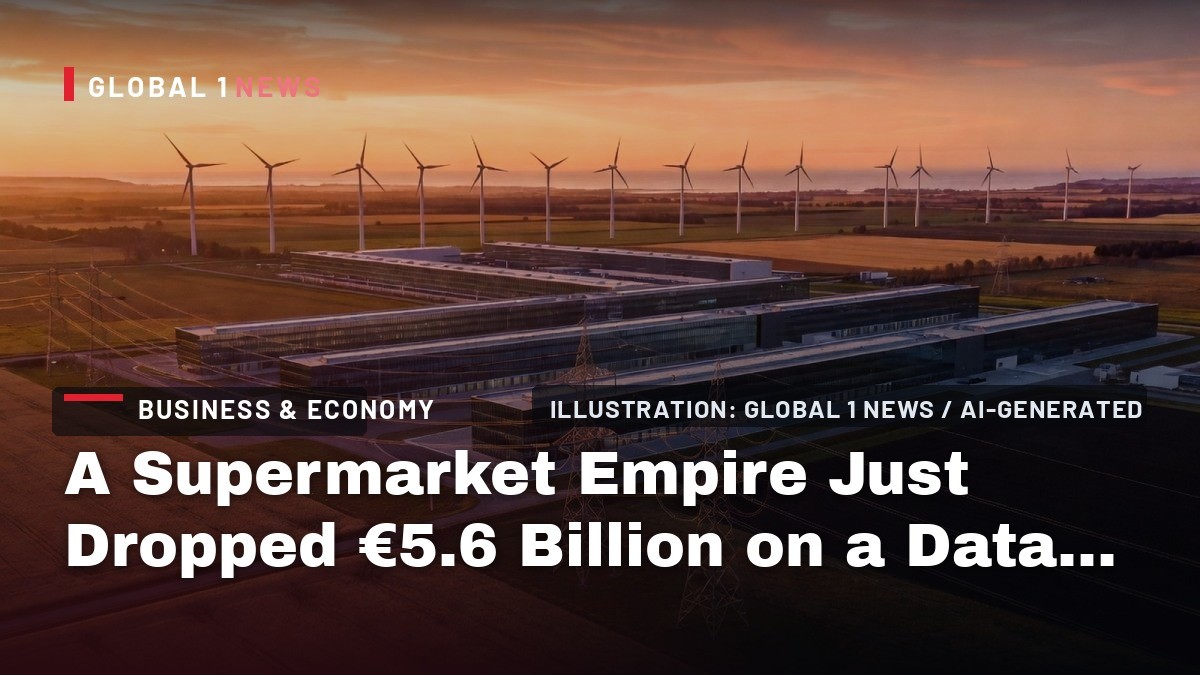
The companies of Schwarz Group — yes, the people who own Lidl and Kaufland, about 14,500 stores across 33 countries, €185.6 billion in sales last year — just committed up to €5.6 billion to build a 240-megawatt data center near Rostock, Germany. Not for grocery checkout systems. For cloud and AI infrastructure that runs under German law, for the German state, for a country that's been talking about digital sovereignty for a decade and finally found somebody willing to build the thing.
And here's the kicker. The company building it sells groceries.
The Setup — What the Supermarket Just Did
The announcement came at a joint press conference in Schwerin on August 27, 2026, with Gerd Chrzanowski, general partner of Schwarz Group, and Manuela Schwesig, the minister-president of Mecklenburg-Vorpommern. The numbers: up to €5.6 billion by 2033 for a data center in the industrial park at Dummerstorf, capacity of 240 megawatts, and the potential to grow to a full 1-gigawatt grid connection by 2045.
The site matters. Northern Germany has wind — onshore and offshore — in quantities most of Europe would kill for. The proposed site can hook into the 380-kilovolt extra-high-voltage grid, which moves power efficiently and cuts grid fees. The climate is cold enough for free air cooling most of the year. The waste heat will feed Rostock's district heating network, with a letter of intent already signed with the city's public utility.
This isn't a vanity project, either. Schwarz Group already runs Schwarz Digits, its IT and digital division with roughly 7,500 employees, and STACKIT, a sovereign cloud platform that's been selling to real customers for years. The Dutch central bank uses it. KPN launched a European sovereign cloud with it in the Netherlands. Google even partnered with STACKIT in 2024 for sovereign storage for its customers. The infrastructure muscle was already there — this announcement just scales it to hyperscale proportions.
The Part That Matters — Sovereignty, With a Barcode on It
Here's the sentence that should scare every American cloud executive, and it's not the €5.6 billion. It's from the minister-president: "The goal of the state government is to become more independent from foreign providers of data centers and cloud and AI applications."
And here's the sentence that should embarrass every European politician who's given a sovereignty speech and built nothing: "Digital sovereignty is not created by appeals or speeches. It is created by action, by reliable infrastructure, and by practical applications." That's Chrzanowski, the general partner of a company best known for discount groceries, saying the thing European governments have circled for years without doing.
Look at what's actually being built. Digital building permits running on STACKIT. OpenDesk secure workstations for teachers — by the end of this year. And the partnership is explicitly designed as a blueprint for the whole Federal Republic: build it once in Mecklenburg-Vorpommern, transfer it to every state that wants it. That's the playbook of someone who understands scale. And let me tell you, a company that moves €185.6 billion of groceries a year understands scale better than most cloud sales teams.
The Two Readings — Sovereignty in Action, or the Biggest Vertical Integration Play You've Never Heard Of
Reading one is the one in the press release: this is Europe's answer to the hyperscaler duopoly. A European company, under German law, with German data protection standards, building European infrastructure. Public sector data stays at home. Government workloads don't route through cloud zones owned by American corporations.
Reading two is the one the press releases don't say out loud: this is a €185.6 billion company vertically integrating its own IT, then selling the surplus into a captive government market. Schwarz doesn't need a 40% cloud margin to win. It needs its own stores, its own logistics, its own 604,000 employees' worth of workloads to run somewhere. The cloud business is a hedge on that bill — and the sovereignty narrative is the moat that wins government contracts the American hyperscalers can't touch on trust alone.
That's not a criticism. That's the smartest business move I've seen in this industry in a long time. Every hosting provider — including me — should be asking why we're not selling the same story.
The Secondary Bottleneck Nobody's Talking About — the Silicon Ceiling
Now here's where the sovereignty story hits the wall, and it's the part nobody in Schwerin mentioned: the silicon. STACKIT — and every other "sovereign" European cloud — still runs on American chips and a big chunk of American software underneath. Nvidia, AMD, Intel, the whole fabless American stack. The press release says the exact cloud and AI chip configuration "has not yet been finalized" — a polite way of saying they're still figuring out whose silicon gets to be sovereign.
That's the real bottleneck, and it's the same one I've been writing about for weeks: the AI buildout's physical and supply-chain constraints. You can build the building under German law. You can store the data under German law. But the compute fabric — the GPUs, the networking, the memory — comes from a supply chain that runs through Taiwan and California. A sovereign cloud built on someone else's silicon is a house with a foreign foundation.
The second part of the ceiling is scale. Two hundred forty megawatts by 2033 is real — it's roughly the size of the Lübbenau project in Brandenburg, where Schwarz is spending €11 billion on a 200MW facility on the site of a former coal-fired power plant. But the hyperscalers add that kind of capacity every few months. Google alone is guiding $195 to $205 billion of capex this year. The gap between a €16.6 billion German sovereignty bet and the American buildout isn't a moat. It's an ocean.
None of which makes the Schwarz move wrong. It makes it honest: sovereignty is a slow, expensive, iterative project. And somebody had to start.
What This Means for Independent Hosting Providers
First, sovereign cloud is a real demand pool — and it's growing. The Dutch central bank picked a supermarket's cloud. German states are signing up for teacher workstations and digital building permits. If you run infrastructure in Europe, start building the German-law, data-residency, GDPR-native story now, because procurement officers are actively looking for alternatives to the American giants.
Second, compliance is the moat — not technology. Schwarz isn't beating AWS on raw performance. It's beating them on trust, on law, on "whose constitution protects this data." You can do the same with your own operation. Certifications, residency guarantees, audit trails — that's the product now.
Third, don't underestimate the unlikely competitor. A company that sells groceries can become a serious cloud provider. Capital plus trust beats technology in this market. When you plan your competitive set, add the retailers and the utilities and the sovereign funds — they're all coming.
Fourth, watch the silicon question. The sovereignty ceiling is real, and it's a market signal. If Europe starts mandating where AI chips are manufactured or which software can run on government clouds, every hosting provider's hardware roadmap changes. Keep your supply chain diversified and your ears open.
Fifth, read the gap between announced and realized. €5.6 billion by 2033, 240 megawatts, "subject to standard approvals." That's a decade of permitting, construction, and grid connection risk. It's a serious commitment — but it's not capacity today. Plan like it's real, price like it's real, but don't treat the press release as a done deal.
The Bottom Line
I've spent a decade watching this industry consolidate toward the biggest balance sheets. So when one of the biggest retailers on Earth decides the cloud is a core business — not a side project, not a digital-transformation buzzword, but a €16.6 billion infrastructure bet across two German states — I stop and pay attention.
The supermarket isn't waiting for Europe to get its act together. It's building the thing the politicians keep promising. And if you're in this business, that's both an inspiration and a warning: sovereignty is finally becoming a market, and the people who build the actual infrastructure are going to win it — whether or not they've ever operated a checkout line.
— Allan Ali, Founder
This article was produced with AI-assisted research and editorial support. Sources: Schwarz Group press release (Aug 27, 2026), DPA via Yahoo Finance, The European, Techzine, DatacenterDynamics, STACKIT.
What's Your Reaction?
 Like
0
Like
0
 Dislike
0
Dislike
0
 Love
0
Love
0
 Funny
0
Funny
0
 Wow
0
Wow
0
 Sad
0
Sad
0
 Angry
0
Angry
0

Publisher of Global1.News. Automation architect, systems builder, and the guy making sure the truth gets published.













Comments (0)