
Manchester power cut triggers rail chaos across north-west England
A 90-second power failure at the Manchester Rail Operating Centre near Ashburys station on 6 August 2026 exposed the extreme vulnerability of Britain's centralised rail signalling system, leaving thousands of passengers across Greater Manchester, Merseyside and the Midlands stranded with no trains r
A 90-second power failure at the Manchester Rail Operating Centre near Ashburys station on 6 August 2026 exposed the extreme vulnerability of Britain's centralised rail signalling system, leaving thousands of passengers across Greater Manchester, Merseyside and the Midlands stranded with no trains running safely for hours.
Manchester ROC Power Failure Exposes Britain's Fragile Centralised Rail Network
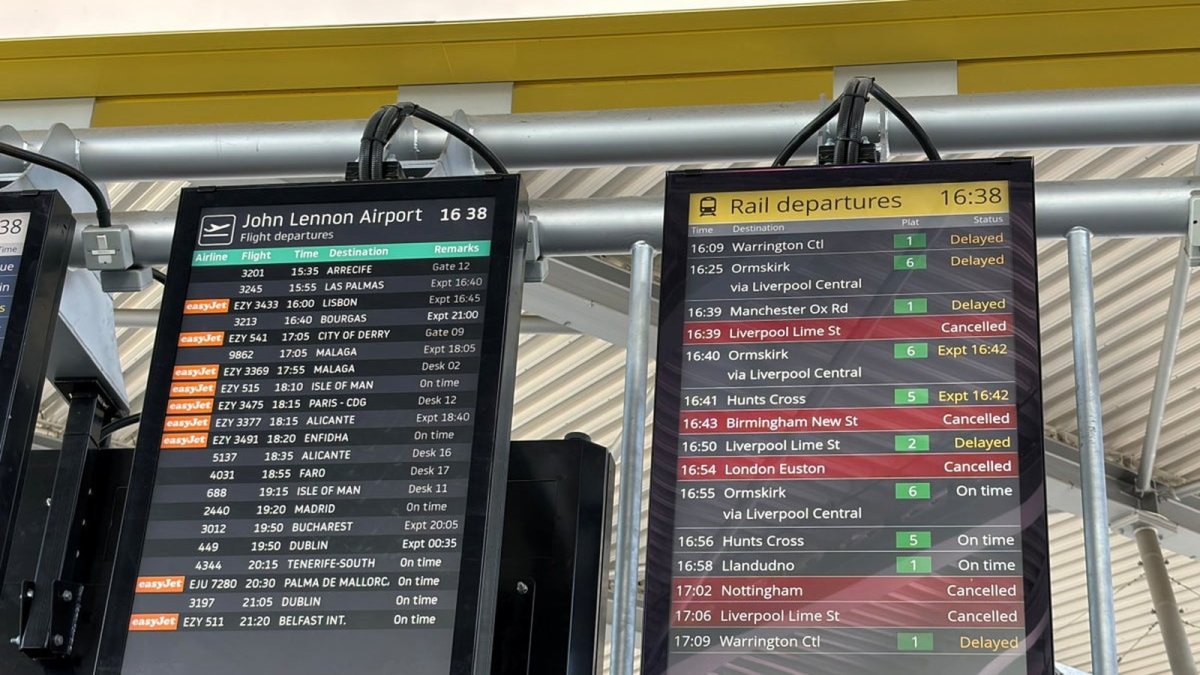
Manchester, UK – 7 August 2026 — A brief power cut at the Manchester Rail Operating Centre triggered severe, region-wide rail disruption, halting services across seven operators and leaving commuters in Manchester, Liverpool and Preston facing cancelled trains well into Friday 7 August.

The 90-Second Power Cut That Stopped the North West
The incident began shortly before 2pm on Thursday 6 August when power failed at the Manchester Rail Operating Centre, sited in the city's east end. Network Rail confirmed the outage lasted just 90 seconds, yet it immediately knocked out signalling control for the entire north-west region. Because the centre manages signals across a vast area, the failure forced all signals to default to red as a safety measure, bringing every train to a complete standstill.
The centralisation of signalling into a handful of regional hubs has fundamentally altered the risk profile for millions of daily passengers across northern England. Where once a localised fault might have been contained within a few miles of track, the Manchester ROC now acts as a single point of control for services stretching from the Scottish border to the Midlands, meaning even a brief interruption can cascade into region-wide paralysis. This architecture, introduced to replace hundreds of individual signal boxes, has delivered operational efficiencies but at the cost of concentrated vulnerability that older distributed systems largely avoided.
Engineers describe the fail-safe mechanism that automatically sets signals to red as a deliberate design choice rooted in collision prevention, yet it also guarantees that any loss of command authority brings the entire network to a standstill until power and communications are methodically restored. The 2014 consolidation programme traded the resilience of dispersed staffing for streamlined oversight, leaving fewer on-site personnel able to intervene when automated systems falter. Historical comparisons with pre-digital eras show that while individual box failures once affected smaller areas, the modern model amplifies both the scale of disruption and the time required for recovery across multiple operators.
The 90-second outage therefore exposes a deeper policy tension between modernisation targets and the need for robust redundancy in critical transport infrastructure. As the network moves toward full digital signalling under future control periods, questions persist about whether efficiency gains have outpaced investment in backup resilience, leaving passengers exposed to prolonged knock-on effects that extend well beyond the initial fault.
Backup Generators Fail to Activate
Network Rail's back-up power generators did not activate immediately, leaving the system without power long enough for the safety protocols to engage fully. Engineers then had to carry out a controlled power-up and power-down sequence to restart operations safely. Signalling was not fully restored until late on Thursday evening, according to Network Rail's own statements. The Manchester ROC, one of 12 such centres built to manage the entire British rail network, opened in 2014 and was intended to replace 800 signal boxes. It is scheduled to control all north-west England railways by 2034.
The failure of backup generators to engage immediately reveals a critical weakness in the redundancy standards applied to national rail operations. Infrastructure designed to maintain continuity during primary power loss instead required extended manual intervention, underscoring gaps in testing regimes and maintenance priorities that have drawn scrutiny from industry observers. Network Rail’s investigation will need to examine not only the immediate technical fault but also broader spending decisions on resilience measures across the twelve operating centres.
Similar vulnerabilities have surfaced in debates over power, water and telecoms networks, where cost pressures have sometimes delayed upgrades to backup systems. The controlled power-up and power-down sequence, necessary to avoid damaging sensitive signalling equipment, illustrates why recovery cannot be instantaneous even after primary supply returns. This process, involving sequential verification of circuits and communications links, highlights the trade-offs inherent in highly integrated control technology and raises questions about whether current investment levels adequately reflect the economic and social costs of extended outages.
Parallels with other critical national infrastructure suggest that rail may require a recalibration of resilience benchmarks, particularly as electrification and digital systems increase dependence on uninterrupted power. The episode could prompt renewed calls for independent audits of backup provisions across the network, ensuring that future modernisation does not repeat the same exposure to single-point failures.
Operators Across the Region Grind to a Halt
Seven operators were affected: Avanti West Coast, CrossCountry, East Midlands Railway, London Northwestern Railway, Northern, TransPennine Express and Transport for Wales. National Rail said the communications-centre failure hit five operators directly, with Avanti West Coast, East Midlands Railway and Northern among those reporting the heaviest impact. Greater Manchester, parts of the Midlands and north-west England bore the brunt, with trains left stranded wherever signals turned red.
Additional Incidents Compound the Chaos
Thursday's disruption was worsened by two further incidents. A wartime bomb discovered near the railway between Tamworth and Burton-on-Trent at a quarry in Barton-under-Needwood forced the line to close, affecting CrossCountry services until it was safely detonated and the A38 and tracks reopened around 7.40pm. Separately, a trespasser caused cancellations and delays on services between Preston and Lancaster, hitting Avanti West Coast, Northern and TransPennine Express trains on Thursday night.
Passenger Struggles in Greater Manchester and Beyond
Commuters at Manchester Victoria station were left stranded, with one passenger posting on social media that they had been "sat on a train at Preston for almost an hour waiting to head north and there's absolutely no information on what's happening." Northern advised passengers not to travel before 10am on Friday, while TransPennine Express warned that disruption would continue before midday. Thousands of passengers across Liverpool Lime Street, Preston and the Midlands faced lengthened journeys, missed connections and overcrowded carriages on Friday 7 August.
Network Rail and Operator Responses
Chris Wright, Network Rail's North West route director, said: "I'm extremely sorry for the disruption today and the very difficult journeys many people have experienced. Our engineers are working tirelessly to restore the signalling systems impacted by the power cut at lunchtime." He added that engineers worked through the night to restore systems and recover the railway. Warrick Dent, chief operating officer of Northern, apologised to customers and warned that some knock-on delays might continue into Friday morning. Andrew McClements, customer experience and transformation director at TransPennine Express, said "sadly, we're not out of the woods yet" and urged passengers to check National Rail Enquiries before travelling. TransPennine Express relaxed ticket restrictions for the whole day, while Avanti West Coast allowed travel on one or two services before or after booked trains.
Union Scrutiny and Future Safeguards
Eddie Dempsey, RMT union general secretary, praised train crew but highlighted the severe impact of a 90-second power cut in an important operations centre covering a wide geographical area without a working backup supply. He said the union would work with Network Rail to scrutinise how the infrastructure coped and what actions need to be taken in the future. Transport Secretary Heidi Alexander wrote on X that she was receiving regular updates while Network Rail worked to resolve the issue, and advised passengers to check before they travel.
Union scrutiny led by figures such as Eddie Dempsey will focus on infrastructure staffing levels and the adequacy of safety systems, pressing for greater transparency in how resilience is maintained. The political dimension is sharpened by the Labour government’s rail reform agenda and the creation of Great British Railways, with Transport Secretary Heidi Alexander already signalling close oversight. Any resulting measures could encompass mandatory backup power testing, periodic resilience audits and updated contingency frameworks.
The Office of Rail and Road, as independent regulator, is positioned to enforce higher standards if the investigation identifies systemic shortcomings. This episode may therefore accelerate a broader policy shift toward embedding redundancy requirements more explicitly within future control periods, ensuring that efficiency-driven centralisation does not compromise operational integrity.
Long-Term Questions Over Centralised Control
The Manchester ROC's design means one facility controls a huge geographical area. When power fails and back-up generators do not engage, safety systems set signals to red to prevent collisions, bringing all movement to a standstill. Andy Bowes-Roden, deputy editor of Modern Railways magazine, told BBC Radio 5 Live there would be quite a lot of disruption on Friday morning, easing throughout the day, with the service hopefully back to normal by rush hour but not fully sorted until the following morning, and an awful lot of refunds expected.
The strategic direction of Britain’s rail modernisation, centred on digital signalling and the eventual rollout of ETCS, now faces renewed examination following the Manchester incident. Industry commentators such as those at Modern Railways have long tracked the shift from distributed signal boxes to centralised centres, noting both efficiency gains and emerging questions over single-point resilience. Whether the twelve-ROC model requires revised standards for backup capacity and contingency staffing will likely feature in forthcoming reviews.
Passengers can expect the industry response to include accelerated testing protocols and possibly revised contingency plans, yet the immediate cost to the regional economy remains substantial. Commuters and businesses in Manchester and Liverpool, along with hospitality sectors reliant on reliable inter-city links, absorb the impact through lost productivity and disrupted supply chains. The episode tests the credibility of long-promised infrastructure improvements and may influence future funding allocations under the national recovery plan.
What This Means for the UK
Season ticket holders across the North now confront the practical economics of repeated disruption, with Delay Repay claims likely to surge and many commuters weighing the viability of flexible working arrangements against unreliable services. A single point of failure in Manchester ripples outward to affect Liverpool, Preston and long-distance routes operated by Avanti West Coast and CrossCountry, demonstrating how centralised control concentrates risk across multiple regions and operators simultaneously.
The reputational damage to British rail is immediate, amplifying political pressure on ministers already navigating reform. Passengers in northern England, frequently promised levelling-up investment, will expect the forthcoming investigation to deliver concrete improvements rather than further consolidation without corresponding resilience safeguards. The episode underscores the daily dependence of regional economies on a network whose vulnerabilities have been laid bare.
Claims and Compensation for Affected Passengers
Passengers delayed by more than 15 minutes can usually claim under the Delay Repay scheme by contacting their train operator, subject to the relevant deadlines. Network Rail confirmed that passengers with tickets could travel on any Bee Network services in the Manchester area while disruption continued. National Rail said trains could operate on Friday 7 August but delays were likely until noon because several trains and crew were in the wrong locations after the unexpected shutdown.
The Bottom Line — What Comes Next
Recovery is projected to continue through Friday with a full timetable anticipated by Saturday morning, yet the Network Rail investigation will extend over coming weeks to determine root causes and recommend safeguards. Passengers are advised to submit Delay Repay claims promptly where delays exceeded fifteen minutes and to verify service status before travel, particularly as residual crew and stock displacement lingers.
The longer-term question is whether Britain’s rail network can sustain another comparable failure without eroding public confidence further. The episode serves as a stark reminder that modernisation must be matched by rigorous resilience standards if the system is to support both daily commutes and wider economic ambitions.
By Erica Thornton, Staff Writer
This article was produced with AI-assisted research and editorial support. Reporting is based on sources cited in the article.
What's Your Reaction?
 Like
0
Like
0
 Dislike
0
Dislike
0
 Love
0
Love
0
 Funny
0
Funny
0
 Wow
0
Wow
0
 Sad
0
Sad
0
 Angry
0
Angry
0

US Politics and Policy Correspondent at Global1.News. Based in Washington DC, covering American politics, policy, elections, and the courts. Knows how the system works and tells you what it actually means.














Comments (0)