
Mexico and Japan Forge Partnership to Tackle Record Sargassum Invasion
Mexico and Japan are joining forces to fight the sargassum invasion choking the Mexican Caribbean, deploying robotics, satellite monitoring and specialized vessels in a new partnership that could turn the region’s smelliest probl
Mexico and Japan Forge Partnership to Tackle Record Sargassum Invasion
Mexico and Japan are joining forces to fight the sargassum invasion choking the Mexican Caribbean, deploying robotics, satellite monitoring and specialized vessels in a new partnership that could turn the region’s smelliest problem into an economic opportunity. The agreement, announced after an August 3 meeting in Mexico between Foreign Minister Roberto Velasco and Japanese Foreign Minister Toshimitsu Motegi, arrives as President Claudia Sheinbaum’s government pours more than 2 billion pesos into its own Navy-led collection plan and Quintana Roo families watch a record seaweed season threaten their livelihoods.
Tags: sargassum crisis, Mexico Japan collaboration, Quintana Roo beaches, sargassum collection vessels, Caribbean tourism, President Sheinbaum, Navy sargassum plan, JICA training, circular economy sargassum, EU Caribbean conference
Diplomatic Agreement Reached in August 2026
Foreign Minister Roberto Velasco met Japanese Foreign Minister Toshimitsu Motegi on August 3, 2026, to launch a new working group focused on the sargassum crisis. The two officials agreed to expand cooperation in political, economic, scientific and technological areas. Their joint statement also launched a high-level economic dialogue to increase bilateral trade, which reached US $9.9 billion from January to May 2026.
The partnership builds directly on President Claudia Sheinbaum’s national plan announced at the July 30 mañanera in Palacio Nacional. That plan allocates more than 2 billion pesos, or US $115 million, to strengthen at-sea collection led by the Secretaría de Marina. Admiral Raymundo Pedro Morales Angeles oversees the effort to raise daily collection capacity from 1,227 tonnes to 1,870 tonnes this year.
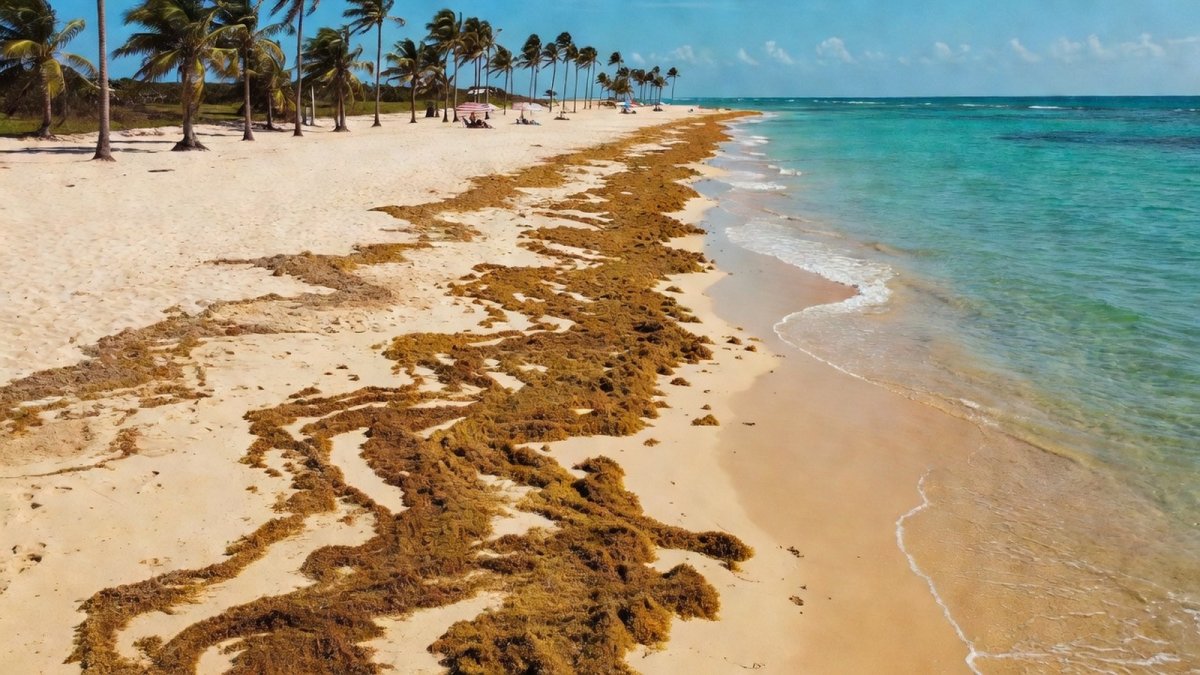
Quintana Roo communities have already felt the strain. Nine thousand tons of sargassum arrive daily on the state’s shores, part of roughly 90,538 tons drifting offshore. University of South Florida data showed nearly 5 million metric tons accumulated in the Mexican Caribbean by June, four times the 2025 level and twenty-seven times the historical average.
The working group established under the agreement will coordinate efforts across political, economic, scientific, and technological fronts to tackle the sargassum influx.
During the high-level economic dialogue, officials highlighted the $9.9 billion in bilateral trade, which has grown 4 percent in recent years. Japan’s decades-long engagement with Caribbean nations on sargassum monitoring provides valuable technical continuity, from early warning systems to pilot harvesting projects.
The partnership signals Mexico’s intent to elevate its role in multilateral environmental diplomacy. Japan’s involvement matters because its engineering precision and sustained funding can accelerate scalable technologies that smaller Caribbean states have struggled to develop alone, giving Mexico a stronger voice in setting standards for algae-based industries across the hemisphere.
Japan’s Technology and Training Support
Japan will supply ocean-monitoring technology, robotics, sensors and specialized sargassum-collecting vessels. These tools will help intercept the macroalgae before it reaches beaches in Cancún, Playa del Carmen, Puerto Morelos, Tulum and Mahahual. Satellite monitoring and biological decomposition methods will also be shared through JICA in coordination with AMEXCID.
Technical training programs will prepare Mexican personnel to operate the new equipment. The collaboration includes academic research and business-oriented R&D aimed at turning sargassum into fertilizer, biofuels, building materials and soap. Officials expect these steps to support marine conservation and reduce harm to fisheries and public health.
Semarnat Secretary Alicia Bárcena noted that sargassum has shifted from a seasonal event to a continuous condition. The new Japanese equipment is expected to complement existing Navy operations and help protect coral reefs, mangroves and seagrass beds along the Caribbean coast.
Mexico’s Expanded National Collection Plan
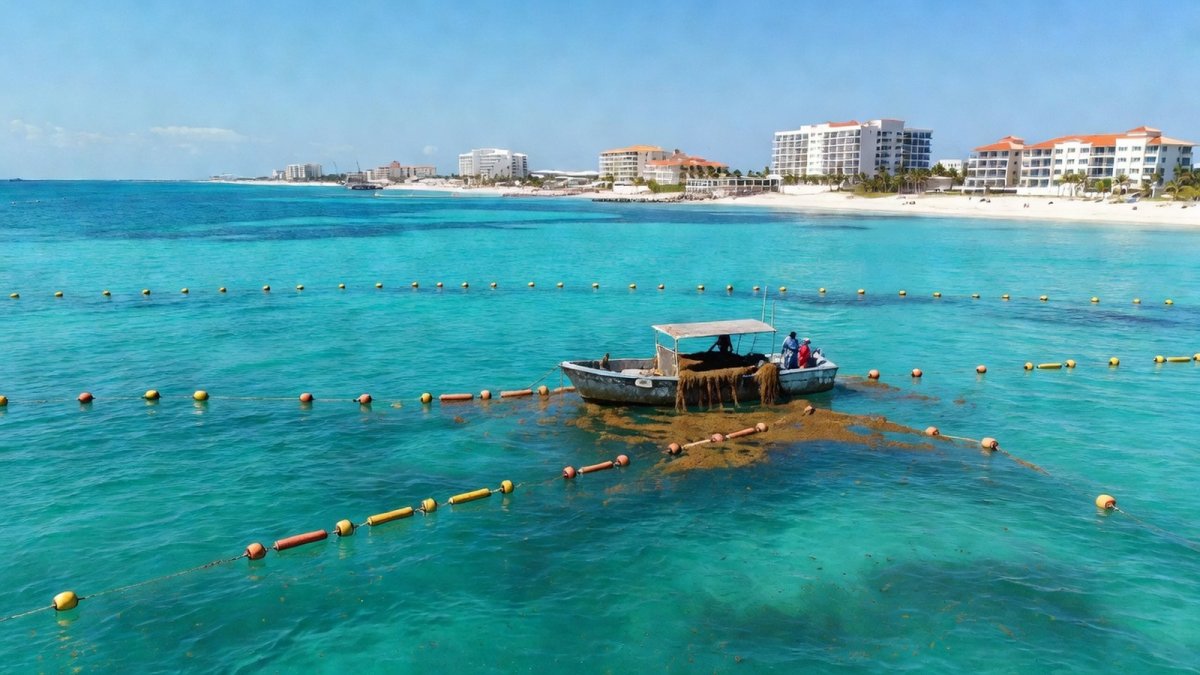
Under the Navy-led strategy, two new tugboats and six sargassum-collecting vessels known as sargaceros have already been acquired. Approximately 50 kilometers of new anti-sargassum barriers will be installed in priority coastal zones this year. A second stage in 2027 aims to reach 4,000 tonnes per day of collection capacity.
Current combined efforts by authorities, the private sector and hotel employees collect 2,177 tonnes daily. Governor Mara Lezama has invested more than 770 million pesos during her administration, emphasizing interception at sea before the algae reaches shore. The state’s satellite monitoring center, the only one of its kind in Latin America, uses images from ten European Space Agency satellites to produce daily forecasts for more than 140 beaches.
President Sheinbaum described the effort as titanic yet still insufficient. She stressed the need to prevent sargassum from landing on beaches and called on scientists from Semarnat and the Secretariat of Science to analyze the surge and develop recycling methods.
Each new sargacero vessel carries an approximate price tag of 250 million pesos, reflecting the specialized equipment needed for open-water operations. Mexico’s Navy currently operates two oceanic ships, eleven coastal vessels, and several amphibious craft supported by dedicated beach teams, yet only two boats are stationed in the Caribbean, with another transiting the Panama Canal to join them.
The cleanup math is exacting: the Navy’s installed capacity is 1,227 tons a day at sea and 950 tons on beaches, with private crews and hotel staff pushing the combined total to roughly 2,177 tons daily. Fifty kilometers of floating barriers now protect priority coastal stretches, and the 2027 target is 4,000 tons a day through phased investments.
Funding arrives in two stages, beginning with 768.7 million pesos allocated for 2026. This initial tranche will cover vessel construction, barrier maintenance, and training programs, while later disbursements will scale operations once early infrastructure proves effective. The measured approach seeks to avoid overcommitment while steadily building national response capability.
Effects on Quintana Roo Families and Businesses
Hotel workers, waiters, beach vendors and fishing families in Quintana Roo have faced direct economic pressure. Businesses reported a 30 percent drop in sales during the first half of 2026 as tourist arrivals declined. Many households that depend on tianguis sales and small tourism services worry about layoffs during peak seasons.
Fishing cooperatives and ejido members have seen reduced catches because sargassum depletes oxygen in shallow waters and traps young sea turtles. Families in Puerto Morelos and Mahahual, where the circular-economy hub is located, hope new collection vessels will ease pressure on their livelihoods.
Governor Lezama stated that many beaches remain clean thanks to coordinated work by the Navy, state government and hotel operators. She encouraged visitors to return to Cancún, Tulum, Playa del Carmen and Puerto Morelos, noting the sustained effort to keep shores accessible.
Behind those percentages are real households. Families that depend on steady tourist traffic are stretching budgets and delaying plans for home repairs or children’s education as the seaweed blankets once-pristine shores.
Deoxygenation from decaying algae kills fish stocks, while dense mats trap sea turtle hatchlings and smother reefs, mangroves, and seagrass beds. Governor Lezama has reassured residents and travelers that many beaches remain clean and has extended a warm invitation to enjoy Quintana Roo’s hospitality.
Much rides on the coming tourism season. Clean sands and healthy waters mean paychecks for thousands of families and continued support for local schools and clinics. When visitors return, they reinforce the shared stake communities hold in protecting both their environment and their economic future.
Turning Sargassum Into Economic Opportunity
Semarnat has identified 198 national initiatives for sargassum use, with 11 showing potential for industrial scaling. Thirty-nine Mexican companies already produce items such as biogas, bioethanol, sodium alginate, biofertilizers, plastic lumber and bioplastics. The Puerto Morelos hub receives Navy-collected material for further processing.
These developments aim to create new jobs in coastal communities while reducing waste. Small business owners and hotel workers see potential for additional income streams if conversion technologies reach commercial scale under the Mexico-Japan program.
The product list keeps growing: alongside biogas and bioethanol, Mexican firms now make sodium alginate, biofertilizers, plastic lumber, laminates, biochar, paints and bioplastics. The Puerto Morelos circular-economy hub serves as a central testing ground where researchers refine processes and train local workers.
One hundred ninety-eight initiatives are underway, with eleven candidates advancing toward commercial scale. Japan’s research and development priorities in fertilizer, biofuels, building materials, and soap align closely with these efforts, offering technical partnerships that can speed commercialization. Coastal communities stand to gain steady employment as collection and processing facilities expand.
By linking harvesting crews with manufacturing lines, the emerging industry creates pathways for fishers and beach workers to transition into higher-value roles. Successful scaling could anchor long-term economic resilience, turning seasonal cleanup campaigns into year-round production that benefits families across the Caribbean coast.
Regional Conference Scheduled for October
The EU-Caribbean Global Gateway Conference on Sargassum will take place in Cancún on October 1-2, 2026. All Caribbean nations plus Brazil and Japan are invited to discuss regional cooperation, circular-economy solutions and harvesting technology. Bárcena highlighted Japan’s strong interest in supplying sargassum vessels.
The meeting is expected to strengthen ties between Mexico’s Caribbean coast and international partners. Participants will review progress on the new working group and explore further applications of robotics and satellite tools.
Local families and business owners hope the conference will accelerate practical support that protects both the environment and the tourism economy that sustains them.
By Rosa Martinez, Staff Writer
This article was produced with AI-assisted research and editorial support. Reporting is based on sources cited in the article.
What's Your Reaction?
 Like
0
Like
0
 Dislike
0
Dislike
0
 Love
0
Love
0
 Funny
0
Funny
0
 Wow
0
Wow
0
 Sad
0
Sad
0
 Angry
0
Angry
0

Latin America/Andes Correspondent at Global1.News. Based in Bogota, covering politics, environment, energy, and social movements across the Andean region. Passionate about environmental journalism and communities protecting their land.














Comments (0)