
Maduro and Wife Seek Dismissal of US Drug Charges, Claiming Head-of-State Immunity
In a historic legal maneuver that could redefine the boundaries of international criminal law, former Venezuelan President Nicolás Maduro and his wife, Cilia Flores, have formally asked a U.S.
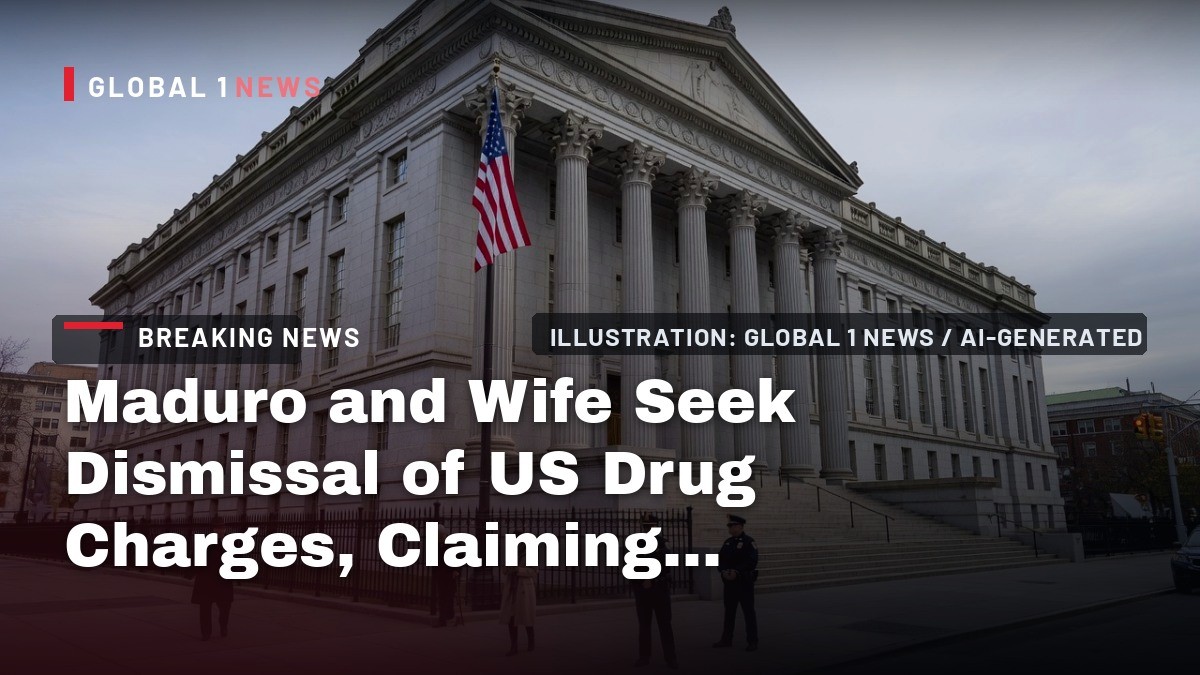
In a historic legal maneuver that could redefine the boundaries of international criminal law, former Venezuelan President Nicolás Maduro and his wife, Cilia Flores, have formally asked a U.S. judge to throw out the sprawling drug-trafficking indictment against them, arguing that they are immune from prosecution as the recognized head of state and first lady of a foreign nation. The papers, filed Wednesday in Manhattan federal court, represent the most significant legal challenge yet to a case that has already broken new ground by placing a captured foreign leader in a Brooklyn jail cell. The motion sets the stage for a contentious legal battle over whether a U.S. courtroom can exercise jurisdiction over a sitting—albeit disputed—foreign sovereign.
Immunity Motion: A Claim of Absolute Sovereign Protection
The defense team for Maduro, 63, filed a memorandum in the Southern District of New York asserting that the court lacks jurisdiction over their client, not on the merits of the case, but on the fundamental principle that a head of state cannot be subjected to the criminal process of another nation. The argument is rooted in centuries-old doctrines of international law, which the defense argues have never been set aside in an American courtroom for a leader recognized by his own country.
"No American court has ever presided over the criminal trial of a foreign leader who was recognized by their own country as the sitting head of state at the time the charges were brought," the memorandum states. "That is not an accident of history. It reflects a rule older than the common law: heads of state are exempt from the criminal process of any national court but their own."
The filing goes further, framing the immunity not as a privilege granted by the United States, but as an inherent right of sovereign nations. "That immunity flows not from goodwill that can be withdrawn on a whim, but from the perfect equality and absolute independence of sovereigns," the lawyers wrote. "Thus, this Court lacks jurisdiction with respect to Mr. Maduro, who is recognized by the Bolivarian Republic of Venezuela as its head of state."
Official Acts Defense: The Core of the Legal Strategy
Beyond the blanket claim of head-of-state immunity, Maduro’s legal team has advanced a secondary, conduct-based argument. They contend that even if the court were to find that head-of-state immunity does not apply, the specific actions alleged in the indictment were official acts carried out in his capacity as a leader, and therefore cannot be the subject of criminal prosecution in a foreign court.
"The official character of these acts - such as issuing diplomatic passports, deploying the military, and announcing Venezuelan foreign policy - is apparent from the face of the Indictment," the memorandum argues. "Because these actions were undertaken in his official capacity on behalf of a foreign sovereign, he may not be required to respond in this Court to the Indictment's characterizations of his motives and intent in taking these actions."
This line of reasoning seeks to preempt the prosecution’s narrative that Maduro used the levers of state power to facilitate a criminal enterprise. By characterizing the alleged conduct as quintessential sovereign functions, the defense aims to place the actions beyond the reach of U.S. criminal law, regardless of the alleged underlying intent.
In a separate but related argument, the defense insists on Maduro’s factual innocence. The former president "vehemently denies that he had anything to do with drug trafficking or intended to benefit anyone engaged in terrorism," according to the filing. His lawyers added a pointed warning about the potential outcome of a trial: "If this case were to proceed to trial, it would be apparent that he has been falsely accused."
Cilia Flores’ Separate Filing: Sovereignty Belongs to Venezuela
Cilia Flores, 69, who faces charges alongside her husband, filed her own separate papers on Wednesday, asserting a parallel claim of immunity. Her legal team argues that as the spouse of the head of state, she too is shielded from prosecution under principles of sovereign immunity.
"It is an attribute of Venezuela's sovereignty, and only Venezuela may surrender it," her lawyers wrote in the filing. This argument mirrors the central tenet of her husband’s motion: that the immunity belongs to the foreign state, not the individual, and that only the state itself—not a U.S. prosecutor or judge—can waive it.
The separate filing underscores the coordinated nature of the defense strategy, as both defendants seek to have the indictment dismissed on jurisdictional grounds before the case proceeds to the merits. The court will now have to grapple with whether the immunity extends to a first lady who is not herself the head of state, a question that adds another layer of complexity to an already unprecedented legal scenario.
The Charges: A Fourth Superseding Indictment and Decades of Alleged Conspiracy
The motion to dismiss targets a fourth superseding indictment that was unsealed by the U.S. Attorney's Office for the Southern District of New York in January 2026. The indictment charges Maduro with narco-terrorism conspiracy, and charges both Maduro and Flores with cocaine importation conspiracy, possession of machine guns and destructive devices, and conspiracy to possess machine guns and destructive devices.
The allegations paint a picture of a decades-long criminal partnership. The indictment alleges that Maduro, first as a deputy in Venezuela's National Assembly and later as the country's president, conspired with narco-terrorists from some of the world's largest cartels to facilitate the importation of cocaine into the United States. U.S. prosecutors have stated that Maduro carried out a conspiracy to move thousands of tons of cocaine into the U.S. by colluding with Venezuelan law enforcement to protect and assist drug kingpins.
The charges carry the potential for life prison sentences if a jury agrees that the defendants were part of a conspiracy to send cocaine into the United States. Both Maduro and Flores have pleaded not guilty to the charges, which were first brought six years ago. The original charges were announced in 2020 by then-U.S. Attorney Geoffrey Berman, and a $15 million U.S. reward was offered for information leading to Maduro's capture.
Capture and Detention: From Caracas to a Brooklyn Jail
The legal proceedings are the culmination of a dramatic and controversial operation that began in early January 2026. Maduro and Flores have been held at a Brooklyn jail since U.S. forces seized them from their Caracas home in a middle-of-the-night raid on January 3, 2026, an operation code-named "Absolute Resolve." They were subsequently brought to New York to face the federal charges.
On January 5, 2026, Maduro was escorted to the Daniel Patrick Moynihan Manhattan U.S. Courthouse for an initial appearance. There, he faced charges including narco-terrorism, conspiracy, drug trafficking, and money laundering. The Trump administration has defended the raid as a "surgical law enforcement operation," while Maduro has characterized his capture as a kidnapping and has referred to himself as a prisoner of war.
The circumstances of his detention are central to the defense’s broader narrative of overreach. The fact that he was physically brought to the United States by military force, rather than through an extradition process, raises questions that the defense is likely to press, even as their primary argument rests on immunity.
Due Process and Extraterritoriality: Challenging the Reach of U.S. Law
In addition to the immunity arguments, Maduro’s defense team has raised a separate challenge based on due process and the extraterritorial reach of U.S. law. They argue that the indictment fails to establish that the alleged crimes took place in or were aimed at the United States, a requirement they say is necessary for the court to exercise jurisdiction.
The defense points to the narco-terrorism statute, which was enacted in 2006 with the USA PATRIOT Act reauthorization. This statute includes a jurisdictional element that authorizes prosecution of foreign conduct under only five enumerated scenarios that connect the conduct to the United States. The motion argues that the Indictment fails to allege any such basis for jurisdiction over the solely foreign conduct it describes.
This argument strikes at the heart of the prosecution’s case, which relies on the theory that a conspiracy to flood the U.S. with cocaine has a direct and intended effect on American soil. The defense contends that the government has not met the legal threshold to bridge the gap between Maduro’s alleged actions in Venezuela and the jurisdictional requirements of the statute.
Next Steps: Oral Arguments and a Trial Date
The motions to dismiss will be heard by Judge Alvin K. Hellerstein, who has set oral arguments for November 17, 2026. The judge will consider the complex legal questions surrounding head-of-state immunity, official acts, and extraterritorial jurisdiction before deciding whether the case can proceed.
Federal prosecutors are scheduled to file their response to the defense arguments later this month, in September 2026. Their response will be critical in shaping the judge’s analysis, as they will need to articulate a legal basis for overcoming the immunity claims and establishing jurisdiction over the foreign defendants.
If the motions to dismiss are denied, the case is scheduled to go to trial on June 1, 2027. The trial would be a landmark event, bringing the former leader of a foreign nation before a U.S. jury to answer for alleged crimes committed while in office. The defense’s insistence on a trial, should it come to that, suggests a strategy of challenging the evidence and the narrative of the prosecution.
An Unprecedented Case: The First Foreign Head of State in a U.S. Courtroom
The Maduro prosecution is without precedent in American history. Never before has a foreign head of state been captured by U.S. forces and put on trial in an American courtroom for drug trafficking. This fact is central to the defense’s argument, which posits that the absence of prior cases is not a coincidence but a reflection of a deeply held legal principle.
The case has also raised significant questions on the international stage. After Maduro's removal, Venezuela's high court ordered his former vice president and socialist ally, Delcy Rodriguez, to assume the role of interim president. Rodriguez, who has run Venezuela since, is backed by the country's military, marking the first time a woman has held the office in Venezuela. The legality of the U.S. military operation that led to Maduro’s capture has been questioned internationally, with the UK House of Commons Library publishing a briefing on the issues of international law raised by the operation.
Legal observers note that the case tests U.S. courts' long-standing reluctance to apply international law in criminal cases. For more than a century, U.S. judges have weighed immunity claims in cases involving foreign officials, but the Maduro prosecution presents a unique confluence of factors: a disputed election, a military capture, and a head of state who is recognized by his own country’s institutions. The court’s decision on the immunity motion will be watched closely by governments and legal scholars around the world, as it could set a precedent for how the U.S. judiciary interacts with foreign sovereigns.
Analysis: What This Means for the Rule of Law and International Relations
For the average reader, this case is more than a legal drama about a foreign leader; it is a stress test of the American legal system’s ability to navigate the treacherous waters of international politics. The outcome of the immunity motion will determine whether the U.S. can hold a foreign leader accountable for crimes that allegedly affected American citizens, or whether the principle of sovereign equality will shield him from prosecution. If Judge Hellerstein allows the case to proceed, it would signal that the U.S. is willing to extend its criminal jurisdiction to the highest offices of foreign states, a move that could have profound implications for diplomatic relations and the safety of U.S. officials abroad. Conversely, if the motion is granted, it would affirm the traditional view that the immunity of a head of state is absolute, regardless of the severity of the alleged crimes. The decision, whichever way it goes, will not only determine the fate of Maduro and Flores but will also define the limits of American power in a world where the lines between national sovereignty and international justice are increasingly blurred.
This article was produced with AI-assisted research and editorial support. Sources: AP News, NPR, Reuters, Fox News, Al Jazeera.
By Jessica Ali, Staff Writer
What's Your Reaction?
 Like
0
Like
0
 Dislike
0
Dislike
0
 Love
0
Love
0
 Funny
0
Funny
0
 Wow
0
Wow
0
 Sad
0
Sad
0
 Angry
0
Angry
0

Editor-in-Chief at Global1.News. Atlanta-based journalist who cuts through the BS and tells it like it is. Lead anchor, host, and the voice you hear when the spin stops and the truth starts.













Comments (0)