
Kenya Orders Foreign Small Traders to Close as Ruto Backs Local Hawkers
Kenya’s President William Ruto has ordered a sweeping crackdown on foreign nationals operating small-scale businesses, declaring that local traders and hawkers need protection from competition in the country’s vast informal economy. The directive, issued...
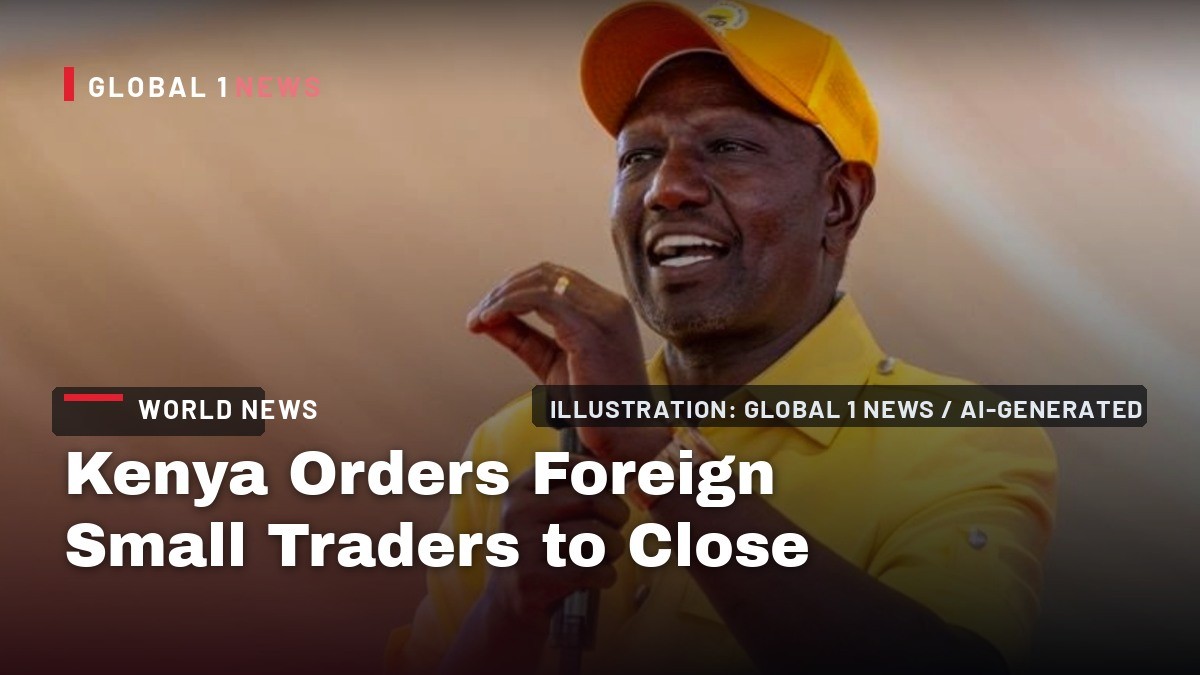
Kenya’s President William Ruto has ordered a sweeping crackdown on foreign nationals operating small-scale businesses, declaring that local traders and hawkers need protection from competition in the country’s vast informal economy. The directive, issued Wednesday afternoon during a meeting with small-scale traders at State House in Nairobi, is set to take effect on Monday, September 7.
“From next week, all [foreign] traders doing those small businesses should close them,” Ruto said, according to remarks carried by multiple Kenyan outlets. He also promised to fast-track proposed legislation that would preclude foreigners from certain areas of trade, arguing that Kenya remained open to foreign investment but that investors — including Chinese traders — should create jobs and expand production rather than compete with Kenyans in small businesses.
“It cannot be that a person comes from China or elsewhere to be a hawker or open a small shop,” the president told the assembled traders. “We have made efforts to improve the economy, we have not improved investor confidence for hawkers to come to Kenya.”
The announcement lands with political precision. Ruto plans to seek a second term in the Kenyan presidential election next year, and the informal sector represents a critical constituency. But the move also places Nairobi in a delicate position as East Africa’s dominant economic hub, a city whose markets, construction sites, and street corners have long absorbed migrants from across the region and beyond.
Who Will Be Affected? The Numbers Remain Unclear
It is unclear how many foreign nationals are involved in small-scale trading or how many would be affected by the crackdown. Government figures show that Kenya hosted about 857,000 registered refugees and asylum seekers by the end of June, with nearly 14 percent living in urban areas rather than in the country’s refugee camps. Kenyan law recognises the right of refugees to work and operate businesses, although they are required to obtain appropriate documentation — a special permit is available for those wishing to engage in trade or business.

In Nairobi and other major towns, migrants from the region can be found working in barber shops and salons, construction, operating motorbike taxis and street vending, as well as selling clothes, food and household goods. Some have fled conflicts or economic hardship at home; others have moved to Kenya in search of better opportunities under the relatively free movement of people allowed within the East African Community (EAC), a regional bloc of eight countries.
The practical mechanics of the crackdown remain undefined. Which businesses will be shuttered first? How will authorities distinguish between a refugee with a valid work permit and a migrant without documentation? Will enforcement target Nairobi’s central business district, the sprawling markets of Eastleigh, or extend to secondary cities like Mombasa and Kisumu? These questions hang over the directive as traders on both sides of the equation wait for clarity.
July’s Burundian Trader Incident: A Flashpoint of Tension
The growing presence of foreigners has at times caused tensions with local traders and workers who accuse them of competing for scarce jobs and business opportunities. In July, a video of a Kenyan man confronting a Burundian trader in Nairobi and accusing him of taking opportunities from locals sparked widespread criticism — and offered an early warning of the political currents Ruto is now navigating.
The clash prompted Fred Ngoga, an expert on regional conflict prevention from Burundi, to appeal for the protection of his country’s citizens. “The majority of Kenyans are decent and good people who welcome their brothers and sisters from Burundi,” he said at the time, adding that most Kenyans had rejected the hostility directed at the trader. Kenya’s foreign ministry also sought to reassure Burundians and other East Africans living in the country following the incident.
That reassurance now sits in tension with the president’s new directive. For Burundians, Rwandans, Ugandans, Tanzanians, South Sudanese, and Congolese who have built lives in Kenya’s informal economy, the message from State House is unambiguous: small-scale trade is reserved for Kenyans. The question is whether the enforcement will match the rhetoric — and what it will mean for the social fabric of neighbourhoods where migrants are not just economic actors but neighbours, customers, and friends.
The EAC Free-Movement Paradox
Kenya’s position as a signatory to the EAC’s free-movement protocols complicates the picture. The bloc has long aspired to a borderless region where goods, services, and people move freely. In practice, that vision has been unevenly realised — but Nairobi has drawn workers and investment from across the region as the bloc’s largest economy.
Ruto’s directive does not explicitly target EAC nationals, and his remarks focused on Chinese traders and unspecified “others.” But the language of protectionism is difficult to contain. When a president says small businesses should be closed to foreigners, a Ugandan street vendor in Nairobi hears the same message as a Chinese shopkeeper in Eastleigh. The distinction between “investor” and “hawker” may be clear in policy terms, but on the ground, the lines blur.
In economic terms, the informal economy is not strictly a zero-sum game. Migrants often fill niches — specific goods, specific services, specific supply chains — that generate demand and employment for Kenyans as well. Landlords rent to foreign traders. Kenyan wholesalers supply them. Kenyan transporters move their goods. A crackdown that removes one layer of the ecosystem can ripple outward in unpredictable ways, potentially hurting some of the very Kenyan traders the directive is meant to protect.
Refugees Caught in the Middle
For Kenya’s refugee population, the directive raises particular concerns. Government figures record about 857,000 registered refugees and asylum seekers, nearly 14 percent of them living in urban areas rather than camps. Under Kenyan law, refugees may work and operate businesses with the appropriate documentation, and a special permit is available for those wishing to engage in trade. The new crackdown does not explicitly revoke those rights, but the enforcement environment may change dramatically.
Kenya hosts a large refugee population, and many refugees live and work outside the country’s designated camps. The risk is that a broad sweep targeting “foreign traders” will catch permit-holding refugees who have played by the rules — a Somali refugee running a small shop in Eastleigh, a South Sudanese woman selling vegetables in a Nairobi market, a Congolese barber in a city salon could all find themselves subject to scrutiny, regardless of their legal status. The distinction between a refugee with a work permit and a migrant without one may be lost in the practical application of a crackdown driven by political imperatives.
The timing is also notable. Kenya has hosted refugees for decades — including large numbers from Somalia, South Sudan, and the Democratic Republic of Congo — and the new directive adds another layer of uncertainty for populations already living in precarious circumstances.
The Political Calculus: Re-Election and the Informal Sector
The timing of Ruto’s directive also carries political significance. The Kenyan presidential election is scheduled for next year, and the informal sector represents a massive constituency. The small-scale traders Ruto addressed at State House are not just economic actors; they are voters, community leaders, and influential voices in their neighbourhoods. By positioning himself as their champion against foreign competition, Ruto is consolidating a political base that will be crucial in the coming campaign.
The president’s framing is careful. He said Kenya remained open to foreign investment, and that investors — including Chinese traders — should create jobs and expand production rather than compete with Kenyans in small businesses. This distinction allows Ruto to maintain Kenya’s pro-investment posture while responding to grassroots grievances about competition. Whether that distinction holds in practice is another matter.
There is also a broader regional resonance. South Africa has seen a wave of protests about undocumented migrants this year, with tens of thousands of Africans there opting to be repatriated voluntarily, some saying they have been the targets of intimidation and attacks. Kenya’s crackdown, while framed in economic terms, taps into the same currents of anxiety about migration and competition that are coursing across the continent.
For comparison, West Africa has long travelled a different path: the free-movement protocols of the Economic Community of West African States (ECOWAS) allow citizens of member states to live and work across borders with relatively little friction. Senegalese traders operate in Abidjan, Ivorian merchants in Dakar, Nigerian businesses across the region. That system has its own tensions, but it reflects a different political settlement — one where mobility is understood as a right of regional citizenship rather than a concession to be revoked. Kenya’s approach, by contrast, suggests a more transactional relationship with its regional neighbours.
What Happens Next: Enforcement, Legislation, and Reaction
The directive is set to take effect on Monday, September 7. Between now and then, the government must define the parameters of enforcement. Which agencies will conduct the crackdown? Will there be a grace period for businesses to wind down? How will disputes be adjudicated? These operational details will determine whether the directive is a genuine policy shift or a political gesture aimed at shoring up support ahead of the election.
Ruto also promised to fast-track proposed legislation to preclude foreigners from certain areas of trade. That legislative process will be closely watched, both by foreign traders in Kenya and by the regional governments whose citizens may be affected. The EAC’s institutional response — if any — will also be significant. A formal protest from a member state could strain regional relations, while silence would signal acceptance of Kenya’s right to set its own labour market rules.
For now, the mood in Nairobi’s markets is one of uncertainty. How the directive will actually be enforced on the ground remains an open question — whether authorities will conduct sweeping closures, target specific sectors, or allow for exemptions and appeals. Foreign traders are weighing their options: some may formalise their operations, others may seek Kenyan partners, and still others may simply close up shop and move elsewhere. The full impact of the crackdown will only become clear in the weeks and months after September 7.
What is certain is that Kenya is making a choice. As the region’s economic hub, Nairobi has benefited enormously from its openness — to capital, to goods, and to people. The new directive signals that openness has limits, and that the protection of local livelihoods will take precedence over the free movement of small-scale traders. Whether that choice strengthens Kenya’s economy or diminishes its regional standing will be measured in the markets, streets, and polling stations of the coming year.
This article was produced with AI-assisted research and editorial support. Sources: BBC News, The Kenya Times, TUKO.co.ke, Anadolu Agency, Kenyans.co.ke.
By Amara Diop, Staff Writer
What's Your Reaction?
 Like
0
Like
0
 Dislike
0
Dislike
0
 Love
0
Love
0
 Funny
0
Funny
0
 Wow
0
Wow
0
 Sad
0
Sad
0
 Angry
0
Angry
0

West Africa/Sahel Correspondent at Global1.News. Dakar-based journalist covering politics, security, climate, and development across Francophone and Anglophone West Africa. Tells the stories of a region undergoing profound transformation.












Comments (0)