
Norway's Crown Prince Becomes King Haakon VIII After His Father's Death
A New King for an Ancient Throne: Haakon VIII Ascends as Norway Faces a Royal Reckoning COPENHAGEN — The bells of Oslo Cathedral have not yet fallen silent, but the weight of a thousand years of history has already settled on the shoulders of a new monarch. Crown Prince Haakon, 53, became King Haakon VIII on Friday following the death of his father, King Harald V.
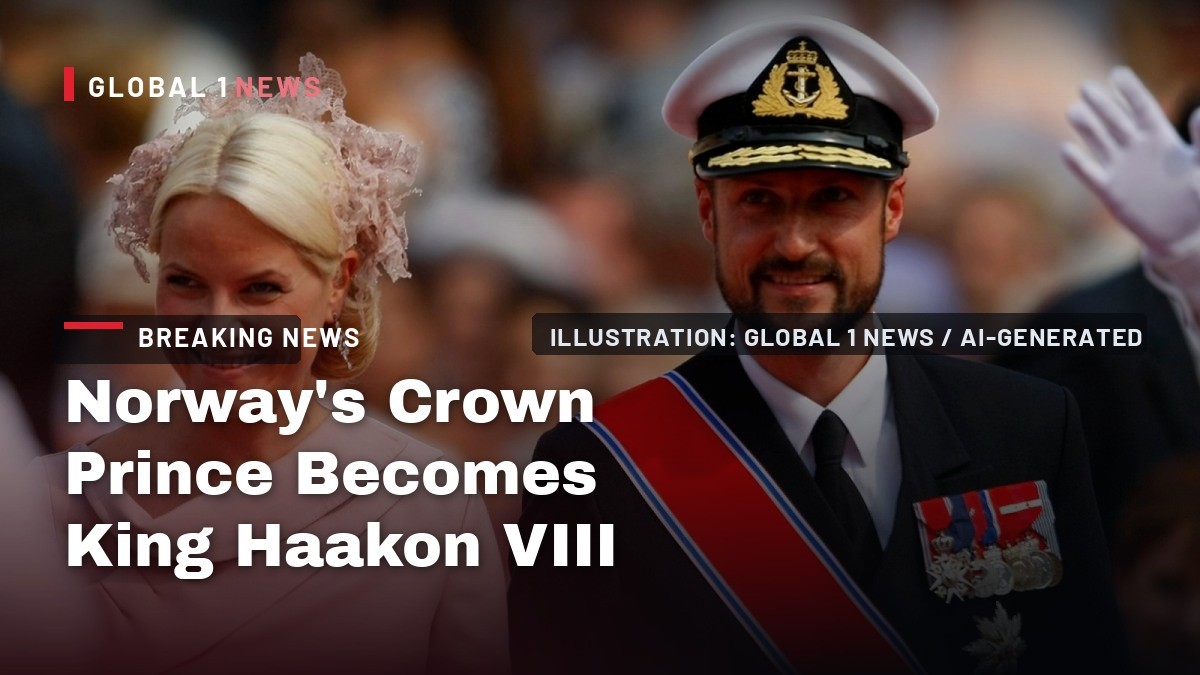
A New King for an Ancient Throne: Haakon VIII Ascends as Norway Faces a Royal Reckoning
COPENHAGEN — The bells of Oslo Cathedral have not yet fallen silent, but the weight of a thousand years of history has already settled on the shoulders of a new monarch. Crown Prince Haakon, 53, became King Haakon VIII on Friday following the death of his father, King Harald V. The transition, while long anticipated as the elder king’s health declined, marks a pivotal moment not just for the Scandinavian nation, but for the very institution of monarchy in a modern European democracy.
For Thai readers who hold their own monarchy in the deepest reverence, the news from Oslo carries a particular resonance. The challenges facing the new Norwegian king — stabilizing a royal house buffeted by scandal, navigating the complex legacy of a stepson’s criminal conviction, and restoring public faith in an ancient institution — are a reminder that even the most established thrones must adapt to the currents of a changing world. As King Haakon VIII steps into his role, he inherits a crown that traces its lineage to King Harald Fairhair in the ninth century, a continuity that echoes the deep roots of our own Chakri dynasty.
A Monarch Prepared by Duty and Tragedy
King Haakon VIII is not a stranger to the burdens of the throne. In recent years, as his father’s health faltered, the then-Crown Prince served as regent on multiple occasions, stepping into the constitutional role with a quiet competence that earned him respect across the political spectrum. He knows the machinery of state, the protocols of power, and the delicate balance between symbolic leadership and the real authority of Norway’s elected parliament.
His path was set from birth. Born two years after his sister, Princess Märtha Louise, Haakon became heir to the throne in 1991 upon the death of his grandfather, King Olav, because he was the oldest male. The Norwegian Constitution was amended in 1990 to allow future firstborns of any gender to take precedence in the line of succession, but the change was not applied retroactively. Now, with his ascension, his eldest child, Ingrid Alexandra, becomes Crown Princess and heir to the throne — a historic moment for a nation that has embraced gender equality as a cornerstone of its identity.
Haakon’s preparation has been both academic and practical. He holds a bachelor’s degree in political science from the University of California at Berkeley and a master’s degree in development studies from the London School of Economics and Political Science, with a specialization in international trade and Africa. He graduated from the Royal Norwegian Naval Academy in 1995 and completed the Foreign Ministry’s trainee program for diplomats. Yet for all his formal education, the new king has often spoken of a simpler dream. In a 1998 book, he confessed that as a child he dreamed of owning a toy shop, before realizing that his path was already paved. An avid surfer, skier, and sportsman, he once told Norwegian broadcaster NRK that if he had not been born royal, he would have been a surfer.
A Love Story That Divided a Nation
The new king’s personal journey has been as scrutinized as his public duties. When Haakon met Mette-Marit Tjessem Høiby at a popular music festival in 1999, he knew the relationship would face an uphill battle. She was a single mother whose son’s father had been sentenced to prison for cocaine possession, and she had been seen at parties where illegal drugs were used. The country was divided — some cheered for love, others were deeply skeptical.
In a May 2000 interview with NRK, Haakon acknowledged that in the early 1990s, “a youth culture emerged in Oslo” and that Mette-Marit was “an active part of this environment at the time.” He admitted, “It is clear that there is relatively extravagant partying there.” Yet he sought and won permission from his father — who had himself married a commoner — to wed Mette-Marit. They married in August 2001 at Oslo Cathedral, and despite her background, the Norwegian people found much to admire in this statuesque blond woman with a down-to-earth manner and an undisguised love for her husband.
The couple’s popularity soared, cultivated through a careful blend of the common touch and the glamor demanded of royalty. They have two children together, Ingrid Alexandra and Prince Sverre Magnus, and Haakon became stepfather to Mette-Marit’s son, Marius Borg Høiby, who holds no royal title. For years, the family projected an image of modern, approachable monarchy — a model that resonated with Norwegians who valued their royals as symbols of national unity rather than distant figures of power.
The Scandals That Shook the Throne
That carefully cultivated image has been severely tested in recent years. In June, Marius Borg Høiby was sentenced to four years in prison after being convicted of rape. He was found guilty of two of the four rape charges he faced and acquitted of the other two, but was also convicted of assault and abuse in a close relationship. His lawyers have said they will appeal the convictions. The trial unfolded amid renewed scrutiny of the royal family following disclosures about Mette-Marit’s past contacts with Jeffrey Epstein, the deceased sex offender.
The Queen — as Mette-Marit is now styled — has publicly apologized for her association with Epstein, saying she exercised poor judgment in maintaining contact with him. She is not accused of any wrongdoing. In a television interview in March, she said she was manipulated and deceived by Epstein and felt unsafe during a 2013 encounter with him at his Palm Beach, Florida, mansion. The revelations have cast a long shadow over the royal house, and the new king’s task of stabilizing the monarchy will require navigating these painful chapters with transparency and grace.
Adding to the family’s reputational troubles is the matter of Haakon’s sister, Princess Märtha Louise, who has written books in which she claimed to have contact with angels. In 2024, she wed Durek Verrett, an American who describes himself as a shaman and healer. In 2022, she announced she would no longer officially represent the Norwegian royal house, following “many questions relating to me and my fiancé’s role.” Critics blame her for contributing to the family’s declining popularity.
A Fragile Mandate in a Modern Democracy
The new king’s most pressing task will be shoring up popular support for the monarchy. While a majority of Norwegians still support the institution, the proportion has declined in recent years. A poll published by Norway’s Dagbladet newspaper in late 2022 showed 68% of respondents saying they wanted to keep the monarchy. When NRK asked the same question in 2017, support stood at 81%. The trial of Marius Borg Høiby this year has taken a further battering on those numbers.
Norway’s monarchy has ancient roots, but its modern form is a relatively recent construction. When Norway regained its independence from Sweden in 1905, three-quarters of voters in a national plebiscite approved restoring the monarchy. Today, the role is largely symbolic — power lies with an elected parliament — but the royal family retains celebrity and a role in promoting the wealthy nation around the world. For a country that prides itself on egalitarian values, the monarchy exists in a delicate tension: it must be both ordinary and extraordinary, both of the people and above them.
For Thai readers, this balancing act is deeply familiar. Our own monarchy has navigated similar currents, adapting ancient traditions to the demands of a modern constitutional state. The challenges facing King Haakon VIII — the scrutiny of personal lives, the weight of public expectation, the need to remain relevant in a rapidly changing society — are universal challenges for any institution that claims both historical legitimacy and contemporary relevance.
Health, Resilience, and the Road Ahead
Queen Mette-Marit’s health adds another layer of complexity to the new reign. In 2018, the royal palace announced that she had been diagnosed with a rare form of chronic pulmonary fibrosis, an incurable condition that made breathing increasingly difficult and brought a dry cough, fatigue, weight loss, and loss of appetite. She received a lung transplant in June, a major procedure that underscores the fragility of her condition. The new king will need to balance his duties with the care his wife requires, a challenge that will test his resilience and the support of the Norwegian people.
Yet there is also warmth and continuity in the royal family’s story. In connection with the couple’s 50th birthdays in 2023, NRK interviewed Haakon and aired old videos of him playing guitar, with Ingrid Alexandra and Mette-Marit singing, and another where he and his children mimic the moves of a Norwegian rapper. He watched the clips and burst into laughter, saying they showed that “I am all in.” That human quality — the willingness to be seen, to laugh at oneself, to embrace the messiness of family life — may be the new king’s greatest asset.
As King Haakon VIII begins his reign, he carries forward a legacy that is both ancient and evolving. The monarchy he now leads is a symbol of Norwegian identity, a thread connecting the Viking age to the digital era. For the people of Norway, and for observers across the world — including here in Southeast Asia, where monarchies hold deep cultural and spiritual significance — his success will depend on his ability to honor the past while embracing the future. The bells have rung, the throne is filled, and a new chapter in Norway’s long history has begun.
By Ann Srisawat, Staff Writer
This article was produced with AI-assisted research and editorial support. Sources: Khaosod English.
What's Your Reaction?
 Like
0
Like
0
 Dislike
0
Dislike
0
 Love
0
Love
0
 Funny
0
Funny
0
 Wow
0
Wow
0
 Sad
0
Sad
0
 Angry
0
Angry
0

Southeast Asia Correspondent at Global1.News. Based in Bangkok, covering Thai and Southeast Asian politics, economy, technology, and culture. Deep regional perspective on one of the world's most dynamic regions.












Comments (0)