
Kim Min-seok Wins Democratic Party Chair in Ranked-Choice Runoff
The Democratic Party of Korea (DP) has a new leader. Former Prime Minister Kim Min-seok was elected party chair at the party’s national convention in Daejeon on August 17, 2026, defeating incumbent chair Jung Chung-rae by a margin of 54.08 percent to 45.92 percent. The result closes a six-week leadership race that laid bare the deepening factional divisions within the ruling party—divisions that map directly onto the political fortunes of President Lee Jae-myung.
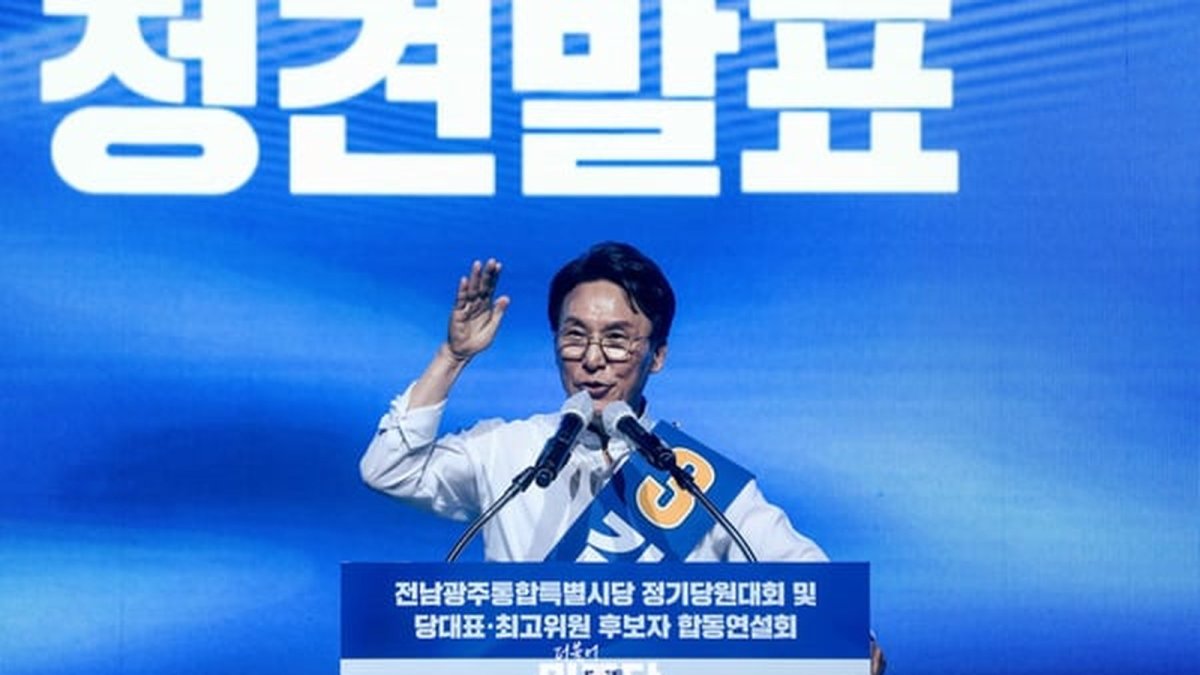
The Democratic Party of Korea (DP) has a new leader. Former Prime Minister Kim Min-seok was elected party chair at the party’s national convention in Daejeon on August 17, 2026, defeating incumbent chair Jung Chung-rae by a margin of 54.08 percent to 45.92 percent. The result closes a six-week leadership race that laid bare the deepening factional divisions within the ruling party—divisions that map directly onto the political fortunes of President Lee Jae-myung.
The victory was not a straightforward one. Kim failed to secure a first-round majority under the party’s newly adopted one-member, one-vote system, triggering a ranked-choice runoff for the first time in the DP’s history. Under that process, the second-choice votes of third-place finisher Rep. Song Young-gil were redistributed between Kim and Jung, ultimately delivering Kim his final margin. The outcome positions Kim to oversee candidate nominations for the April 2028 general elections, a role that will test his ability to unify a party still recovering from a contentious internal contest.
The Mechanics of a Historic Runoff
The DP’s leadership race was conducted under a new voting framework that weighted dues-paying members and delegates at 70 percent, with a national opinion survey accounting for the remaining 30 percent. The public opinion poll, conducted over two days by two polling firms among a combined 4,000 respondents reached by automated phone survey, was limited to Democratic Party supporters and independents to screen out backers of the conservative opposition. Because the system does not guarantee a majority winner, the party adopted ranked-choice voting: if no candidate clears 50 percent on first-preference ballots, the last-place finisher is eliminated and votes are reallocated by second choice. Voting took place in waves, with results announced region by region. Kim narrowly outpolled Jung in the opening round in Chungcheong on August 1, taking 45.05 percent to Jung’s 44.61 percent, with Song a distant third at 10.34 percent. Jung answered the next day in Busan, Ulsan, and South Gyeongsang Province, beating Kim 46.65 percent to 43.85 percent. The race turned decisively in Kim’s favor on August 15 in Gwangju and the Jeolla provinces—the party’s largest single bloc of members at roughly a third of the total. Kim won 57.54 percent there to Jung’s 32.65 percent, pushing his cumulative share past 50 percent for the first time. The final regional round, in Seoul and Gyeonggi Province on August 16, went to Kim by a razor-thin margin of 46.66 percent to 46.28 percent, pulling his majority back below 50 percent and leaving him with an overall cumulative lead of 49.91 percent to 41.51 percent heading into the convention. The ranked-choice redistribution of Song’s votes then delivered Kim his final 54.08 percent.A Proxy Fight for the Soul of the Party
The contest was widely understood as a proxy fight between the pro-Lee camp and a harder-line faction associated with Jung, who has at times pushed back against the presidential office on the pace of judicial overhaul and other issues. Kim’s campaign speech in July framed the race as a referendum on whether the party would fully back Lee’s agenda—a framing that resonated strongly in the party’s traditional strongholds. Kim’s strongest results came in Gwangju and the Jeolla provinces and the greater Seoul area after Lee announced an 800 trillion won ($564 billion) semiconductor investment package for the Gwangju region. The timing of that announcement, coming just days before the Gwangju and Jeolla voting round, was widely seen as a strategic intervention by the presidential office on Kim’s behalf. It was a reminder that in Korean party politics, the resources of the Blue House—or in this case, the presidential office in Yongsan—can still shape internal contests. Overall, however, Lee’s approval rating slipped to 44 percent in recent days, the lowest since he took office, according to local media reports. That slippage suggests that while Lee’s endorsement carried weight within the party, the broader public mood is more cautious. The 44 percent figure, while still respectable by recent Korean presidential standards, signals that the administration’s political capital is not unlimited as it approaches the mid-point of its term.Kim Min-seok: The 86 Generation’s Long Road Back
Kim Min-seok’s political biography is, in many ways, a microcosm of the Democratic Party’s own turbulent history. A former student council president at Seoul National University, Kim was a leading figure of the “86 generation”—those born in the 1960s who attended university in the 1980s and spearheaded the pro-democracy movement. In the 1996 general elections, he became the youngest member of the National Assembly at age 32 and won reelection four years later. His career then took a dramatic turn. In 2002, he gave up his seat to run as the Millennium Democratic Party’s candidate for Seoul mayor, losing to Grand National Party candidate Lee Myung-bak. Later that year, in a move that would haunt him for nearly two decades, Kim bolted from the party and joined presidential candidate Chung Mong-joon’s party, National Unity 21, in the process of unifying the party’s standard-bearer between Roh Moo-hyun and Chung. The episode branded Kim a political turncoat, and the ensuing fallout cost him his seat in the 2004 general elections and consigned him to a prolonged period in the political wilderness. Kim’s rehabilitation began in 2016 when he rejoined the Democratic Party. He returned to the National Assembly after an 18-year hiatus by winning the Yeongdeungpo B constituency in Seoul in the 2020 general elections, and won reelection in 2024 to become a four-term lawmaker. His ties with Lee Jae-myung began in 2022 during Lee’s second bid for the Blue House, when Kim served as head of strategic planning within the party’s election campaign committee. Following Lee’s defeat, Kim continued as a key aide, serving as chair of the policy committee in Lee’s first term as party chairman and later as head of the situation room for the election campaign committee during the 2024 general elections. During Lee’s second stint as party chairman starting in August 2024, Kim worked closely with Lee as a senior member of the Supreme Council. At the time, Kim warned of the possibility of the Yoon administration declaring martial law—a warning that drew considerable attention after the incident actually occurred. In last year’s presidential election, Kim directed Lee’s campaign as a standing co-chair of the election campaign committee and eventually served as the first prime minister of the Lee administration. His elevation to party leader is thus the culmination of a four-decade arc that has seen him move from student activist to political pariah to the highest ranks of power.The Supreme Council: A Split Verdict
Alongside the chair, the convention seated five Supreme Council members from an eight-candidate field. Voters picked two of the eight names, and the five candidates with the highest combined vote share won seats, with the top finisher becoming senior Supreme Council member. Five of the eight candidates were aligned with the pro-Lee camp—Rep. Park Sun-won, Rep. Kim Yong, Rep. Seo Mi-hwa, Rep. Kim Young-ho, and Rep. Im Mi-ae—while three were aligned with Jung’s camp: Rep. Choi Min-hee, Rep. Han Min-soo, and Rep. Lee Sung-yoon. Late on August 16, two lower-ranked pro-Lee candidates, Im Mi-ae and Kim Young-ho, dropped out of the race and threw their support behind Kim Yong in an effort to consolidate pro-Lee votes and prevent Jung’s camp from taking three of the five seats. The final results confirmed a split verdict. Choi finished first by vote share and will serve as senior Supreme Council member, followed in order by Park Sun-won, Seo Mi-hwa, Lee Sung-yoon, and Han Min-soo. Three of the five seats went to lawmakers aligned with Jung, while only two went to pro-Lee lawmakers. The consolidation effort on the pro-Lee side partially failed, leaving the Supreme Council with a factional balance that will require careful management.The ABC Plan and a “Creative Horizontal Relationship”
In his acceptance speech, Kim pledged to reshape the party around people’s livelihoods, broader political outreach, and competent governance, while emphasizing a “creative horizontal relationship” of cooperation with President Lee’s administration. “I will change the Democratic Party,” Kim said, adding that the party’s “language, policies, attitudes and culture will all evolve.” Kim introduced what he called the “Democratic Party ABC Plan,” built on three pillars: “Affordability,” focusing on livelihoods and the cost of living; “Broadening,” aimed at expanding the party’s political reach and support base; and “Competence,” emphasizing capable, livelihood-oriented politics that delivers tangible results. The framework echoes the “ABCDE” strategy—AI, biotechnology, cultural content, defense industry, and energy—that Kim said he designed while serving as prime minister. On the relationship between the ruling party and the presidential office, Kim described it as “a creative horizontal relationship of full cooperation that supports the president and the government at the center of state affairs.” This framing is notable for what it does not say: it avoids the language of subordination that has sometimes characterized ruling party-president relations in Korea, while also steering clear of the independence that Jung’s camp had advocated. Kim’s formula suggests a middle path—loyal but not servile—that may prove difficult to sustain in practice.Implications for 2028 and the Party’s Trajectory
The outcome of this leadership race carries significant implications for the DP’s trajectory ahead of the April 2028 general elections. Kim’s victory consolidates Lee’s control over the party apparatus, at least at the leadership level. The new chair’s mandate to oversee candidate nominations gives the pro-Lee camp a powerful tool to shape the party’s parliamentary slate. Yet the Supreme Council results—with three of five seats going to Jung-aligned lawmakers—suggest that the factional balance within the party is more contested than the chairmanship result alone would indicate. Kim’s reference to former President Kim Dae-jung as his lifelong mentor and President Lee as his longtime political colleague is significant. It positions him as a bridge between the party’s democratic movement heritage and its current governing responsibilities. His warning that “even greater internal and external storms will come” acknowledges the challenges ahead, from economic pressures to the complex geopolitical environment on the Korean Peninsula. The 44 percent approval rating for Lee is a cautionary signal. While the president retains a solid base, the erosion of support suggests that the administration cannot take its political position for granted. Kim’s emphasis on affordability and livelihoods reflects a recognition that the party’s electoral fortunes will depend on its ability to address everyday economic concerns rather than purely ideological appeals. For scholars of Korean politics, this leadership race offers a case study in how the Democratic Party continues to navigate its internal tensions between loyalty to a sitting president and the institutional autonomy of the party itself. The ranked-choice runoff, adopted to ensure legitimacy under the new one-member, one-vote system, functioned as intended—producing a majority winner while exposing the depth of factional division. Whether Kim can translate his narrow victory into effective party leadership will be one of the key questions of Korean politics over the next two years. This article was produced with AI-assisted research and editorial support. Sources: The Diplomat, The Hankyoreh, The Korea Post. By Prof. David Park, Staff WriterWhat's Your Reaction?
 Like
0
Like
0
 Dislike
0
Dislike
0
 Love
0
Love
0
 Funny
0
Funny
0
 Wow
0
Wow
0
 Sad
0
Sad
0
 Angry
0
Angry
0
Prof. David Park
East Asia/Technology Correspondent at Global1.News. Seoul-based voice covering Korean politics, technology, business, and culture. Analyzes how technology and geopolitics intersect across East Asia.













Comments (0)