
K-Tourism Wave: Foreign Spending Surge Signals New Phase in Korea's Inbound Boom
K-Tourism Wave: Foreign Spending Surge Signals New Phase in Korea's Inbound Boom Seoul, South Korea – August 11, 2026 The Republic of Korea's post-pandemic tourism recovery has evolved from a quantitative rebound in arrivals to a qualitative transformation in visitor expenditure.
K-Tourism Wave: Foreign Spending Surge Signals New Phase in Korea's Inbound Boom Seoul, South Korea – August 11, 2026
The Republic of Korea's post-pandemic tourism recovery has evolved from a quantitative rebound in arrivals to a qualitative transformation in visitor expenditure. New data from BC Card and the Ministry of Culture, Sports and Tourism (MCST) show foreign tourists returning in record numbers while altering their consumption patterns, with medical services and lifestyle-oriented long stays emerging as the new frontiers of the "K-tourism" economy.
The Spending Surge in Numbers
BC Card reported on August 3, 2026, that foreign tourist card spending in South Korea rose 53.6% year-on-year during the first half of 2026, with the number of transactions increasing 40.3%. The analysis, based on 3.3 million foreign-issued cards, did not disclose the total transaction amount, but the trajectory is unmistakable. Corroborating this, the MCST reported that foreign visitors spent 10.04 trillion won (approximately US$9 billion) in H1 2026, a 50.8% increase from the same period in 2025.

This spending growth is outpacing the already impressive growth in arrivals. South Korea welcomed 10 million visitors in the first half of 2026, surpassing pre-pandemic levels according to the Korea Herald. The first quarter alone saw 4.76 million foreign visitors, an all-time high representing 23% year-on-year growth per the Korea Tourism Organization. March 2026 exceeded 2.06 million monthly arrivals — the largest monthly total in Korean history — boosted by a BTS comeback concert weekend, while April recorded 2,027,860 arrivals, equivalent to 124% of the April 2019 level.
The geographic distribution of spending is also broadening: Busan payments rose 57.9% year-on-year, and Jeju Island saw an even more dramatic increase of 63.7%, with growth recorded well beyond the traditional Myeongdong tourist enclave. This decentralization suggests that the tourism economy is beginning to diffuse beyond the capital region, with meaningful implications for regional economic balance.
The Medical Tourism Transformation
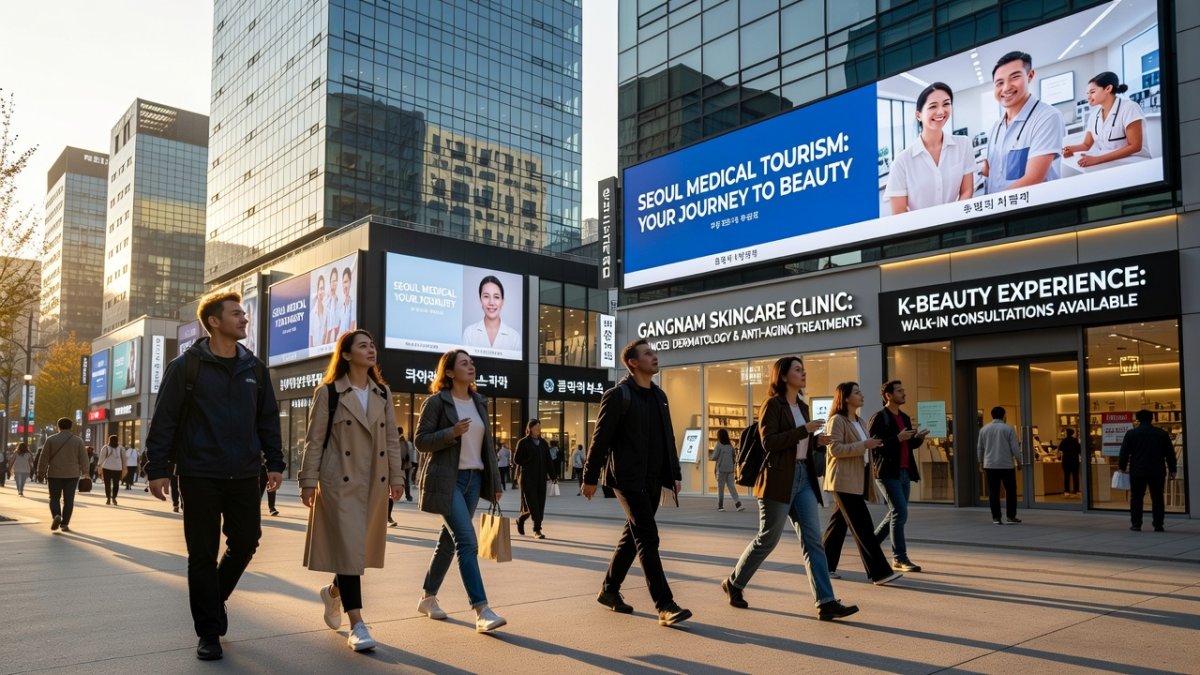
The most striking finding in the BC Card data concerns medical tourism. Foreign visitors' card spending on medical services nearly doubled, rising 98% year-on-year — the fastest growth among all major spending sectors, ahead of clothing at 56.3%.
Most significant is the reversal in the composition of medical spending. Dermatology now accounts for 67.5% of foreign visitors' medical expenditure, dramatically ahead of plastic surgery at 21.3% — a complete inversion from H1 2024, when plastic surgery commanded 46.2% of spending and dermatology trailed at 32.6%. Dermatology spending rose 109.8% year-on-year, while plastic surgery grew a comparatively modest 35.5%. Pharmacy spending soared an extraordinary 1,176.9% year-on-year, with its share of medical spending climbing from 0.3% in H1 2025 to 2% in H1 2026.
Seoul accounts for 92.8% of total medical spending, but the internal geography of that spending is shifting. Gangnam district, long synonymous with Korean aesthetic medicine, saw its share of medical spending in the capital decline by 10.4 percentage points to 39.8%. Meanwhile, Seocho district's share rose 6.7 percentage points to 27.6%, and Jung district gained 3.4 percentage points to reach 7.5%.
BC Card frames this as the emergence of a new economic structure: "A new tourism ecosystem linking medical services and shopping appears to be taking shape. Medical tourism is expected to emerge as a new growth engine for inbound tourism." The connection between clinical visits and retail expenditure represents a significant value-chain integration.
Diversification of Source Markets
The spending data reveals notable diversification in source markets, even as China retains its dominant position. Card usage growth by nationality shows Chinese visitors leading at +56.6%, followed by Singapore at +46.8%, Taiwan at +44.3%, and Japan at +40.1%. Chinese visitor spending jumped 82.7% year-on-year. BC Card attributes the overall consumption rise to "the recovery in the number of Chinese visitors, South Korea's largest inbound tourism market."
The Q1 2026 source mix confirms this pattern. China contributed 1.45 million visitors, up 29% year-on-year. Japan followed with 940,000 visitors (+20.2%), while the United States and Europe combined contributed approximately 690,000 visitors (+17.1%). Taiwan emerged as the fastest-growing major market with 540,000 visitors, a remarkable 37.7% increase. This diversification reduces Korea's vulnerability to any single market's fluctuations, though China's continued centrality means Seoul-Beijing relations will remain a critical variable in the tourism sector's trajectory.
Policy Support and the 23 Million Target
The Lee Jae-myung administration has responded to this momentum with ambitious targets and concrete policy measures. Following the 18.94 million foreign visitors recorded in 2025, the MCST has raised its 2026 target to 23 million, a 21.4% increase, and set a longer-horizon goal of 30 million annual visitors by 2029 — a figure that would represent a fundamental reorientation of the Korean economy toward service exports.
Policy infrastructure is being expanded to support these targets. The Ministry of Justice has extended the K-ETA exemption through December 31, 2026, applying to 22 visa-free countries including the United States, Canada, the United Kingdom, and Australia. In March 2026, Korea expanded eligibility for five- and ten-year multi-entry visas to cover 12 countries, including China, Vietnam, and the Philippines. The number of countries with access to automated immigration kiosks has more than doubled, from 18 to 42. Visitor satisfaction has reached 90.8 on the government's 100-point index, suggesting that the qualitative experience is keeping pace with quantitative growth.
Changing Travel Patterns: Long Stays and Lifestyle Tourism
Perhaps the most forward-looking indicator is the emergence of long-stay tourism as a distinct market segment. Creatrip, a travel platform popular among Asian visitors, reported that one-month stay product transactions rose approximately 272% year-on-year between January 1 and May 10, 2026. Taiwanese tourists account for about 60% of these bookings, representing a 172% year-on-year increase; Hong Kong constitutes the second-largest share, while Japanese visitors represent approximately 10% of bookings.
Creatrip CEO Lim Hye-min articulated the underlying shift: "Foreigners these days perceive the experience of actually living in Korea as an important element of travel. Beyond lowering the barriers to long-term stays, we will expand products and partnerships that reflect lifestyle-oriented demand in areas such as medical care, beauty and wellness." This captures a fundamental evolution from sightseeing to immersive living, with profound implications for urban infrastructure, housing policy, and the service economy.
Geopolitical Context: Northeast Asia's Travel Realignment
Korea's tourism boom cannot be understood in isolation from the region's shifting geopolitical landscape. The Seoul-Tokyo diplomatic thaw has facilitated the recovery of Japanese inbound tourism, while the November 2025 China-Japan friction redirected a share of Chinese outbound demand toward Korea. These dynamics are part of a broader Northeast Asian post-pandemic travel realignment, in which Korea has benefited from regional tensions while working to maintain balanced relationships with all major partners.
The tourism sector has thus become an instrument of Korean external economic diplomacy. The expansion of visa facilitation to Chinese citizens, announced in March 2026, represents a concrete policy gesture toward Beijing even as Korea navigates complex security relationships with the United States and Japan. Tourism serves as a relatively depoliticized domain in which functional cooperation can proceed despite strategic differences.
Policy Implications
The structural shift toward medical tourism and long-stay consumption presents both opportunities and challenges for Korean policymakers. The concentration of medical spending in dermatology raises questions about the sustainability of a model heavily dependent on aesthetic procedures, and the regulatory framework for cross-border medical services remains underdeveloped even as the 1,176.9% surge in pharmacy spending suggests visitors are combining clinical consultations with ongoing treatment regimens.
The geographic dispersion of spending, both within Seoul and toward Busan and Jeju, suggests that regional tourism infrastructure requires continued investment. The long-stay trend also raises housing questions: if foreign visitors increasingly seek month-long residencies, particularly in Seoul, pressure on short-term rental markets will intensify, intersecting with domestic housing affordability concerns.
Looking Ahead
South Korea's inbound tourism sector has entered a new phase characterized by higher spending per visitor, greater source market diversification, and the emergence of medical and lifestyle tourism as growth engines. The 23 million visitor target for 2026 appears achievable given current trajectories, and the 30 million goal for 2029 is ambitious but not implausible.
The deeper significance lies in what this boom represents for Korea's economic structure. Tourism has historically been treated as a secondary sector, overshadowed by manufacturing exports and the chaebol-dominated industrial economy. The current data suggests that service exports, particularly in medical and lifestyle domains, are becoming a meaningful component of Korea's external economic position.
The challenge for the Lee administration will be managing this growth sustainably: the medical tourism boom requires careful regulatory attention to quality standards and patient safety; the long-stay trend demands urban policy responses that balance tourism promotion with residential stability; and the centrality of Chinese visitors requires diplomatic management that protects Korea's interests while maintaining constructive relationships with all regional partners.
Korea has successfully transformed itself from a manufacturing powerhouse into a cultural exporter. The current tourism boom suggests the next transformation may be toward becoming a regional hub for medical services, lifestyle experiences, and extended stays — a permanent feature of Korea's economic landscape if policy choices prove sound.
By Prof. David Park, Staff Writer
This article was produced with AI-assisted research and editorial support. Reporting is based on sources cited in the article.
What's Your Reaction?
 Like
0
Like
0
 Dislike
0
Dislike
0
 Love
0
Love
0
 Funny
0
Funny
0
 Wow
0
Wow
0
 Sad
0
Sad
0
 Angry
0
Angry
0

East Asia/Technology Correspondent at Global1.News. Seoul-based voice covering Korean politics, technology, business, and culture. Analyzes how technology and geopolitics intersect across East Asia.













Comments (0)