
South Africa's Navi Pillay wins Nobel Peace Prize for 'efforts to promote peace and international law'
Former United Nations human‑rights chief and International Court of Justice (ICJ) judge Navanethem “Navi” Pillay has been honoured with the 2026 Nobel Peace Prize.
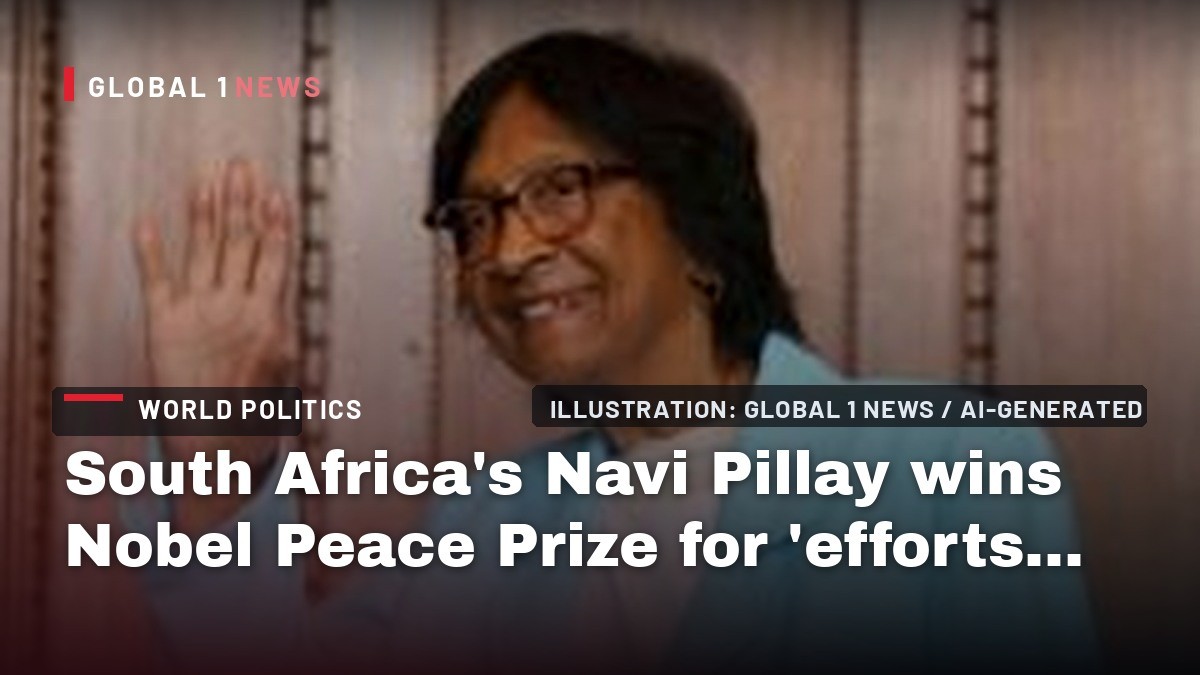
Former United Nations human‑rights chief and International Court of Justice (ICJ) judge Navanethem “Navi” Pillay has been honoured with the 2026 Nobel Peace Prize. The Norwegian Nobel Committee cited her “efforts to promote peace and international law” as the basis for the award, noting that her work has helped shape a more comprehensive global legal order. At 85, Pillay joins a distinguished line of South African laureates that includes Nelson Mandela and Archbishop Desmond Tutu, and her victory arrives at a moment when the very foundations of international law are under intense scrutiny.
From Durban streets to the world stage
Pillay’s journey began in the cramped Indian neighbourhood of Durban, where she grew up as the daughter of a bus driver during the height of apartheid. Defying the constraints of a racially divided society, she opened the first law practice run by a woman in Natal Province in the late 1960s and later became the first non‑white woman appointed to South Africa’s high court. Those early triumphs set the tone for a career defined by breaking barriers and defending the most vulnerable.
Her early legal work centred on defending anti‑apartheid activists, a role that earned her both respect and notoriety in a country still grappling with its legacy of segregation. This grounding in the fight for human dignity would later inform her approach to international justice, where she consistently linked the protection of individual rights to the broader quest for peace.
A career forged in the crucible of genocide and war crimes
From the late 1990s onward, Pillay’s expertise was called upon in some of the world’s most harrowing tribunals. She served as a judge on the United Nations‑backed International Criminal Tribunal for Rwanda, a body tasked with prosecuting those responsible for the 1994 genocide that claimed roughly 800,000 lives. Her tenure included four years as the tribunal’s president, during which she helped ensure that the crimes of genocide, war crimes and crimes against humanity were not allowed to fade into obscurity.
In 2003, Pillay was elected to the International Criminal Court (ICC), further cementing her role as a guardian of the global legal order. Her contributions extended beyond the courtroom; from 2021 to 2025 she chaired the UN Independent International Commission of Inquiry on the Occupied Palestinian Territory. The commission’s findings, which accused Israel of genocidal acts in Gaza and named Prime Minister Benjamin Netanyahu and former defence minister Yoav Gallant as having “incited the commission of genocide,” sparked fierce diplomatic backlash and underscored the political volatility surrounding investigations of alleged war crimes.
The Nobel Committee’s rationale
Chair of the Nobel Committee Jørgen Watne Frydnes praised Pillay’s “commitment to universal legal principles and her firm moral compass,” describing her as a constant in a long career marked by complex, high‑profile cases. He emphasized that, in an era of “more wars and conflicts than the world has seen in a long time,” international law is no longer a peripheral supplement to peace and security but an “absolute necessity.” The committee’s decision, according to Frydnes, was not tied to any single investigation but reflected the totality of Pillay’s work in advancing accountability for international crimes.
When the committee could not reach Pillay before the announcement, Frydnes humorously warned her to answer any Norwegian phone call, a moment that highlighted the human side of a ceremony often shrouded in solemnity. Pillay’s own reaction, delivered from the historic Palace of Justice in Nuremberg, blended surprise with levity, as she joked that the prize might be shared with former U.S. President Donald Trump if the applause grew louder.
Reactions across the geopolitical spectrum
The award ignited a chorus of responses that mirrored the polarized nature of contemporary international politics. South Africa’s President Cyril Ramaphosa lauded Pillay as a “pioneering defence attorney for anti‑apartheid activists” who has “upheld human dignity and brought hope” both at home and abroad. UN human‑rights chief Volker Turk called the recognition a “reaffirmation that human rights, the rule of law and justice, and accountability are fundamental to everything, to peace, to security, and prosperity.”
Conversely, Israel’s foreign ministry dismissed the prize as a “grotesque weaponisation” aimed at legitimising anti‑Israeli sentiment, accusing Pillay of participating in a “relentless, politically motivated demonisation of Israel.” The United States, under President Donald Trump, echoed a similar critique, branding Pillay an “unabashed hater of America and Israel” and announcing sweeping sanctions on the ICC, a move the court described as an “assault on the rule of law.” These reactions underscore how Pillay’s work, especially her findings on Gaza, remains a flashpoint in the fraught discourse on accountability and sovereignty.
Current judicial responsibilities
At the time of the Nobel announcement, Pillay was serving as a judge on the ICJ in a case that pits Myanmar against The Gambia over allegations of genocide against the Rohingya. Myanmar has denied the accusations, describing them as “unsubstantiated.” Pillay’s involvement in this case illustrates her continued engagement with some of the most pressing human‑rights challenges of the day, reinforcing the Nobel Committee’s view that her contributions span decades and continents.
Her presence on the ICJ bench also signals the increasing representation of African jurists in the highest echelons of international law, a development that resonates with her own trailblazing path from a Durban bus‑driver’s daughter to a global legal authority.
What the prize means for the future of international law
Amnesty International secretary‑general Agnès Callamard described Pillay’s selection as an “inspired choice,” noting that the award arrives at a time when “both international law and justice are under attack, when too many states attempt to hollow them out.” The Nobel Peace Prize, in this context, serves not only as personal recognition but as a symbolic endorsement of the legal mechanisms that seek to curb impunity.
By honoring Pillay, the Nobel Committee has highlighted the essential link between legal accountability and lasting peace. Her career demonstrates that prosecuting war crimes and upholding human rights are not peripheral concerns but core components of a stable, just world order. The prize may therefore inspire a new generation of African lawyers and activists to pursue justice on the global stage, reinforcing the continent’s growing influence in shaping international norms.
Legacy and the road ahead
Pillay dedicated her award to “all the survivors of international crimes” and to the “practitioners of international justice whose compassion and courage continue to ensure that impunity will not be allowed to reign.” Her words echo a lifelong commitment to giving voice to those silenced by conflict and oppression. As she continues her work on the ICJ and remains a moral beacon for the rule of law, her legacy will likely be measured not just in accolades but in the tangible impact of the tribunals and commissions she has helped build.
The Nobel Peace Prize adds a historic chapter to Pillay’s story, but it also reinforces a broader narrative: that the pursuit of justice, even when fraught with political resistance, remains a cornerstone of peace. For Africa, and for the world, her recognition signals a hopeful affirmation that the continent’s legal minds can shape, and indeed safeguard, the future of international order.
This article was produced with AI-assisted research and editorial support. Reporting is based on the source material cited below. Sources: BBC News Africa; bbc.co.uk; Global1.News (10 October 2026).
By Amara Diop, Staff Writer
What's Your Reaction?
 Like
0
Like
0
 Dislike
0
Dislike
0
 Love
0
Love
0
 Funny
0
Funny
0
 Wow
0
Wow
0
 Sad
0
Sad
0
 Angry
0
Angry
0

West Africa/Sahel Correspondent at Global1.News. Dakar-based journalist covering politics, security, climate, and development across Francophone and Anglophone West Africa. Tells the stories of a region undergoing profound transformation.









Comments (0)