
Ivory Coast's Sacred Talking Drum Comes Home After a Century in France
Ivory Coast welcomed home the Djidji Ayokwe, a sacred "talking drum" of the Ebrie people, this week when the instrument looted by French colonial troops more than a century ago was carried in a jubilant parade through the streets of Abidjan on the country's independence day holiday.
Ivory Coast welcomed home the Djidji Ayokwe, a sacred "talking drum" of the Ebrie people, this week when the instrument looted by French colonial troops more than a century ago was carried in a jubilant parade through the streets of Abidjan on the country's independence day holiday. For the first time since its return to the country earlier this year, Ivorians were able to lay eyes on the three-metre drum that once carried messages between villages, warnings of danger and calls to ceremony.
Ivory Coast's Sacred Talking Drum Comes Home After a Century in France
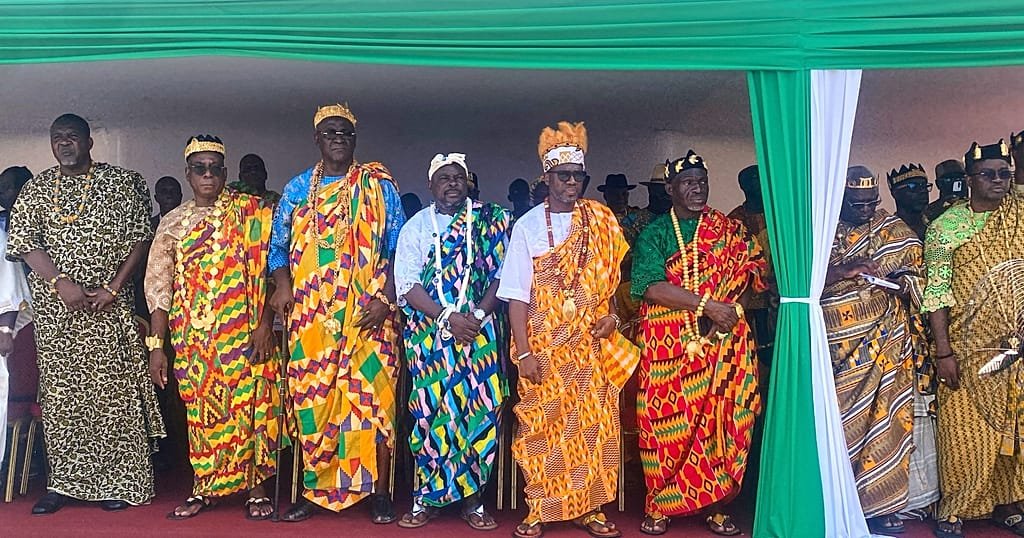
Abidjan, Ivory Coast — The homecoming parade through Yopougon and the traditional ceremony that followed in Adjame turned a restitution handover into a national celebration, uniting cultural leaders, government officials and thousands of residents around one of West Africa's most significant heritage returns. Culture Minister Francoise Remarck welcomed the drum alongside traditional chiefs and a crowd of hundreds, with a dozen elders performing a libation ceremony as an offering to ancestors.

Djidji Ayokwe: The Drum That Spoke for the Ebrie
The Djidji Ayokwe stands as a sacred talking drum of the Ebrie people of Ivory Coast, stretching more than three metres long and weighing 430 kilogrammes. Its black, white and red painted surface marks it as a vessel of authority passed down through generations in Ebrie villages near Abidjan.
Ebrie communities relied on the drum to transmit messages across distances, including warnings of danger from colonial forces and calls to war when threats approached their lands. Villagers also heard its rhythms summon them to ceremonies that strengthened social bonds and preserved oral traditions.
The instrument's name translates roughly as Panther Lion in the Ebrie language, evoking the strength and vigilance required to protect community knowledge. Its deep tones carried precise codes understood only by trained drummers who interpreted each beat as part of a living archive.
Far more than a musical instrument, the Djidji Ayokwe served as a repository of Ebrie memory, recording alliances, disputes and seasonal events through patterns that outlasted individual lifetimes. Elders taught young apprentices the codes so the drum could continue speaking for the people long after its makers had passed.
Its physical presence reinforced Ebrie identity in daily life, standing in central gathering places where leaders consulted it before major decisions. The drum's return now reconnects contemporary Ivorians with this heritage that French colonial authorities severed in 1916.
A Century in Exile: From 1916 to the Quai Branly
French colonial troops seized the Djidji Ayokwe in 1916 during operations that dismantled Ebrie resistance structures around Abidjan. The drum left West African soil and entered European collections as one of many objects removed under colonial authority.
Shipped to Europe in 1929, the instrument spent decades on display in Paris museums, including long-term exhibition at the Quai Branly museum where visitors encountered it as an ethnographic specimen rather than a living voice of the Ebrie.
Ivory Coast formally requested its return in late 2018 as part of a list of 148 works of art taken during the colonial period. Negotiations stretched across several years before France agreed to begin restitution with this particular object.
The official handover occurred in Paris on February 20, 2026, marking the Djidji Ayokwe as the first item returned from the 148-work list. A specially chartered plane carried it back to Ivory Coast in March 2026, landing at Port Bouet airport in Abidjan.
The drum remained sealed inside its huge wooden crate until the independence day ceremony, preserving its condition after nearly a century away from the villages where Ebrie drummers once played it. This careful handling reflected the cultural weight assigned to its homecoming.
Independence Day Homecoming: A Parade Through Abidjan
The ceremony took place on Friday, August 7, 2026, during Ivory Coast's 66th Independence Day holiday. Military units escorted the drum through the Yopougon district of Abidjan in a parade that drew thousands of residents lining the streets.
Workers placed the instrument inside a glass-fronted case mounted on a large decorated float, specifically a red truck, with two traditional Ebrie chiefs standing guard on either side. Participants wearing traditional costumes walked alongside and solemnly sang the drum's name as the float advanced.
Crowds followed the procession, many raising mobile phones to capture the moment the Djidji Ayokwe passed through neighbourhoods where Ebrie families still reside. Yopougon resident Marie-Ange expressed the shared sentiment when she said she felt proud and happy to witness the return.
The route continued to the village of Adjame, the historic site where the drum was originally made, allowing elders to reconnect the instrument with its place of origin. There, a dozen people performed a libation ceremony, pouring drops of liquid onto the ground as an offering to ancestors.
Culture Minister Francoise Remarck joined traditional leaders and hundreds of residents for the afternoon rituals that transformed the restitution into a communal affirmation of Ebrie continuity. The events blended official protocol with longstanding customs that honoured the drum's role in village life.
'We Want to See the Drum With Our Own Eyes'
Adjame mayor Farikou Soumahoro described the day as one of deep emotion and great pride, noting that a nation cannot develop if it does not preserve its memory and promote its heritage. His words captured the broader significance local officials attached to the drum's presence in Adjame once more.
Sixty-nine-year-old villager Jacqueline Akrebie explained the desire of many residents when she said they wanted to see the drum with their own eyes so they could truly believe it belonged to them again. Her statement reflected generations who had only heard stories of the instrument before its return.
Traditional leader Cyriaque Ahoure, aged 63, came to share in the great joy of the occasion while remembering ancestors who had used the drum to protect Ebrie communities. His presence underscored how the restitution touched personal and collective recollections of resistance and continuity.
Culture Minister Francoise Remarck stood with the elders during the libation, representing the government's commitment to completing the handover process that began with formal requests in 2018. Her participation linked state institutions to the Ebrie community's reclamation of its heritage.
The return strengthens Ebrie identity by restoring an object that carries intergenerational memory across decades of separation. Families in Adjame and surrounding areas now see the drum as evidence that cultural losses from the colonial era can be reversed through sustained advocacy.
A Continent-Wide Reckoning With Restitution
Senegal and Benin have also asked for the repatriation of their treasures held in French collections, creating a regional movement that links West African nations in shared demands for cultural recovery. The Djidji Ayokwe's return sets a precedent that other governments now reference in their own negotiations.
France approved a new law in May 2026 enabling the return of hundreds of stolen artefacts, opening pathways for accelerated restitution beyond the initial 148 items requested by Ivory Coast. This legislation responds to sustained pressure from African cultural ministries and diaspora communities.
Britain and South Africa recently handed back Ghanaian royal artefacts, while Sudan recovered hundreds of pieces looted during its war, demonstrating that restitution efforts span multiple continents and conflict contexts. Nigeria's ongoing museum revamp has further amplified calls for the return of looted treasures from European and American institutions.
Museums and private collectors in Europe and the United States now face increased scrutiny over holdings acquired during colonial periods. The pressure has prompted inventories and policy reviews that acknowledge the ethical claims African nations advance for objects like the Djidji Ayokwe.
The drum will next go on display at the specially renovated Museum of Civilisations in Abidjan, where visitors can encounter it within an African interpretive framework rather than a European one. This placement supports heritage tourism and reinforces cultural identity across the region.
For Senegalese readers, the Djidji Ayokwe's journey carries a familiar resonance. Senegal has pressed its own claims for objects held abroad, and the broader West African conversation about restitution has grown louder in recent years as nations weigh what it means to rebuild cultural memory after colonialism. The drum's return is a reminder that heritage is not static: it lives in ceremonies, in the hands of elders, and in the songs that accompany a community's most important moments.
What to Watch For
The Djidji Ayokwe will soon appear in public view at the Museum of Civilisations in Abidjan, allowing broader access for students, researchers and families who wish to study its construction and historical role. The remaining 147 works on Ivory Coast's restitution list await similar negotiations under the new French law.
France's May 2026 legislation could speed returns to Senegal, Benin and other nations that submitted formal requests years earlier. Observers expect the Djidji Ayokwe case to serve as a model for handling large, fragile objects that require specialised transport and ceremony.
The parade through Yopougon carried political weight because the district is the country's largest municipality and was historically a stronghold of former president Laurent Gbagbo. It is now led by the RHDP party of President Alassane Ouattara, whose government organised the event.
President Ouattara has stated that development must benefit the entire national territory, a principle reflected in the decision to route the drum through Yopougon before reaching Adjame. The ceremony therefore combined cultural restitution with visible investment in historically marginalised urban areas.
Cultural heritage now plays a growing role in African national identity, with governments recognising that returned objects can stimulate creative economies through tourism, education and artistic reinterpretation. The Djidji Ayokwe homecoming signals further momentum for these efforts across the continent.
There is also a creative dimension to watch. African artists and musicians have long drawn on the continent's heritage — from Mbalax rhythms to Nollywood storytelling — and repatriated objects like the Djidji Ayokwe offer new material for cultural production, education and artistic reinterpretation. Museums, schools and filmmakers across the region are likely to look to Abidjan's handling of the drum as a model for turning restitution into living culture rather than a closed chapter.
By Amara Diop, Staff Writer
This article was produced with AI-assisted research and editorial support. Reporting is based on sources cited in the article.
What's Your Reaction?
 Like
0
Like
0
 Dislike
0
Dislike
0
 Love
0
Love
0
 Funny
0
Funny
0
 Wow
0
Wow
0
 Sad
0
Sad
0
 Angry
0
Angry
0

West Africa/Sahel Correspondent at Global1.News. Dakar-based journalist covering politics, security, climate, and development across Francophone and Anglophone West Africa. Tells the stories of a region undergoing profound transformation.














Comments (0)