
Israel Prepares for Election Day Under Missile Fire
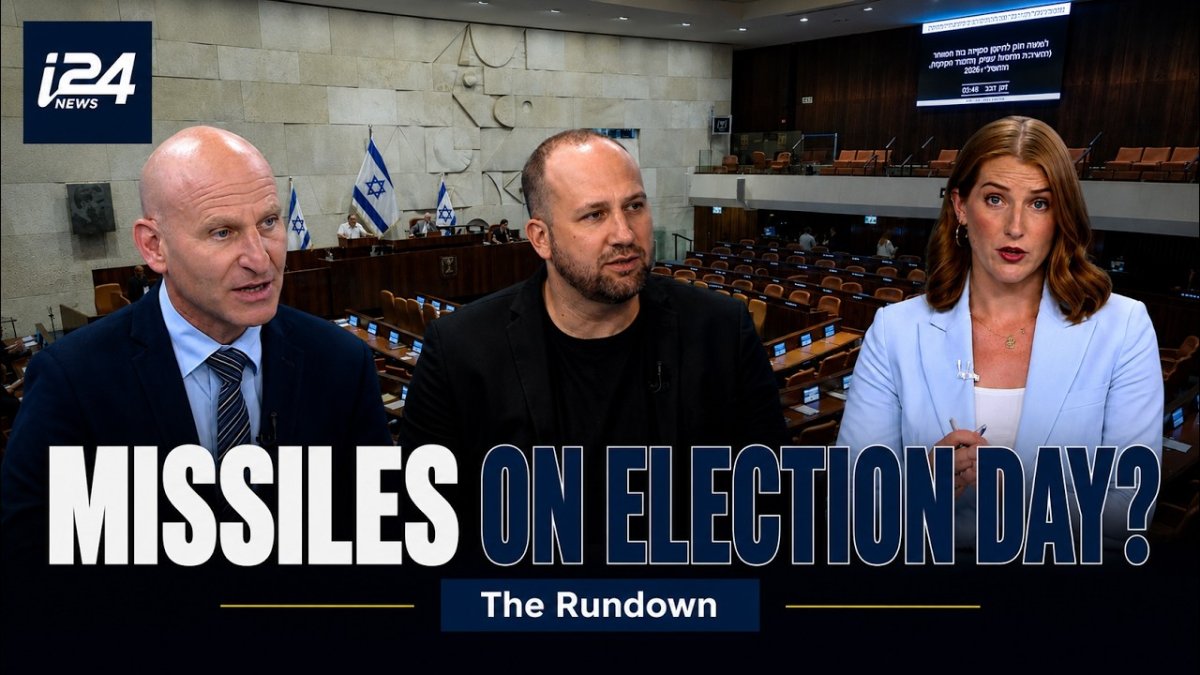
Israel's Central Elections Committee is drafting emergency protocols to keep the October 27 Knesset election running under missile fire, from siren-sealed ballots to frontline soldiers voting with military dog tags.
In a recent i24NEWS English report, Israel's Central Elections Committee was revealed to be drafting emergency procedures that would allow the country's upcoming general election to proceed even if rocket fire disrupts polling stations or ballot counting. The preparations, first detailed in an exclusive i24NEWS Hebrew report this week, mark the first time Israel has prepared wartime voting protocols since the 2026 Iran war reshaped the country's security landscape. With sirens and missile alerts now part of routine life across the country, election officials are working to ensure that nothing, not even an attack on election day, can stop Israelis from casting their ballots.
Israel Prepares for Election Day Under Missile Fire
Jerusalem, Israel – This week — With the 26th Knesset election scheduled for Tuesday, October 27, 2026, Israel's Central Elections Committee is drafting emergency regulations to ensure the democratic process can survive the threat of missile attacks. The committee, chaired by Supreme Court Justice Noam Sohlberg, is expected to approve the new protocols in the coming days, according to the i24NEWS report. The regulations have not yet been formally adopted, but they outline in precise detail how polling stations, counting centers, and frontline soldiers would operate if the country comes under fire while the nation votes.
Voting Under Fire: The Emergency Protocols
Under the proposed regulations, the moment a rocket siren sounds during voting, polling would stop immediately. The election integrity supervisor at the station would activate a camera to document the process, creating a verifiable record of every step taken under duress. Ballots, envelopes, and all voting materials would then be placed inside a specially designated emergency envelope, which would be sealed with adhesive. The polling station secretary would be responsible for safeguarding the sealed envelope, while the election integrity supervisor would take custody of the secured ballot box until voting can safely resume. Members of the polling station committee would decide when conditions allow voting to restart, and the regulations also address scenarios in which voting cannot resume for an extended period because of the security situation.
The attention to procedure reflects a hard lesson of Israel's security reality: elections must be both continuous and credible. A vote that is interrupted by a siren and then resumed must be able to prove that no ballot was lost, altered, or added while the station was closed. The camera documentation, the sealed emergency envelope, and the split custody between secretary and supervisor are designed to preserve the integrity of the process even in the chaos of an incoming missile barrage. Israeli election law has long required strict safeguards against fraud; these wartime protocols extend that same standard to a battlefield environment.
The preparations come amid warnings from Shin Bet chief David Zini, who has cautioned about the potential for foreign interference in the electoral process. With Iran and its regional allies actively waging war against Israel, and with hostile actors known to conduct cyber and influence operations, the security establishment is treating election integrity as a front-line concern. The emergency regulations are part of a broader effort to protect the vote not only from rockets but from manipulation.

Counting the Votes in a War Zone
The contingency plans extend well beyond the polling station. Under the proposed regulations, election workers would conduct the ballot count on a specially designed table covering that would enable them to quickly gather and secure ballots, envelopes, and tally sheets if a rocket siren interrupts the count. The measure is designed to compress what could otherwise be a chaotic evacuation into seconds: with polls closing at 10:00 p.m. and counting typically continuing late into the night, the count is one of the most vulnerable phases of the election. A siren during the count would force workers to move sensitive materials to a protected area, and the special covering is intended to ensure nothing is left behind or lost in the scramble.
The counting arrangements reflect the logistical reality of an election held during an ongoing war. Counting centers would need access to protected spaces, backup power, and communication systems resilient to disruption. Election officials have been working with the Home Front Command and local authorities to identify facilities that can serve as secure counting locations, and the new protocols are expected to be integrated with the Home Front Command's broader civil defense procedures. For the thousands of Israelis who will staff the election — many of them reservists or civil servants juggling wartime duties — the regulations provide a clear script for what to do when the sirens sound.
Soldiers at the Ballot Box
One of the most significant provisions would allow Israeli soldiers serving on the front lines to cast their ballots using their military dog tags as a form of identification. With large numbers of troops expected to remain deployed on multiple fronts — facing Hezbollah in the north, Hamas in the south, and the broader threats of the Iran war — the arrangement is aimed at ensuring service members can participate in the election despite operational conditions. Israeli soldiers have historically voted through military polling stations and absentee arrangements, but the new provision would formalize frontline voting in an active war zone, where troops may not be able to reach a designated military polling station.
The soldier voting measure carries deep symbolic weight in Israeli politics. The IDF has long been described as the people's army, and the ability of deployed troops to vote is seen as a cornerstone of the democratic contract between the state and those who defend it. In a war that has already claimed the lives of hundreds of soldiers, according to official IDF figures released during the conflict, ensuring that those still in the field can have their say in choosing the next government is both a practical and a moral imperative. The Central Elections Committee's willingness to approve identification by dog tags underscores how seriously it takes this obligation.
Regional Context: Israel's 2026 War and Election Season
The election is taking place against the backdrop of the most severe conflict Israel has faced in decades. The 2026 Iran war began on February 28, 2026, after US and Israeli airstrikes killed senior Iranian officials, including Supreme Leader Ali Khamenei. Since then, locations across Israel have been subjected to repeated retaliatory Iranian missile strikes. In the early days of the war, Israeli airspace was closed, disrupting flights from Ben Gurion Airport, and the country's missile defense systems — Iron Dome, David's Sling, and the Arrow system — have been tested in sustained combat. The war has reshaped daily life: sirens, shelters, and Home Front Command instructions are now routine, and the psychological toll on Israeli society has become a central political issue.
Election season officially began in mid-July, and the campaign is unfolding alongside the war. The 25th Knesset, elected in November 2022, became the first Israeli legislature since 1988 to complete its full four-year term without early dissolution — a remarkable achievement of political stability in a country where governments rarely last. Now, as the 26th Knesset election approaches, the war has injected profound uncertainty into the campaign. Prime Minister Benjamin Netanyahu has reportedly sought to postpone his party's primary in case of escalation with Iran, a sign that even the internal politics of the governing coalition are being shaped by the security situation. The Central Elections Committee's emergency protocols are, in effect, an acknowledgment that the campaign and the war will run in parallel until October 27.
Diplomatic and International Reactions
The prospect of elections held under missile fire has drawn attention beyond Israel's borders. International election observation missions, which have monitored Israeli elections in the past, are expected to take a keen interest in how the emergency regulations are implemented. For allies such as the United States, which has been Israel's principal partner in the war against Iran, the ability of Israel to hold a credible democratic vote during wartime is a powerful signal of the resilience of the US-Israel alliance. The Trump administration has backed Israel's military campaign, and Washington is closely watching the political transition that the October election will bring.
European and international bodies, including the UN, have repeatedly called for de-escalation in the region as the war has dragged on, and the election offers a diplomatic inflection point. A credible vote, conducted under fire, would strengthen Israel's argument that it remains a functioning democracy defending itself against existential threats — a narrative that matters in international forums where the conduct of the war has been debated. At the same time, the emergency protocols themselves are being watched as a potential precedent: how does a democracy hold an election when its territory is under missile attack? Israel's answer, once approved, will be studied by governments around the world facing similar threats.
Analysis and What This Means
The emergency regulations reveal something important about the state of Israeli democracy in 2026: the system is adapting to war without surrendering its core functions. The detailed protocols — the sealed emergency envelopes, the camera documentation, the counting mats, the dog-tag voting — are not bureaucratic flourishes. They are the infrastructure of democratic continuity in a country that has learned, over decades of conflict, that the worst response to an attack on the democratic process is to abandon it. By planning for the worst-case scenario, the Central Elections Committee is ensuring that no rocket can disenfranchise a nation.
The political implications are equally significant. The October 27 election will effectively serve as a referendum on the war and on the leadership that has prosecuted it. Netanyahu's reported attempt to delay his primary, the Shin Bet's warnings about foreign interference, and the emergence of wartime voting protocols all point to an election that will be fought not just in studios and rallies but in shelters and on front lines. For Israeli voters, the choice will be about security, strategy, and the shape of the country's future after the guns fall silent.
What comes next is a matter of weeks, not months. The Central Elections Committee is expected to formally approve the emergency regulations in the coming days, and the protocols will then be tested in the run-up to October 27. The war will not pause for the election, and the election will not pause for the war. Israel is preparing to do something few democracies have ever attempted: hold a national vote while the missiles are still flying. If the preparations hold, October 27 will be remembered not only as an election day, but as a demonstration of what democratic resilience looks like under fire.
By Hannah Berg, Staff Writer
This article was produced with AI-assisted research and editorial support. Reporting is based on sources cited in the article.
What's Your Reaction?
 Like
0
Like
0
 Dislike
0
Dislike
0
 Love
0
Love
0
 Funny
0
Funny
0
 Wow
0
Wow
0
 Sad
0
Sad
0
 Angry
0
Angry
0
Israel Correspondent at Global1.News. Based in Tel Aviv, covering Israeli politics, security, technology, and society. Provides balanced, deeply-sourced reporting on one of the most closely-watched regions in the world.











Comments (0)