
Kremlin Rejects European Role in Upcoming Abu Dhabi Talks
The Kremlin has once again drawn a hard line around the diplomatic arena of the upcoming Abu Dhabi peace talks, explicitly refusing to grant the European Union a seat at the table.
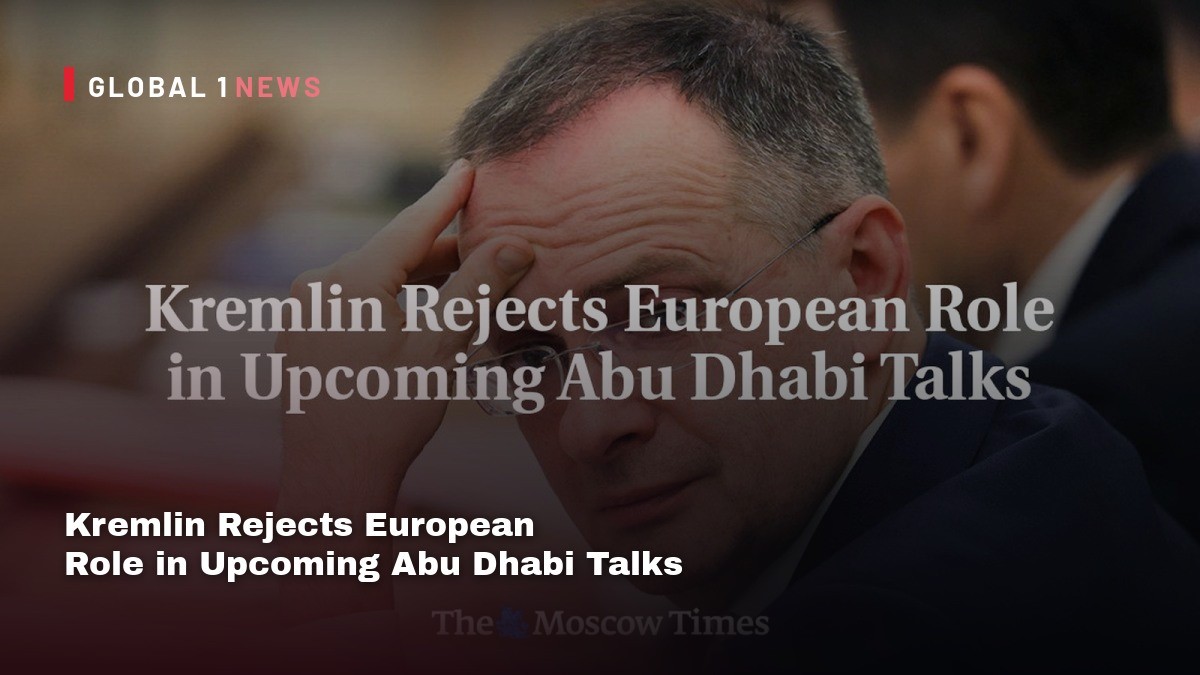
The Kremlin has once again drawn a hard line around the diplomatic arena of the upcoming Abu Dhabi peace talks, explicitly refusing to grant the European Union a seat at the table. This stance, articulated by spokesman Dmitry Peskov on Monday, underscores Moscow’s determination to keep the negotiations strictly between the United States, Ukraine and Russia, while relegating Europe to the periphery of the process.
Official Kremlin Position on European Participation
When pressed about the presence of European officials, Peskov reminded reporters that “the Americans have their own channels of communication with the Europeans, as do the Ukrainians.” He added that American and Ukrainian negotiators are “in all likelihood constructing their own coordination mechanism” with European representatives. This phrasing signals a deliberate framing of Europe as an external observer rather than a co‑mediator, a nuance that aligns with Moscow’s broader diplomatic playbook of limiting multilateral oversight.
By positioning Europe as a side actor, the Kremlin seeks to preserve a bilateral narrative that can be more easily managed from Moscow. The implication is clear: any European attempt to influence the outcome will have to do so through indirect channels, a reality that could constrain the EU’s leverage in shaping post‑war arrangements.
European Leaders’ Expectations and Preparations
Despite Moscow’s rebuff, European officials have been preparing for a robust presence in Abu Dhabi. European Commission President Ursula von der Leyen publicly declared that the EU “will be present alongside our partners” at the talks, a statement echoed by a European Council spokesperson. An unnamed European official told AFP that national security representatives from the EU, NATO, as well as France, Germany and the United Kingdom plan to attend the negotiations in the UAE capital.
Sources reported to Euronews that NATO’s representation will be led by Chief of Staff Geoffrey Van Leeuwen, while the EU delegation will be headed by Bjoern Seibert, von der Leyen’s chief of cabinet, and Anna‑Maria Boura, chief foreign policy adviser to European Council President António Costa. These names signal a high‑level, coordinated European effort to stay engaged, even if they are ultimately excluded from the formal negotiating table.
Ukrainian Coordination with Europe
Ukrainian President Volodymyr Zelensky reinforced the European dimension by confirming a call with von der Leyen on Monday, during which they “coordinated our positions regarding the meeting in Abu Dhabi.” Zelensky’s post on X emphasized a “trilateral format” that includes Europe, suggesting Kyiv’s strategic intent to keep the EU in the loop and to prevent Moscow from monopolising the dialogue.
This coordination reflects Ukraine’s broader diplomatic calculus: while the United States remains the primary guarantor of security assistance, European political and economic support is indispensable for Kyiv’s reconstruction plans. By aligning with Europe ahead of the talks, Zelensky aims to ensure that any settlement reflects not only U.S. security guarantees but also European commitments to post‑war reconstruction and integration.
Underlying Geopolitical Tensions
The exclusion of Europe from the core negotiations is not merely a procedural quirk; it is a symptom of deeper mistrust. The article notes that “Ukraine’s European allies have voiced growing concerns that the Trump administration might try to negotiate over their heads by working directly with Russia on a post‑war security arrangement.” Although the United States is no longer under a Trump administration, the lingering suspicion that Washington could bypass Europe remains a point of friction within the transatlantic alliance.
Adding to the complexity, the piece references a recent phone call between Norwegian Prime Minister Jonas Gahr Støre, Finnish President Alexander Stubb, and Russian President Vladimir Putin. While this outreach was framed as a “push to reassert Europe’s place in the conversation,” it also sparked criticism from other European officials who doubt Russia’s genuine desire for peace. These divergent European reactions illustrate a fragmented stance that Moscow may be exploiting to weaken a unified front.
Russia’s Negotiating Team and Strategic Signalling
The Russian delegation will be led by Kremlin adviser Vladimir Medinsky, a noted arch‑conservative and former culture minister, who will serve as chief negotiator. Accompanying him are senior military and intelligence officials, as well as Deputy Foreign Minister Sergei Ryabkov. The inclusion of high‑ranking security figures signals Moscow’s intent to keep the talks tightly linked to its strategic and security priorities, rather than opening the floor to broader political compromises.
Medinsky’s presence, in particular, underscores the Kremlin’s desire to project a hard‑line image domestically while navigating a diplomatic channel that remains under tight control. By foregrounding military and intelligence personnel, Russia signals that any settlement will be evaluated through the lens of national security, potentially limiting concessions on territory or political reforms.
Historical Context of the Abu Dhabi Talks
The Abu Dhabi negotiations mark the resumption of U.S.–mediated talks that were paused after the United States and Israel launched a war against Iran. The last direct dialogue between Russian and Ukrainian officials took place in February, before the pause. The interruption of talks underscores the volatility of the diplomatic environment and the extent to which external conflicts can derail peace efforts.
Given this backdrop, the current round of talks carries heightened expectations. The involvement of the United States, the presence of senior Russian security officials, and the explicit exclusion of Europe all suggest that the upcoming negotiations will be tightly choreographed, with each side seeking to extract maximum advantage while limiting exposure to external pressure.
Implications for the Kremlin’s International Strategy
By sidelining Europe, the Kremlin is attempting to re‑balance the diplomatic equation in its favour. The move allows Moscow to negotiate directly with its primary adversary, the United States, while keeping European criticism at arm’s length. This approach could enable Russia to secure a settlement that preserves its core strategic interests—particularly regarding the status of occupied territories and the future security architecture in Eastern Europe.
However, the strategy carries risks. Excluding a major regional bloc may alienate European partners and push them closer to Washington, potentially hardening the transatlantic coalition against Moscow. Moreover, the visible presence of NATO officials in Abu Dhabi, as reported by European sources, could complicate Russia’s narrative of a bilateral “U.S.–Russia” dialogue, exposing the Kremlin to accusations of seeking to marginalise its European neighbours.
In the short term, the outcome of the Abu Dhabi talks will likely hinge on the ability of the United States and Russia to manage their bilateral differences while accommodating, or at least tolerating, the peripheral involvement of European actors. In the longer view, the Kremlin’s stance may shape the architecture of any post‑war settlement, influencing whether Europe remains a peripheral stakeholder or is reintegrated into a comprehensive security framework for the continent.
This article was produced with AI-assisted research and editorial support. Reporting is based on the source material cited below. Sources: The Moscow Times; themoscowtimes.com; Global1.News (10 November 2026).
By Irina Volkov, Staff Writer
What's Your Reaction?
 Like
0
 Dislike
0
 Love
0
 Funny
0
 Wow
0
 Sad
0
 Angry
0
Russia/Eastern Europe Correspondent at Global1.News. Covering Russian politics, energy, security, and the shifting dynamics of the post-Soviet space. Provides clear-eyed analysis on one of the world's most opaque regions.










Comments (0)