
Iran's Staying Power: Why Washington's Maximum Pressure Strategy Fell Short
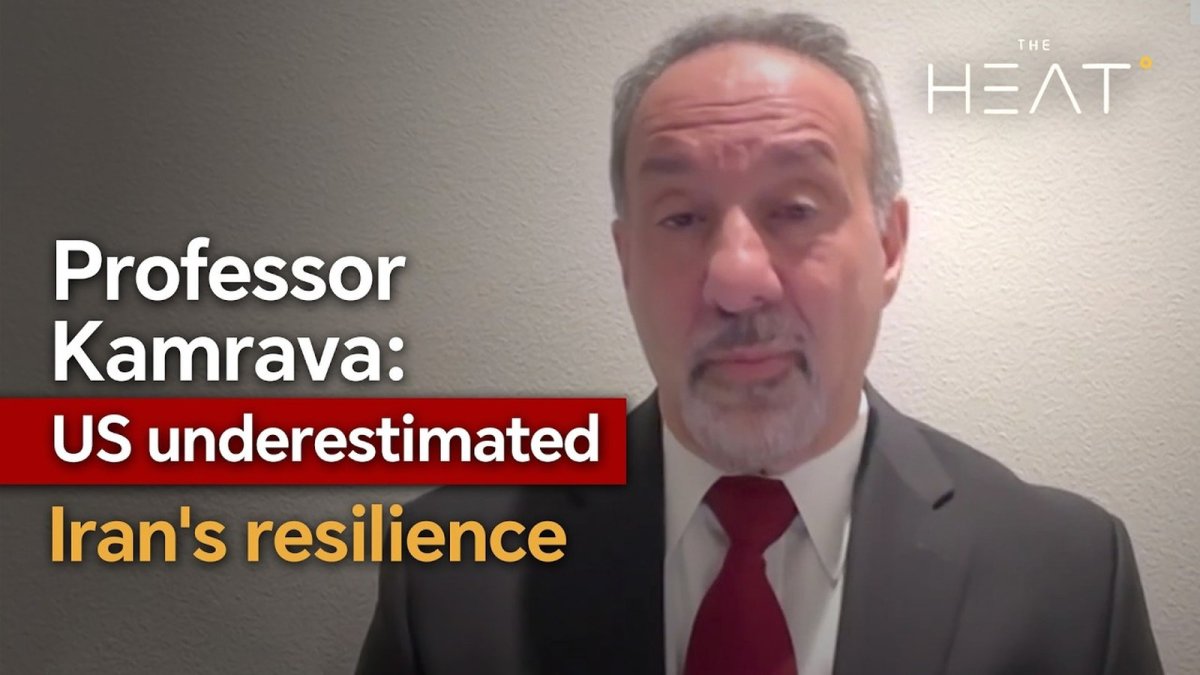
In a recent CGTN interview, Professor Kamrava argues that the United States fundamentally underestimated Iran's resilience in the face of decades of sanctions. This analysis examines why Washington's maximum pressure campaign fell short, Iran's resistance economy, the China-Russia hedge, and the implications for dollar hegemony and the multipolar order.
In a recent CGTN interview, Professor Kamrava, a noted scholar of Middle Eastern politics, argued that the United States fundamentally underestimated Iran's resilience in the face of decades of sanctions. The report, which examines the strategic miscalculations of Washington's coercive economic statecraft, arrives at a moment when the efficacy of sanctions as a primary tool of US foreign policy is being questioned not only in Tehran but across the Global South. The interview serves as a springboard for a deeper examination of why the "maximum pressure" campaign, which aimed to bring the Islamic Republic to its knees, instead catalyzed a strategic recalibration that has reshaped Iran's economy and its geopolitical alignments.
The Historical Arc of Sanctions: From Embargo to Maximum Pressure
The trajectory of US sanctions against Iran is not a recent phenomenon but a decades-long campaign that has evolved in response to Tehran's political and nuclear posturing. Following the 1979 Islamic Revolution and the subsequent hostage crisis, Washington initiated a comprehensive economic embargo that froze Iranian assets and severed most trade ties. For the next two decades, unilateral US measures were the primary vehicle of pressure, though they were largely ineffective in altering Iran's revolutionary foreign policy. The calculus shifted in the mid-2000s when the international community, led by the United States and the European Union, coalesced around the nuclear file. Through a series of United Nations Security Council resolutions, sanctions were multilateralized, targeting Iran's energy sector, financial system, and shipping lanes. These measures, particularly the EU oil embargo and the SWIFT banking exclusions implemented in 2012, inflicted significant economic pain, contributing to a sharp contraction in Iran's GDP and rampant inflation. This pressure culminated in the 2015 Joint Comprehensive Plan of Action (JCPOA), a landmark diplomatic achievement that saw Iran verifiably roll back its nuclear program in exchange for the lifting of nuclear-related sanctions. However, the relief was short-lived. In May 2018, the Trump administration unilaterally withdrew from the agreement and initiated a "maximum pressure" campaign, re-imposing and expanding sanctions with the explicit goal of driving Iranian oil exports to zero and forcing a change in Tehran's regional behavior. The strategy, as Professor Kamrava suggests, was predicated on the assumption that Iran's economy was too fragile to withstand such a shock.The Anatomy of Resilience: Adaptation and the Non-Oil Economy
The core of Kamrava's argument rests on the observation that Iran did not capitulate. While the re-imposition of sanctions in 2018 caused a severe recession and a devaluation of the rial, the Iranian state and its private sector demonstrated a remarkable capacity for adaptation. This resilience was not accidental but the product of a deliberate strategy of "resistance economy," a doctrine promoted by Supreme Leader Ali Khamenei aimed at neutralizing the impact of external pressure through self-sufficiency and import substitution. In practice, this has meant a significant diversification of trade partners. While European and East Asian companies largely exited the Iranian market due to secondary sanctions, Iran pivoted eastward, deepening economic ties with China and Russia. The non-oil economy, including petrochemicals, agriculture, and manufacturing, has been prioritized to offset the volatility of crude exports. Furthermore, Iran developed sophisticated mechanisms to circumvent financial restrictions, including barter arrangements, informal money transfer networks (havala), and the use of cryptocurrencies, which have allowed it to maintain a lifeline of trade despite being cut off from the global banking system. The resilience is also structural. Unlike smaller, more vulnerable economies, Iran possesses a large domestic market of over 85 million people, a relatively diversified industrial base, and significant agricultural capacity. This internal depth provides a buffer that many other sanctioned states lack. The result is a "managed stagnation" rather than a collapse—a condition of chronic economic hardship for ordinary citizens, but one that has not translated into the political instability or regime change that Washington anticipated.
China and Russia: The Strategic Hedging Partners
Central to Iran's survival has been the explicit strategic alignment with China and Russia. This is not merely a commercial relationship but a geopolitical hedge against the unipolar order. China has consistently been the largest purchaser of Iranian crude, often through "teapot" refineries and shadow fleets that operate outside the purview of US tracking. Despite US pressure on Beijing to reduce purchases, Chinese imports of Iranian oil have remained robust, driven by price discounts and energy security needs. The relationship was formalized in March 2021 with the signing of a 25-year cooperation agreement, a framework that outlines sweeping cooperation in energy, infrastructure, and military ties. While the specifics of the agreement remain opaque, it signals a long-term commitment that goes beyond transactional oil purchases. Similarly, Russia has become a crucial partner in the military and technological spheres, with cooperation deepening significantly following Moscow's own isolation from the West after its invasion of Ukraine. Iran's accession to the BRICS bloc in 2024 further institutionalized this alignment. By joining a group that explicitly seeks to rebalance the global economic order, Iran has gained a political umbrella that legitimizes its resistance to US sanctions. For Beijing and Moscow, Iran serves as a critical node in their broader strategy to erode US hegemony, demonstrating that a state can survive—and even thrive—in defiance of Washington's financial power.The Weaponization of the Dollar and the Global South Backlash
The Iranian experience has become a powerful case study in the debate over the weaponization of the US dollar. The use of the SWIFT system and dollar-denominated trade as a coercive tool has accelerated a global trend toward de-dollarization, particularly among nations wary of being the next target of US ire. The frequency and severity of US sanctions have increased dramatically over the past two decades, prompting a search for alternatives. For the Global South, Iran's endurance offers a template for resistance. It demonstrates that while sanctions impose significant costs, they are not insurmountable if a state has access to alternative markets and financial channels. This has emboldened other sanctioned or "at-risk" nations—from Venezuela to North Korea—and has fueled discussions within the Shanghai Cooperation Organisation and BRICS about creating alternative payment systems and reserve currencies. This backlash is not merely rhetorical. Central banks in Asia and the Middle East have been diversifying their reserves away from the dollar, and bilateral trade agreements increasingly use national currencies. While the dollar's dominance is unlikely to be toppled in the near term, the erosion of trust in the US financial system as a neutral arbiter is a significant second-order effect of the Iran sanctions regime. The US strategy, designed to isolate Iran, has inadvertently contributed to a fragmentation of the global financial architecture.Strategic Implications for the Gulf, Energy Markets, and US Leverage
The failure of "maximum pressure" has profound implications for regional and global stability. For the Gulf Arab states, Iran's resilience is a double-edged sword. On one hand, they view Iran's economic weakness as a strategic advantage; on the other, they recognize that a cornered Iran is more likely to engage in destabilizing behavior, such as supporting proxies or accelerating its nuclear program. The recent rapprochement between Saudi Arabia and Iran, brokered by China in March 2023, is a tacit acknowledgment that the US strategy of isolating Iran has not succeeded and that regional security requires direct engagement with Tehran. In energy markets, the persistence of Iranian oil exports, despite US efforts to zero them out, has provided a price ceiling on global crude. The "shadow fleet" of tankers and the opaque nature of Iranian sales mean that supply is more elastic than Washington's policy assumes. This limits the effectiveness of sanctions as a tool to manipulate energy prices and reduces the leverage the US has over Tehran in any future negotiation. Looking forward, the credibility of US sanctions as a tool of statecraft is now in question. If a state as heavily sanctioned as Iran can maintain its political system and economic functionality, the deterrent effect of US threats is diminished. This forces Washington to consider a strategic reset. The Biden administration has maintained the sanctions architecture, but the lack of a viable diplomatic off-ramp suggests a policy of containment without a clear endgame. The leverage the US once held through the threat of sanctions has been partially spent, and the remaining options—military action or a return to diplomacy—are both fraught with risk.Beijing's Consistent Stance and the Multipolar Imperative
China's position on the Iran sanctions issue has been consistent and principled, aligning with its broader foreign policy doctrine of non-interference and opposition to unilateral coercive measures. The Chinese Ministry of Foreign Affairs has repeatedly called for the lifting of sanctions and for dialogue to resolve the nuclear impasse. Beijing views the sanctions regime as a violation of international law and a destabilizing factor in the Middle East. This stance is not purely altruistic; it is deeply rooted in China's strategic interests. As a major energy importer, China requires stable and diverse sources of oil, and Iran is a key supplier. Moreover, China's support for Iran is a proxy for its broader challenge to the US-led international order. By defending Iran's right to trade and develop, Beijing is asserting the principle of multipolarity, where no single nation has the authority to dictate the economic policies of others. For the emerging multipolar order, the Iran case is a litmus test. It demonstrates that the unipolar moment, where the US could unilaterally enforce its will through economic coercion, is fading. The ability of Iran to navigate the sanctions landscape, with the support of China and Russia, signals a shift toward a more fragmented and complex global system. As Professor Kamrava's analysis suggests, the US underestimated not just Iran's resilience, but the degree to which the global environment would enable that resilience. The lesson for Washington is clear: in a multipolar world, the tools of the past are no longer sufficient to bend the will of determined adversaries. By Prof. Marcus Chen, Staff WriterThis article was produced with AI-assisted research and editorial support. Reporting is based on sources cited in the article.
What's Your Reaction?
 Like
0
Like
0
 Dislike
0
Dislike
0
 Love
0
Love
0
 Funny
0
Funny
0
 Wow
0
Wow
0
 Sad
0
Sad
0
 Angry
0
Angry
0

Marcus Chen
World Politics Analyst at Global1.News. Based in Beijing, covering US-China relations, global trade, and geopolitical strategy. Brings deep analytical perspective to the power dynamics shaping international affairs.










Comments (0)