
House Bill Seeks 30% Calamity Pay for Workers
House Bill 4435 seeks 30% calamity pay for Filipino workers required to report during disasters, protecting them from pay deductions and penalties. TRABAHO Party-list renews push after recent typhoons. Bill pending at House labor committee with penalties for non-compliant employers.
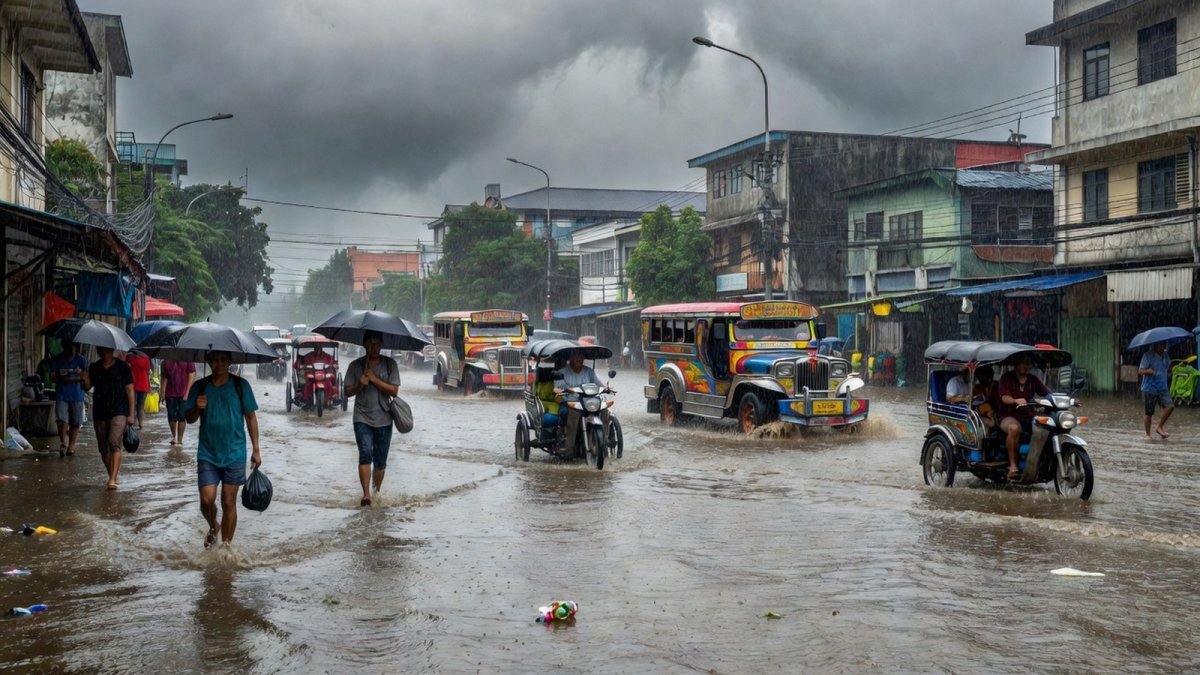
MANILA — For weeks, the images have been painfully familiar: commuters wading through gutter-deep floodwaters, office workers clinging to jeepney handrails as monsoon rains pounded the capital, and mothers in rubber boots carrying children on their hips through submerged barangay streets. As the enhanced southwest monsoon (habagat) and tropical cyclones Luis, Maymay, and Neneng battered the country, a renewed push in Congress is seeking to ensure that the Filipinos who braved these dangers to report for work are properly compensated for their sacrifice.
TRABAHO Party-list has renewed its call for the passage of House Bill No. 4435, or the proposed Calamity Pay Law, on Sunday, August 23, 2026, following weeks of relentless weather that has disrupted daily life across Metro Manila and nearby provinces. The measure, which has been pending before the House Committee on Labor and Employment, seeks to institutionalize an additional 30% premium pay for workers required to report for duty during calamities — a protection that labor advocates say is long overdue for the millions of minimum wage earners, market vendors, and office employees who risk their safety just to keep their jobs.
A Measure Born From Commuters' Ordeals
The proposed measure, filed by Rep. Johanne Bautista of TRABAHO Party-list on September 8, 2025, comes at a time when the Philippines is once again grappling with the harsh realities of the typhoon season. The country experiences an average of 20 tropical cyclones per year, and the enhanced habagat regularly triggers severe flooding in low-lying areas of Metro Manila, Cavite, Laguna, and Rizal.
In a statement released on Sunday, the party-list group highlighted the daily struggles of Filipino workers who have no choice but to brave the elements. "Daily commuters shared their ordeals of surviving through deep floodwaters and enduring severe weather brought by the combined effects of the enhanced habagat and tropical cyclones Luis, Maymay, and Neneng just to avoid pay deductions or employer sanctions," the group said.
This is a reality that resonates deeply with ordinary Filipinos. For the tricycle driver in Quezon City who must navigate flooded streets to earn his daily fare, or the factory worker in Laguna who cannot afford to miss a single day's wage, the choice between safety and survival is often no choice at all. The proposed Calamity Pay Law aims to recognize that when an employee reports to work under such conditions, they are rendering service under circumstances that pose genuine risks to their health and safety — risks that are not part of their normal working conditions.
Who Qualifies for Calamity Pay?
Under House Bill No. 4435, covered workers would be entitled to calamity pay if they are required to work under any of five specific circumstances. First, if the area where the worker resides or works is placed under a state of calamity by the President or the local sanggunian. Second, if the worker's place of work or residence is not placed under a state of calamity but is severely affected by a disaster.
Third, if the worker's place of work is placed under Signal No. 3, Red Rainfall Warning, or an equivalent calamity classification. Fourth, if a work suspension is declared in the worker's place of work or residence. And fifth, under other similar circumstances that would reasonably prevent a worker from safely reporting to their post.
The bill also provides a framework for employers to verify whether workers are entitled to calamity pay. Employers may check the latest available records, assess access to public transportation, consider road closures or impassable roads, and evaluate other factors that may support an employee's claim. This provision is crucial in a country where many workers rely on public transportation — jeepneys, buses, and tricycles — that often grind to a halt during severe weather events.
For the minimum wage earner in Manila who lives in a flood-prone barangay, this verification process could mean the difference between receiving fair compensation and being penalized for circumstances beyond their control. The bill explicitly protects workers from pay reductions for being late due to a calamity and from disciplinary action for failing or refusing to work because of reasonable or imminent danger resulting from a calamity.
Protecting Workers From Penalties and Deductions
One of the most significant aspects of the proposed measure is its protection of workers from punitive actions by employers. Under current practices, many workers who arrive late or fail to report during calamities face salary deductions, written reprimands, or even termination threats. The bill seeks to end this practice by explicitly prohibiting employers from imposing pay reductions for calamity-related tardiness and from taking disciplinary action against workers who refuse to work under dangerous conditions.
The bill's language is clear in its intent: "It recognizes that in times of calamity, an employee reports to work and renders work in conditions that pose risks to their health and safety, which are not part of their normal working conditions." This recognition is a fundamental shift in how labor law views the relationship between employers and employees during emergencies.
For the sari-sari store owner in Marikina who must keep her shop open to serve her kapitbahay even as floodwaters rise, or the hospital worker in Manila who cannot abandon patients despite the storm, this protection acknowledges that their dedication should not be met with punishment. The bill also states that benefits granted under the proposed measure should not result in the reduction or discontinuation of other benefits that workers may already be receiving.
Penalties for Non-Compliant Employers
The proposed Calamity Pay Law does not stop at establishing worker entitlements — it also seeks to impose meaningful penalties on employers who violate its provisions. Employers found violating the proposed law, including through the deliberate failure or refusal to provide calamity pay to qualified workers, would face a fine not exceeding P100,000 or imprisonment of six months to one year.
For corporations, firms, partnerships, associations, or other entities, the bill holds responsible officers accountable. This includes the president, vice president, chief executive officer, general manager, or managing director, who may be held personally liable for violations committed by their organizations. This provision sends a strong message that labor rights cannot be ignored at the highest levels of corporate leadership.
Perhaps most significantly, the bill includes a powerful enforcement mechanism: "Failure on the part of any corporation, trust or firm, partnership, association, or any entity to comply with the provisions of this Act shall be a ground for non-renewal of business permits." This means that businesses that repeatedly violate the calamity pay provisions could face the ultimate consequence — losing their ability to operate altogether.
A Long-Overdue Measure in the Philippine Context
The push for the Calamity Pay Law comes at a critical juncture for the Philippines. Climate change has made typhoons more intense and unpredictable, with the enhanced southwest monsoon regularly causing widespread flooding in Metro Manila and nearby provinces. The recent weeks of heavy rains have once again exposed the vulnerabilities of Filipino workers who must navigate these hazards just to earn a living.
Under existing labor rules, employees who report to work during declared calamities may receive additional pay or hazard pay depending on company policy. However, there is no uniform national calamity pay mandate yet, leaving many workers at the mercy of their employers' discretion. This patchwork approach has created significant disparities — some workers receive proper compensation for risking their safety, while others receive nothing at all.
The proposed measure seeks to create a uniform standard that applies to all covered workers, regardless of their industry or employer. It recognizes the reality that in times of calamity, the bayanihan spirit that defines Filipino communities often extends to the workplace, with employees going above and beyond their normal duties to keep operations running. The bill honors this dedication by ensuring that workers are not financially penalized for circumstances beyond their control.
For the Overseas Filipino Worker (OFW) who sends remittances home to support their family, knowing that their loved ones in the Philippines are protected by such a law provides peace of mind. For the market vendor in Divisoria who must open her stall despite the floods to earn her daily income, the assurance of calamity pay could mean the difference between keeping her business afloat and losing everything.
Next Steps and the Road Ahead
The proposed bill remains pending before the House Committee on Labor and Employment, where labor-related measures are deliberated before floor action. The committee's review will be crucial in determining whether the bill advances to the full House for debate and eventual vote. TRABAHO Party-list has been vocal in urging the committee to prioritize the measure, especially given the recent spate of severe weather events.
As the Philippines continues to experience the effects of climate change, with more intense typhoons and prolonged monsoon seasons, the need for such legislation becomes increasingly urgent. The bill's proponents argue that institutionalizing calamity pay is not just a matter of worker welfare — it is a matter of economic justice and social equity. When workers are forced to choose between their safety and their livelihood, the entire community suffers.
For the Filipino worker who has waded through floodwaters to reach their workplace, who has braved Signal No. 3 winds to serve their community, or who has risked their health to keep essential services running, the passage of this bill would be a recognition of their sacrifice. It would say that their safety matters, that their dedication is valued, and that they should not have to choose between their job and their life.
As the rainy season continues and the threat of more typhoons looms, the call for the Calamity Pay Law grows louder. The measure represents a concrete step toward a more just and compassionate labor system — one that recognizes the dignity of every worker, from the office employee in Makati to the market vendor in Baclaran. The question now is whether Congress will act with the urgency that the situation demands.
This article was produced with AI-assisted research and editorial support. Sources: Philippine Star.
By Bella Reyes, Staff Writer
What's Your Reaction?
 Like
0
Like
0
 Dislike
0
Dislike
0
 Love
0
Love
0
 Funny
0
Funny
0
 Wow
0
Wow
0
 Sad
0
Sad
0
 Angry
0
Angry
0

Philippines/Southeast Asia Correspondent at Global1.News. Manila-based journalist covering Philippine politics, environment, maritime security, and social issues. Passionate about marine conservation and the communities protecting the Philippines' natural heritage.












Comments (0)