
Hamas Money Pipeline Survives Ceasefire: Sham Charities, Turkey and the Cash That Keeps Flowing
US charges against Hasna, OFAC sanctions on El-Kahira, and Turkey's MIT ties to Hayya show Hamas sustaining funds via Istanbul and sham charities despite the Gaza ceasefire, complicating Netanyahu's disarmament demands and IDF operations.
In a recent i24NEWS English report asking where Hamas is getting its money from now, the channel traced the group's financial lifelines from Istanbul to Gaza at a moment when ceasefire talks and US sanctions pressure have made every dollar a matter of diplomatic consequence. The reporting landed as Washington, London and Jerusalem were closing in on the same answer from three directions: court filings, sanctions designations and intelligence cooperation.
Hamas Money Pipeline Survives Ceasefire: Sham Charities, Turkey and the Cash That Keeps Flowing
Jerusalem, Israel — The answer emerging from court filings, Treasury designations and intelligence cooperation between Washington, London and Jerusalem paints a picture of a resilient financial network that has adapted to sanctions, ceasefire terms and leadership change. Even as the Gaza ceasefire holds and a US-brokered disarmament framework stalls over sequencing, the money keeps moving.

US Prosecution of Sham Charity Network
The US Department of Justice announced charges this week against Turkish national Mohammad Yousef Hasna, 45, of Istanbul, also known as Orhan Korkmaz and Abu al-Baraa. Hasna was arrested in the United Kingdom and faces extradition to the United States on counts of conspiring to provide material support to Hamas, conspiring to finance terrorism, and financing terrorism, each carrying a maximum 20-year sentence.
Hasna served as global director of a UK-registered entity described in court documents as the Sham Charity. The organization reported gross income of $41.8 million in fiscal year 2023, which nearly doubled to approximately $81.56 million in fiscal year 2024 after October 7, with roughly $91 million reported as spent in the fiscal year ending last month in 2025.
The rapid growth of the charity's reported income reflects how external networks adapted after October 7 to sustain Hamas operations even as Western scrutiny intensified. This pattern aligns with Hamas's longer-term reliance on layered financial structures that blend purported humanitarian work with direct support for its political and military wings, allowing funds to reach Ministry of Social Development warehouses in Gaza via Egyptian routes. US officials have framed such cases as critical to disrupting the group's ability to maintain parallel governance structures inside the Strip.
Coordination between the Department of Justice, the FBI, UK authorities, and Israel's Shin Bet in the Hasna investigation highlights an expanding transatlantic effort to target Hamas financing nodes that operate under charitable cover. These partnerships build on earlier actions against Iran-backed networks and underscore how intelligence sharing has become central to mapping cash flows that originate in Europe and Turkey before reaching Gaza. The involvement of senior Hamas figures such as Ghazi Hamad illustrates the direct linkage between these external channels and decision-making inside the enclave's administrative bodies.
Broader US sanctions activity against nearly 1,000 terrorism-financing targets tied to Iran and its proxies provides context for the Hasna charges, showing a sustained campaign that treats sham charities as extensions of designated foreign terrorist organizations. By focusing on the misrepresentation of deliveries and the use of recipient lists controlled by Hamas officials, prosecutors aim to close loopholes that have historically allowed funds to bypass restrictions even during periods of heightened enforcement.
Operations Linked to Hamas Officials in Gaza
Hasna worked directly with senior Hamas leader Ghazi Hamad, a member of the Hamas Politburo and Minister of the Ministry of Social Development in Gaza. Since at least 2023, he arranged cash deliveries to Hamad, procured supplies for import into Gaza, and transported materials by truck from Egypt through the Rafah crossing to warehouses controlled by the Sham Charity or the Ministry of Social Development.
Assistant Attorney General for National Security John A. Eisenberg stated: "The money that flows from sham charities like the one described in the complaint fuels Hamas's terrorist activities, including the atrocities the group committed on October 7. Hamas cannot function without injections of money through its illicit financial networks." US Attorney Jamie McDonald of the Southern District of New York added that Hasna "abused his position as the global director of a purported humanitarian organization to raise money and provide funds and supplies to Hamas... using the lie of philanthropy."
FBI Counterterrorism Division Assistant Director Jarod Brown noted that Hasna "knew the resources were going to that group rather than to needy non-combatants." The investigation received assistance from UK authorities and Israel's Shin Bet.
Recent Treasury Actions Against Turkish Financiers
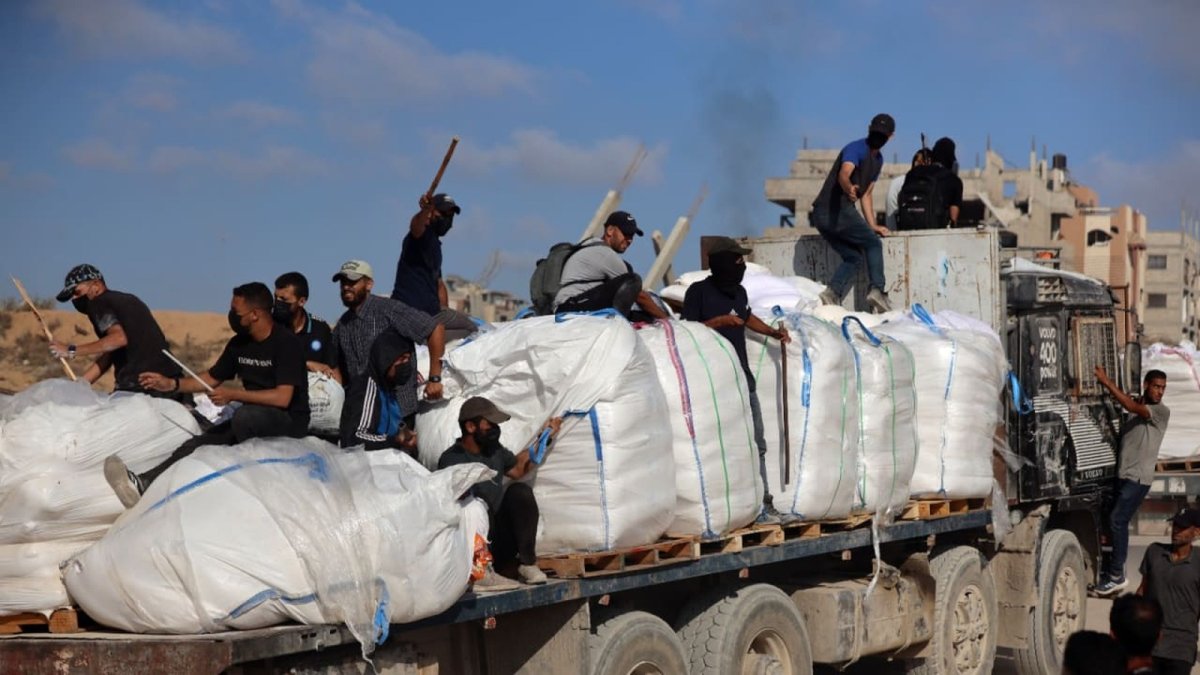
In late July, the Treasury Department's Office of Foreign Assets Control designated the Turkey-based money exchange El-Kahira for General Trading and its UK-based secretary general Mahmoud al Abyari. El-Kahira transferred hundreds of thousands of dollars for Hamas and laundered funds for organized crime networks including Sweden's Foxtrot group.
This marked the third round of sanctions against Hamas's Turkish financial infrastructure in under two years, following earlier designations this year of Ghazi Destek Dernegi, Hayat Yolu, and the Palestinian White Hands Assistance and Solidarity Association. OFAC also froze $38.6 million in TRON crypto wallets linked to Hamas financiers and the Muslim Brotherhood network.
The late-July designation continues a sequence of Treasury moves that have progressively narrowed Hamas's access to Turkish financial infrastructure. Each successive round has targeted registered associations used as intermediaries, while the addition of cryptocurrency seizures this year shows authorities adapting to digital transfer methods that emerged after traditional banking channels faced tighter controls.
Turkey's placement on the FATF grey list since 2021 adds regulatory pressure that could intensify if further Hamas-related cases surface during the October plenary in Paris. Repeated designations of money exchanges and charities operating from Istanbul suggest that enforcement gaps persist despite Ankara's stated commitments under the ceasefire framework. These measures also intersect with separate laundering activities involving organized crime groups, complicating efforts to isolate Hamas financing from wider illicit flows in the region.
Historical US State Department estimates of Iranian support reaching up to $120 million annually for Palestinian militant groups provide background for why Treasury actions now emphasize Turkish nodes that supplement state sponsorship.
By targeting both conventional transfers and cryptocurrency holdings, OFAC seeks to address the diversified revenue streams Hamas has developed, including taxes on goods and waqf properties acquired after 2007, together estimated by analysts at roughly a billion dollars a year and structured to evade sanctions.
Ankara's Ongoing Support for Hamas Leadership
In recent days, Ibrahim Kalin, head of Turkey's MIT intelligence agency, personally congratulated Khalil al-Hayya on his election as Hamas Political Bureau leader. Kalin hosted the Hamas political bureau in Istanbul earlier this year, while Turkish Foreign Minister Hakan Fidan also met Hayya. Hayya defeated Khaled Meshaal in the leadership vote and succeeded Yahya Sinwar.
Turkey's continued relationship with Hamas has blocked its re-entry into the F-35 program under CAATSA Section 1245, as stated in a State Department letter to Congress this month. The letter credited Ankara's role in the first phase of the Gaza ceasefire while expressing concern over the Hamas ties.
Ibrahim Kalin's personal congratulations to Khalil al-Hayya shortly after his election as Hamas Political Bureau head reflect Turkey's continued role as a political host for the group's exiled leadership. Hosting the group's political bureau in Istanbul earlier this year and facilitating meetings with Foreign Minister Hakan Fidan demonstrate a pattern of engagement that predates the current ceasefire and extends to figures long connected to Muslim Brotherhood networks across the region. This stance persists even as Turkey faces CAATSA restrictions that block F-35 re-entry until it relinquishes Russian S-400 systems.
The election of Hayya, who defeated Khaled Meshaal and succeeded Yahya Sinwar, occurred against the backdrop of an ongoing US-Israel campaign against Iran that began earlier this year and included ballistic missile exchanges affecting both Israeli and US personnel. Turkish support for Hamas leadership during this period illustrates how Ankara positions itself as an intermediary while maintaining ties that predate the outbreak of war in late 2023 and the subsequent Trump-brokered arrangements. Such engagement raises questions about the durability of any disarmament commitments that rely on external actors with longstanding relationships to the group's political structures.
State Department communications to Congress in recent weeks explicitly linked Turkey's Hamas connections to delays in defense cooperation, even while acknowledging Ankara's involvement in the initial Gaza ceasefire phase. The dual messaging captures the tension between short-term diplomatic utility and longer-term concerns over financial and political lifelines that allow Hamas to retain external backing even as internal reconstruction efforts remain stalled.
Current Stalemate Over Gaza Disarmament
The ceasefire brokered in October by the Trump administration under the Board of Peace framework was followed this week by a US-announced disarmament deal that the i24NEWS report and Israeli officials alike have described in cautious terms. Hamas accepted staged disarmament in exchange for Israeli withdrawal, yet Prime Minister Netanyahu said this week that Israel will not withdraw from current lines until Hamas completely disarms, a position he laid out on social media and in remarks to ministers.
IDF strikes continued across Gaza in early August, with at least 17 Palestinians killed. Since the ceasefire took effect, the Hamas-run Gaza health ministry has reported more than 1,190 additional Palestinian deaths, figures that cannot be independently verified. Nearly one year after the post-war framework, Hamas remains armed while IDF forces stay present in Gaza.
Netanyahu's insistence this week on complete disarmament before any Israeli withdrawal from current lines stems from assessments that partial measures would leave Hamas capable of regrouping through remaining external channels. The continuation of IDF strikes in early August, resulting in at least 17 reported deaths, occurs alongside cumulative figures from the Hamas-run health ministry showing more than 1,190 additional Palestinian fatalities since the ceasefire took effect. These developments highlight how funding resilience documented in recent US cases directly influences the pace of any staged withdrawal under the Board of Peace framework.
The Trump administration's announcement of a historic disarmament deal accepted by Hamas in stages must contend with the reality that the group retains access to diversified revenue sources, including Iranian patronage and Turkish intermediaries, even as coordination of reconstruction inside the enclave remains constrained by the group's control of administrative bodies. The persistence of armed elements inside Gaza alongside an active IDF presence, nearly a year after the post-war framework was first outlined, underscores the difficulty of translating financial sanctions into verifiable security outcomes on the ground.
Israeli security calculations in Jerusalem and Tel Aviv treat the documented flows through Istanbul and sham charities as indicators that Hamas can sustain parallel authority structures despite ceasefire terms. This view shapes demands for full disarmament and affects planning for southern Israeli communities and the West Bank, where any resurgence enabled by external financing would extend the timeline for stabilization and increase operational burdens on the IDF.
Impact on Israeli Security and the Disarmament Framework
Israeli officials in Jerusalem and Tel Aviv view the documented Turkish and sham charity channels as evidence that Hamas retains external financing despite sanctions. The Shin Bet's role in the Hasna case underscores ongoing intelligence cooperation with US and UK partners to disrupt these routes.
Netanyahu's position on withdrawal reflects assessments that partial disarmament would leave Hamas able to regroup using funds from Istanbul and other hubs, directly affecting security for communities in southern Israel and the West Bank.
For Israel, sustained external funding risks prolonging the presence of armed Hamas elements in Gaza, delaying reconstruction coordination through bodies such as the Ministry of Social Development and increasing pressure on decision-makers in Tel Aviv and Jerusalem.
By Hannah Berg, Staff Writer
This article was produced with AI-assisted research and editorial support. Reporting is based on sources cited in the article.
What's Your Reaction?
 Like
0
Like
0
 Dislike
0
Dislike
0
 Love
0
Love
0
 Funny
0
Funny
0
 Wow
0
Wow
0
 Sad
0
Sad
0
 Angry
0
Angry
0
Israel Correspondent at Global1.News. Based in Tel Aviv, covering Israeli politics, security, technology, and society. Provides balanced, deeply-sourced reporting on one of the most closely-watched regions in the world.













Comments (0)