
Krasnodar Mayor Resigns After Contentious Tenure
Yevgeny Naumov, who has led the southern Russian city of Krasnodar since his election in November 2022, announced his early resignation on Monday, 5 October 2026.
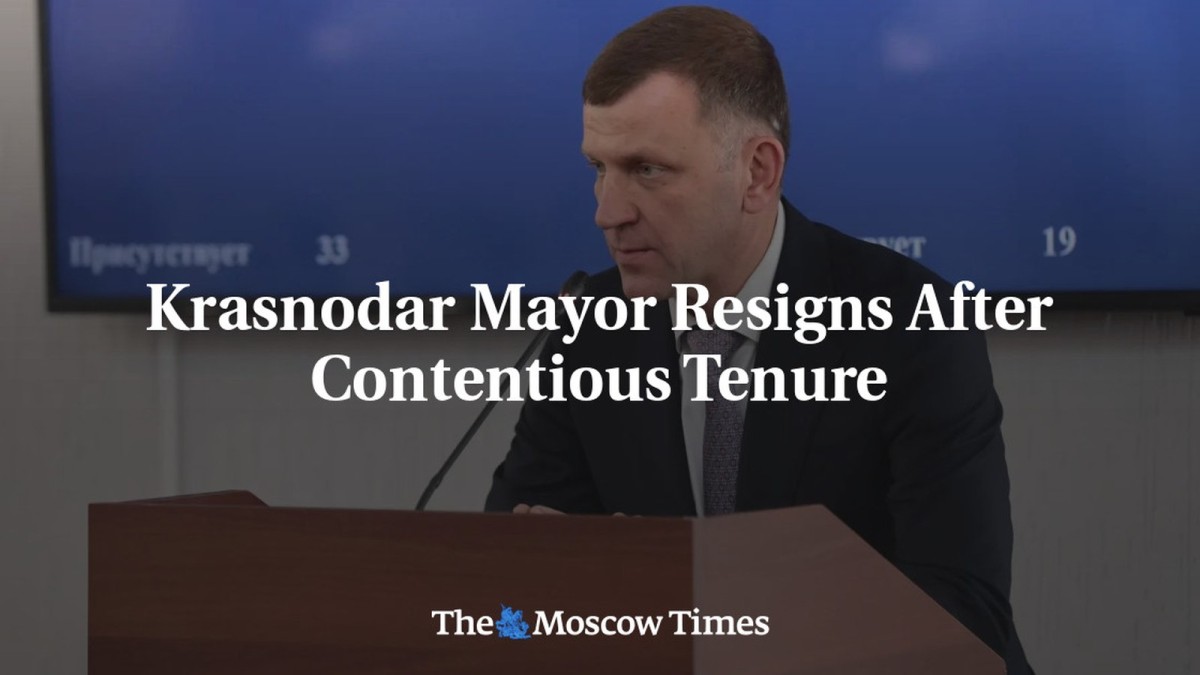
Yevgeny Naumov, who has led the southern Russian city of Krasnodar since his election in November 2022, announced his early resignation on Monday, 5 October 2026. The resignation was accepted by the Krasnodar City Duma, which immediately installed First Deputy Mayor Dmitry Vasilyev as acting head of the city. The Duma will now choose a new mayor from a shortlist prepared by Governor Veniamin Kondratyev, who initiated a fresh selection process for mayoral candidates last month.
Background to Naumov’s Ascendancy
Naumov, a native of Krasnodar born in 1980, spent his professional life within municipal and regional administration before being elected mayor by local lawmakers in November 2022. His five‑year term was originally slated to run until November 2027, but the abrupt departure truncates that schedule by more than a year.
During his tenure, Naumov oversaw a series of urban development initiatives that quickly became flashpoints for public dissent. The most visible of these was the approval, in January 2026, of a plan to erect an Orthodox church on the grounds of a riverside park—an action taken despite vocal opposition from residents who feared the loss of public green space.
Public Opposition and Petitions
Public discontent manifested in several measurable ways. Since November 2025, more than 30,000 Krasnodar residents have signed a petition demanding Naumov’s resignation. Media reports indicate that a separate general infrastructure plan, adopted under his leadership, provoked commentary from roughly 27,000 residents, many of whom took to the streets in mass protests.
The scale of these petitions and protests suggests a broad-based grievance that extends beyond isolated issues. Residents complained not only about the church project but also about perceived mismanagement of winter weather emergencies and delays in key transit projects, indicating a cumulative erosion of confidence in the municipal administration.
Legal Challenges to Municipal Decisions
A local court has begun hearing a lawsuit targeting Naumov’s administration over the controversial church construction. The legal action underscores the depth of civic resistance, turning what began as a planning dispute into a judicial contest. While the outcome of the case remains pending, the very initiation of the lawsuit signals a willingness among Krasnodar’s citizenry to employ formal legal channels to contest municipal authority.
The lawsuit also reflects a broader pattern of increasing legal scrutiny of regional officials, a trend that has emerged in other Russian cities where public grievances have escalated into courtroom battles. This development may signal a shift in the balance of power between local administrations and an increasingly mobilized civil society.
Political Implications for the Regional Power Structure
Governor Veniamin Kondratyev’s role in the mayoral succession process is a critical element of the unfolding political drama. By presenting a shortlist of candidates, Kondratyev retains decisive influence over the city’s future leadership while ostensibly adhering to procedural norms. The timing of his new selection process—launched just a month before Naumov’s resignation—raises questions about whether the governor anticipated or even facilitated the mayor’s departure.
In the Russian administrative hierarchy, regional governors act as key intermediaries between the Kremlin and local governments. Kondratyev’s involvement therefore situates the Krasnodar mayoral turnover within a larger framework of regional alignment with federal priorities. Observers will watch closely to see whether the eventual appointee aligns more closely with the governor’s agenda and, by extension, with Moscow’s strategic objectives for the southern region.
Impact on Urban Planning and Infrastructure Projects
Naumov’s resignation creates immediate uncertainty for ongoing infrastructure initiatives. Projects that were stalled or delayed under his watch—particularly transit developments cited by protestors—may now be reassessed by the acting mayor and any successor. The pending court case over the church construction could also halt or reshape the use of the contested riverside park, affecting both the city’s cultural landscape and its public recreation spaces.
Stakeholders, including local businesses and developers, are likely to adopt a cautious stance until the new mayor’s policy direction becomes clear. This pause could have short‑term economic repercussions, especially if the city’s winter emergency response mechanisms remain under strain.
Broader Context of Media Suppression
The Moscow Times, the outlet that reported Naumov’s resignation, has recently been designated an “undesirable” organization by Russia’s Prosecutor General’s Office, a label that criminalizes its operations and places its staff at risk of prosecution. This designation follows an earlier classification as a “foreign agent.” The government’s justification—that the outlet “discredits the decisions of the Russian leadership”—reflects a pattern of tightening control over independent reporting.
For journalists covering municipal controversies like those in Krasnodar, the hostile environment amplifies the challenges of gathering and disseminating information. The Moscow Times’ statement underscores the stakes involved in reporting on local governance disputes, especially when those disputes intersect with broader political sensitivities.
Prospects for Governance Stability in Krasnodar
The immediate future of Krasnodar’s municipal governance hinges on the City Duma’s selection of a new mayor from Governor Kondratyev’s shortlist. The acting head, Dmitry Vasilyev, will oversee the city’s administration during this transition, but his authority is limited to caretaker functions. The eventual appointee will need to address the lingering public grievances that precipitated Naumov’s resignation.
Should the new mayor adopt a more conciliatory approach to civic concerns—particularly regarding public space usage and infrastructure delivery—it may quell the ongoing protests and restore a measure of stability. Conversely, a continuation of top‑down decision‑making without meaningful public consultation could reignite dissent, potentially prompting further legal challenges and civic mobilization.
In any case, the Krasnodar episode illustrates how local governance disputes can quickly become entangled with regional power dynamics and national media policies, offering a microcosm of the broader tensions shaping Russia’s political landscape in 2026.
This article was produced with AI-assisted research and editorial support. Reporting is based on the source material cited below. Sources: The Moscow Times; themoscowtimes.com; Global1.News (06 October 2026).
By Irina Volkov, Staff Writer
What's Your Reaction?
 Like
0
Like
0
 Dislike
0
Dislike
0
 Love
0
Love
0
 Funny
0
Funny
0
 Wow
0
Wow
0
 Sad
0
Sad
0
 Angry
0
Angry
0
Russia/Eastern Europe Correspondent at Global1.News. Covering Russian politics, energy, security, and the shifting dynamics of the post-Soviet space. Provides clear-eyed analysis on one of the world's most opaque regions.










Comments (0)