
Russia takes aim at Kyiv when Germany's Merz makes surprise trip
As the relentless rhythm of air‑raid sirens once again echoed across Kyiv, the city found itself at the centre of a stark illustration of the widening gulf between Russia’s escalating strike campaign and Europe’s mounting resolve to sustain Ukraine’s defence.
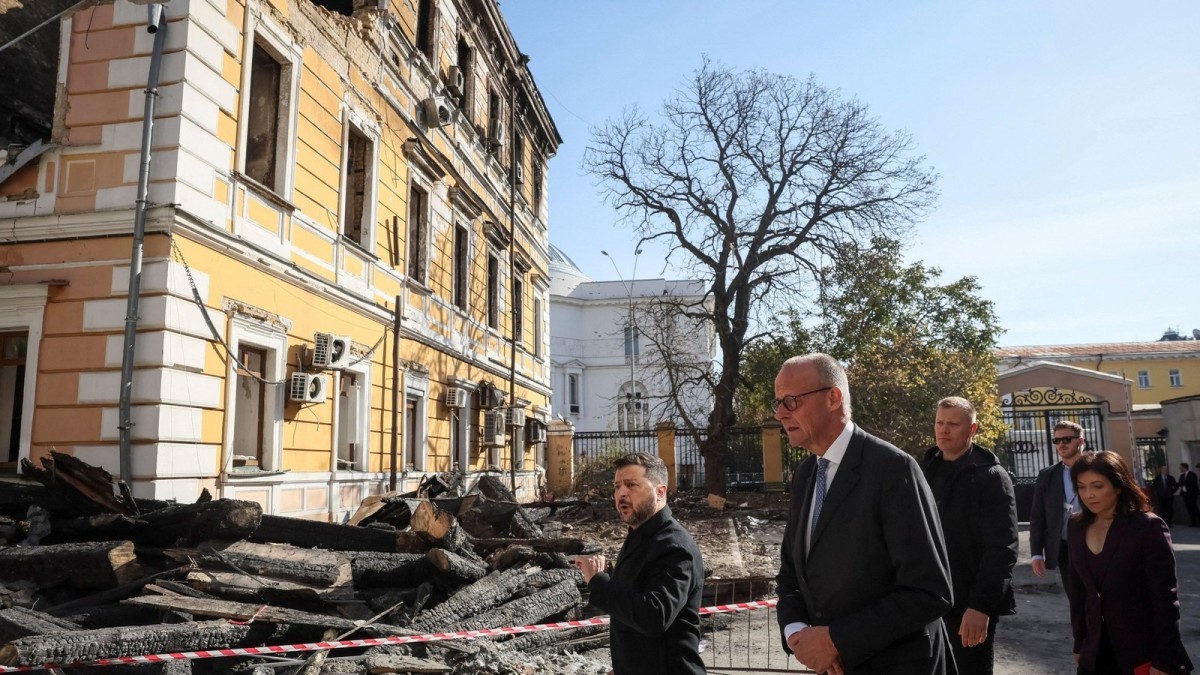
As the relentless rhythm of air‑raid sirens once again echoed across Kyiv, the city found itself at the centre of a stark illustration of the widening gulf between Russia’s escalating strike campaign and Europe’s mounting resolve to sustain Ukraine’s defence. The latest Russian attack, which struck the Northern Bridge – a vital artery linking the eastern and western banks of the Dnipro – arrived just hours after German Chancellor Friedrich Merz landed in the Ukrainian capital on a surprise visit aimed at reinforcing European solidarity. The convergence of these events underscores a broader strategic calculus: Moscow’s intensified targeting of urban infrastructure seeks to erode civilian morale, while European capitals are signalling, through high‑level diplomacy and fresh aid packages, that the conflict’s trajectory remains a central concern for the continent’s security architecture.
Russian targeting of Kyiv’s urban lifelines
On Sunday, Russian forces directed a missile at the Northern Bridge, a key crossing that facilitates movement across the Dnipro River. Kyiv Mayor Vitali Klitschko confirmed that the strike damaged the road surface, and visual evidence posted on social media showed a fireball erupting as traffic traversed the structure. The attack is part of a spate of round‑the‑clock strikes that have increasingly focused on civilian‑grade targets – residential districts, gas stations, schools, rail lines and communications hubs – rather than purely military objectives.
These assaults have transformed Kyiv, a city that for nearly two years of full‑scale war had largely been spared the devastation seen along the frontlines, into a place that now operates on a war footing. The mayor warned that the surge in attacks threatens to undermine the city’s already strained infrastructure, especially as the winter months approach and energy supplies become a critical vulnerability.
German diplomatic outreach and the Merz visit
Chancellor Friedrich Merz arrived in Kyiv on a surprise trip, meeting President Volodymyr Zelenskyy at the National Academy of Sciences. The meeting, conducted amid the ongoing siren barrage, highlighted the symbolic weight of European presence on the ground. Zelenskyy conveyed the harsh reality faced by Kyiv’s residents, describing “terrible nights and days” under relentless bombardment and branding Russia’s actions as “absolute barbarians.” Merz echoed this condemnation, labeling the attacks on civilians as war crimes and stressing the necessity for Europe to halt Russia’s aggression.
Merz’s remarks extended beyond moral censure; he warned that if Russia’s war machine is not stopped, it could eventually turn its attention toward Europe itself. This perspective reflects a growing anxiety within European policy circles that the conflict’s spill‑over risks could manifest through covert attacks or broader destabilisation, especially as Moscow continues to issue warnings to foreign diplomats operating in Kyiv.
New German military aid package
In parallel with the diplomatic visit, German officials signalled a forthcoming military assistance package valued at more than €1 billion. The package is set to include combat drones, satellite technology for targeting Russian launch sites, and a joint production programme for drones designed to counter Russia’s new fast‑moving, jet‑powered unmanned aerial systems. A German source described the aid as addressing “the most significant current gap in Ukraine’s air defence system,” with an expectation that its impact would be rapid and tangible.
Additionally, German government sources indicated that Merz’s trip would feature an announcement of approximately €350 million earmarked for generators, transformer stations and grid repairs. This allocation aims to shore up Ukraine’s energy infrastructure ahead of the winter, a season during which Russia has previously inflicted prolonged power outages by striking energy facilities.
European unity and the NATO dimension
Merz used his Kyiv visit to call for heightened unity within NATO and the European Union against Russian aggression. He warned that the rise of the far‑right, Moscow‑friendly AfD party in Germany could complicate domestic consensus on support for Ukraine. Nonetheless, the Chancellor’s message was clear: a cohesive European front is essential to deter further Russian escalation.
The European Union’s diplomatic corps has also reaffirmed its commitment. EU Ambassador Katarina Mathernova posted on X that threats from Moscow would not deter Europe’s support, emphasizing that such intimidation only underscores the importance of continued assistance. She noted that while European embassies maintain contingency plans, especially for the approaching winter, “nobody is moving,” suggesting that diplomatic presence remains steadfast despite Russian warnings.
Russia’s strategic messaging to foreign actors
In the days leading up to Merz’s visit, the Russian foreign ministry issued a stark warning to foreigners and diplomats in Kyiv, threatening “massive” new airstrikes should they ignore the directive to leave the city. The ministry framed any potential casualties as the responsibility of those who disregarded the warning. This tactic mirrors a similar warning issued in May, indicating a pattern of using diplomatic pressure to sow uncertainty and possibly deter high‑profile visits.
Despite these warnings, leaders from supportive nations have continued to travel to Kyiv, signalling a refusal to be cowed by Moscow’s intimidation. The persistence of such visits, coupled with the ongoing flow of military aid, suggests that European states view the diplomatic risk as outweighed by the strategic imperative to sustain Ukraine’s resistance.
Energy security concerns as winter looms
Russia has openly admitted to deliberately targeting Ukraine’s energy sector as winter approaches, a strategy that proved devastating the previous year when attacks knocked out power and heating for days as temperatures fell to minus 20 °C. The prospect of renewed energy outages has prompted both Ukrainian authorities and the international community to consider contingency measures. Kyiv’s three‑million‑strong population is now contemplating evacuation plans for the vulnerable and disabled, while the government urges preparedness for potential blackouts.
The German commitment of €350 million for generators, transformer stations and grid repairs directly addresses these vulnerabilities. By bolstering Ukraine’s ability to generate and distribute electricity, the aid seeks to mitigate the humanitarian impact of any future energy attacks, thereby reducing one of Russia’s most potent leverage points.
Implications for regional stability and future trajectories
The convergence of a high‑profile German diplomatic mission, a fresh German aid package, and a renewed Russian strike on Kyiv’s critical bridge encapsulates the evolving dynamics of the conflict. Moscow’s targeting of urban infrastructure serves both a tactical purpose – degrading civilian morale and logistical capacity – and a strategic purpose – signalling to Europe that the war’s repercussions can extend beyond Ukraine’s borders.
For Europe, the Merz visit and the accompanying aid commitments underscore a willingness to sustain a costly support regime, even as domestic political pressures, such as the rise of the AfD, threaten to fracture consensus. The emphasis on counter‑drone capabilities reflects an adaptation to Russia’s evolving tactics, particularly the deployment of fast‑moving, jet‑powered drones that have complicated Ukraine’s air‑defence posture.
Looking ahead, the durability of European unity will be tested by the intensity of Russian attacks, the efficacy of the new German aid in plugging air‑defence gaps, and the broader geopolitical contest between Moscow and the West. As winter approaches, the battle for energy security will become a decisive front, with the ability to keep lights on and heating running potentially shaping public resilience in Kyiv and influencing the political calculus in European capitals.
This article was produced with AI-assisted research and editorial support. Reporting is based on the source material cited below. Sources: Daily Sabah Middle East; dailysabah.com; Global1.News (05 October 2026).
By Malik Hassan, Staff Writer
What's Your Reaction?
 Like
0
Like
0
 Dislike
0
Dislike
0
 Love
0
Love
0
 Funny
0
Funny
0
 Wow
0
Wow
0
 Sad
0
Sad
0
 Angry
0
Angry
0

Middle East Correspondent at Global1.News. Based in Beirut, covering politics, conflict, energy, and society across the Middle East. Brings context and depth to a region often reduced to headlines.











Comments (0)