
Google announces new experimental "CC" AI agent for families
Google is rolling out another AI experiment that could reshape how families juggle the endless stream of emails, calendars, and paperwork that defines modern life.
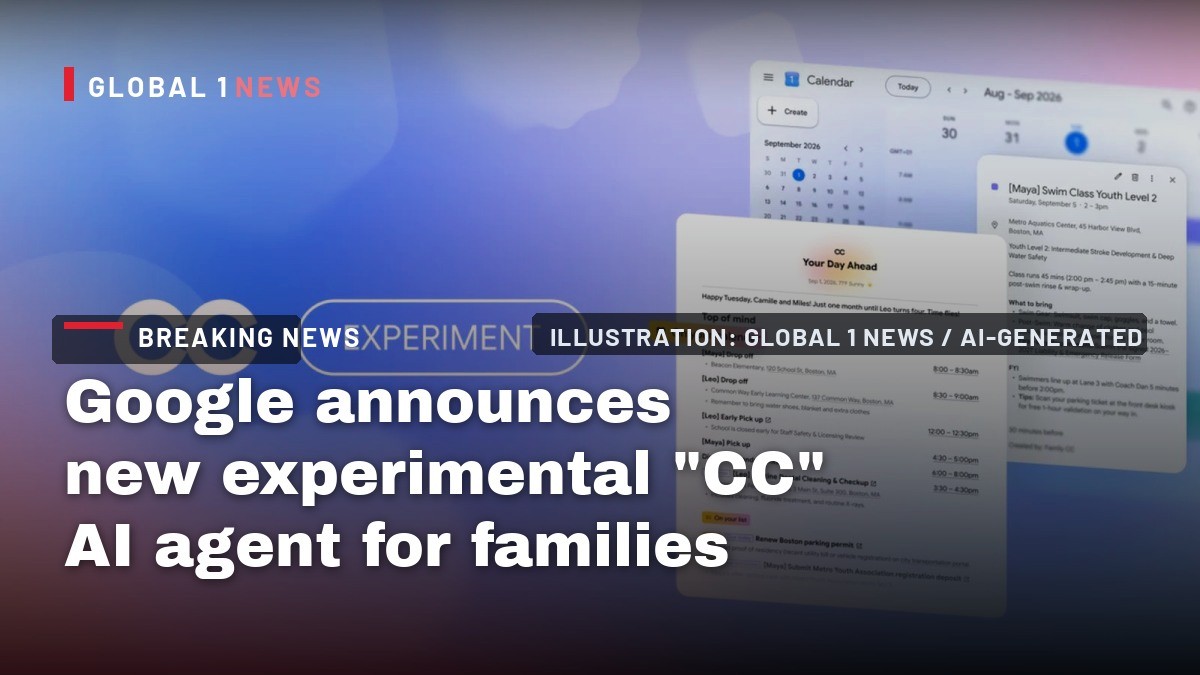
Google is rolling out another AI experiment that could reshape how families juggle the endless stream of emails, calendars, and paperwork that defines modern life. Dubbed “CC,” the new agent builds on the company’s earlier Daily Brief service, but it’s engineered to serve up to six members of a household from a single, shared Google account. In an era where data is the most valuable currency, Google is leveraging its deep trove of user information to offer a highly personalized, yet tightly controlled, AI assistant that promises to take on the mundane chores that keep families from focusing on what matters.
From Daily Brief to CC: The evolution of a family‑focused AI
Google’s Gemini models already have a distinct edge: they sit on top of the massive data pool generated by users entrenched in the Google ecosystem. The original “CC” concept, announced in 2025, morphed into Gemini’s Daily Brief, a service that scans a user’s Google account and surfaces daily action items. The new CC retains that core function—summarizing the day’s events, nudging users about pending tasks, and even drafting documents—but it expands the scope from a single user to an entire family unit.
According to Google, each CC instance runs on its own isolated cloud environment powered by the Antigravity platform and the latest Gemini models, currently Gemini 3.8 Flash. This architecture is meant to keep family data siloed from other users while still allowing the AI to draw on the collective context of the household. The move from a one‑person briefing tool to a shared family resource marks a strategic shift: Google is betting that the convenience of a joint AI assistant will outweigh any lingering concerns about data privacy.
How CC works: Interaction, data sharing, and control
CC is anchored to a dedicated Google account, which family members can opt into individually. The agent only accesses emails that are explicitly shared with it, meaning users can designate specific addresses—such as school scheduling emails—to be always visible to the AI. Content can also be fed to CC via email or Google Chat, and the agent can monitor a shared Google Drive folder where families can drop invitations, documents, and other files for the AI to process.
Crucially, Google emphasizes that CC will not reach beyond the family group without explicit confirmation. The AI can add items to shared calendars, send a “Your Day Ahead” email each morning to all registered users, and create documents based on user instructions, but any outbound communication to external addresses requires user approval. This safeguard is designed to address privacy concerns while still delivering a seamless, collaborative experience.
Practical benefits: From calendar chaos to paperwork automation
The most immediate advantage of CC lies in its ability to offload routine tasks. By aggregating each family member’s schedules, the AI can generate a consolidated “Your Day Ahead” briefing that highlights appointments, deadlines, and updates on previously assigned tasks. It can also add events to shared calendars, ensuring that everyone stays on the same page without endless back‑and‑forth messages.
Beyond scheduling, CC aims to tackle the paperwork mountain that families often face. The agent can fill out school permission slips, generate routine documents, and even draft responses to emails, all while checking with the user for any missing details. This level of automation could free up countless hours for parents, allowing them to focus on caregiving and work rather than administrative minutiae.
Privacy and security: The trade‑off of deep personalization
Google’s biggest selling point for CC is its ability to leverage the wealth of data already stored in users’ Google accounts. That same data, however, raises legitimate privacy questions. While the AI only sees emails that are deliberately shared, the very act of granting an agent access to personal communications is a significant concession. Google’s isolation of each CC instance on a separate cloud environment is intended to mitigate risk, but the underlying model still processes sensitive information.
Moreover, the service is limited to personal Gmail accounts of users aged 18 or older, effectively restricting children’s direct interaction with the agent. This restriction reflects both regulatory caution and a strategic decision to position CC as a parental tool rather than a child‑focused assistant, sidestepping the “legal baggage” that comes with handling minors’ data.
Availability and rollout: Waitlist and early adopters
Google is currently accepting sign‑ups for a CC waitlist. Users who were already using the earlier version of CC—now Daily Brief—will be automatically upgraded in the coming days. The transition promises a seamless migration for existing users, preserving their established data pipelines while expanding functionality to a household level.
Because CC is not tied to Google’s paid subscription tiers, it remains accessible to anyone with a qualifying personal Gmail account. This open‑access approach could accelerate adoption among families already entrenched in Google services, though the lack of a premium tier also means Google is not monetizing the feature directly at launch.
Potential challenges: Token consumption and performance limits
One lingering uncertainty is how efficiently CC can synthesize a family’s data without exhausting the AI’s token budget. The source material notes that it is “unclear how good CC will be at pulling together a family’s data and taking useful action without burning through a mountain of AI tokens.” In practice, this could translate to slower response times or limited depth in processing, especially for larger households with extensive email and document histories.
Additionally, the Gemini 3.8 Flash model powering CC is the latest publicly disclosed version, but Google has not released a newer Pro model since early this year, despite previous promises at its I/O conference. The absence of a more advanced model may constrain CC’s capabilities, at least until Google rolls out a next‑generation engine.
What CC means for the future of family AI assistants
Google’s CC experiment signals a broader industry trend: leveraging entrenched data ecosystems to deliver hyper‑personalized AI services. By bundling calendar management, document creation, and email summarization into a single family‑wide agent, Google is testing whether the convenience payoff outweighs privacy concerns. If successful, CC could set a benchmark for competitors, prompting them to develop similar household‑centric assistants that tap into their own data silos.
For families, the promise is clear: an AI that learns each member’s preferences, automates routine chores, and keeps everyone synchronized without the need for constant manual coordination. Whether CC lives up to that promise will hinge on its ability to balance deep personalization with robust privacy safeguards—a delicate dance that will define the next generation of consumer AI.
This article was produced with AI-assisted research and editorial support. Reporting is based on the source material cited below. Sources: Ars Technica; arstechnica.com; Global1.News (20 September 2026).
By Jessica Ali, Staff Writer
What's Your Reaction?
 Like
0
Like
0
 Dislike
0
Dislike
0
 Love
0
Love
0
 Funny
0
Funny
0
 Wow
0
Wow
0
 Sad
0
Sad
0
 Angry
0
Angry
0

Editor-in-Chief at Global1.News. Atlanta-based journalist who cuts through the BS and tells it like it is. Lead anchor, host, and the voice you hear when the spin stops and the truth starts.















Comments (0)