
Goethe-Institut Dakar: Kéré's Earthen Masterpiece Redefines African Architecture
In the Fann Résidence neighbourhood of Dakar, a new landmark has risen from red West African clay: the Goethe-Institut Senegal, the first purpose-built cultural centre the German institution has ever commissioned, and the first designed by an African architect to win the Pritzker Prize. Its April inauguration was more than a building opening — it was a statement about what African architecture can achieve when it draws strength from the earth beneath its feet.
In the Fann Résidence neighbourhood of Dakar, a new landmark has risen from red West African clay: the Goethe-Institut Senegal, the first purpose-built cultural centre the German institution has ever commissioned, and the first designed by an African architect to win the Pritzker Prize. Its April inauguration was more than a building opening — it was a statement about what African architecture can achieve when it draws strength from the earth beneath its feet.
Goethe-Institut Dakar: Francis Kéré's Earthen Masterpiece Puts African Architecture on the World Stage
Dakar, Senegal — When Diébédo Francis Kéré stood before the completed Goethe-Institut in April, the building behind him told a story four decades in the making: a boy from a small Burkinabé village who learned to build with mud and bamboo had just delivered the cultural institution's first purpose-built home anywhere in the world. For Senegal, for the continent, and for the future of sustainable design, the opening marked a turning point.
A Cultural Landmark Rises in Dakar
The official inauguration took place April 16-18 2026 in Dakar's Fann Résidence district. Senegal's Minister of Culture, Crafts and Tourism Amadou Ba joined Germany's Serap Güler for the ceremonies that welcomed artists, diplomats and community members under the shade of the central baobab.
The project carried a price tag of approximately €4 million, about $4 million, and delivered 1,700 square metres of space designed for language courses, exhibitions and performances. Construction stretched eight years from 2018 to 2026, reflecting the careful sourcing of local materials and the close partnership between Kéré's Berlin studio and the Dakar-based firm Worofila.
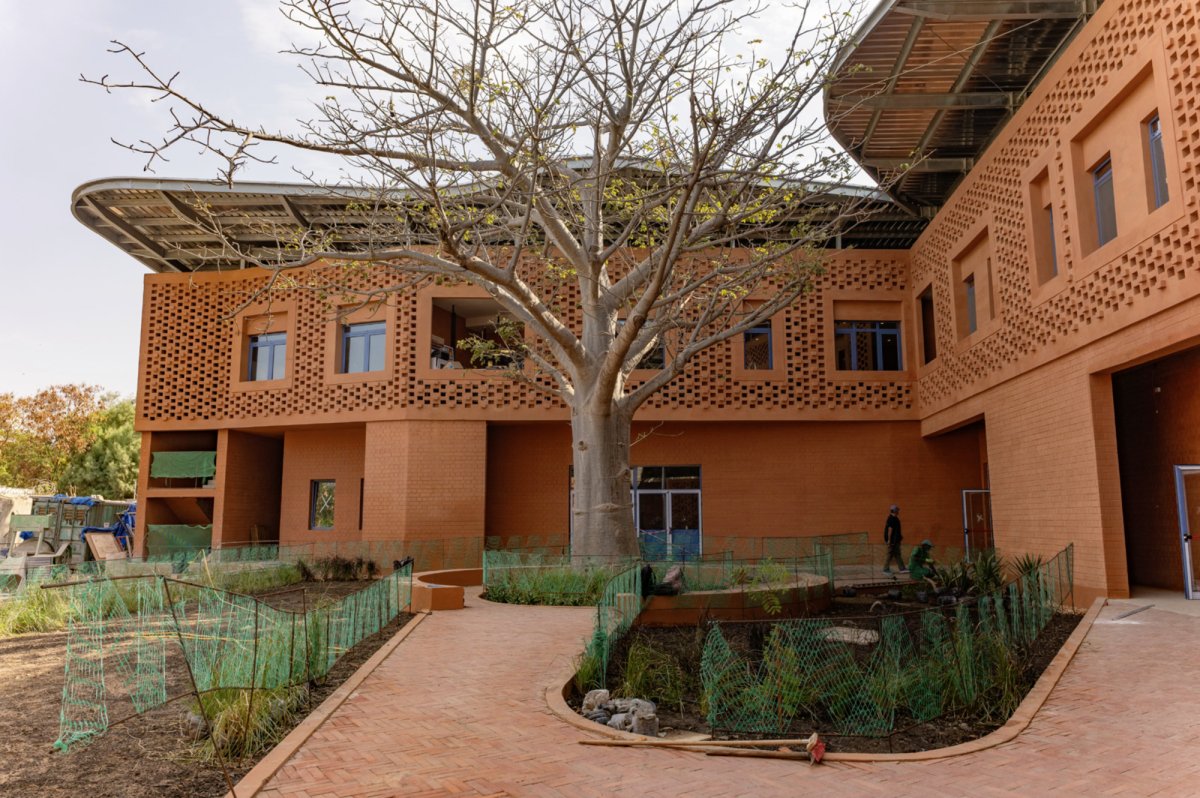
The courtyard was built around a large baobab tree, a living symbol of the region that now anchors the entire complex. Visitors enter through perforated walls that frame views of the tree while allowing breezes to move freely across the open ground.
For 75 years the Goethe-Institut had operated without ever commissioning a purpose-built building anywhere in the world. This Dakar project became the first purpose-built Goethe-Institut in Africa and the institution's first purpose-built centre in its entire history.
The collaboration between Kéré Architecture and Worofila brought together international vision and deep local knowledge. Senegalese masons and carpenters worked alongside the design team to shape every compressed earth brick on site.
The new centre strengthens German-Senegalese cultural exchange by offering a permanent home for joint programmes in film, music and literature. It stands as a concrete sign that cultural institutions can honour African building traditions while serving contemporary needs.
Francis Kéré: From Gando Village to the Pritzker Prize
Diébédo Francis Kéré was born in Gando, a small village in Burkina Faso, where daily life revolved around farming and the seasonal rhythms of the Sahel. From an early age he watched elders shape mud into walls that kept homes cool during the hottest months.
He travelled to Germany on a carpentry scholarship and later studied architecture in Berlin. The skills he gained abroad never replaced the knowledge he carried from Gando; instead they sharpened his ability to translate village wisdom into modern structures.
His first building, the award-winning Gando Primary School completed in 2001, was raised with village labour using local red clay and cement bricks topped by a large overhanging roof for thermal protection. The project proved that community participation could produce architecture of lasting quality.
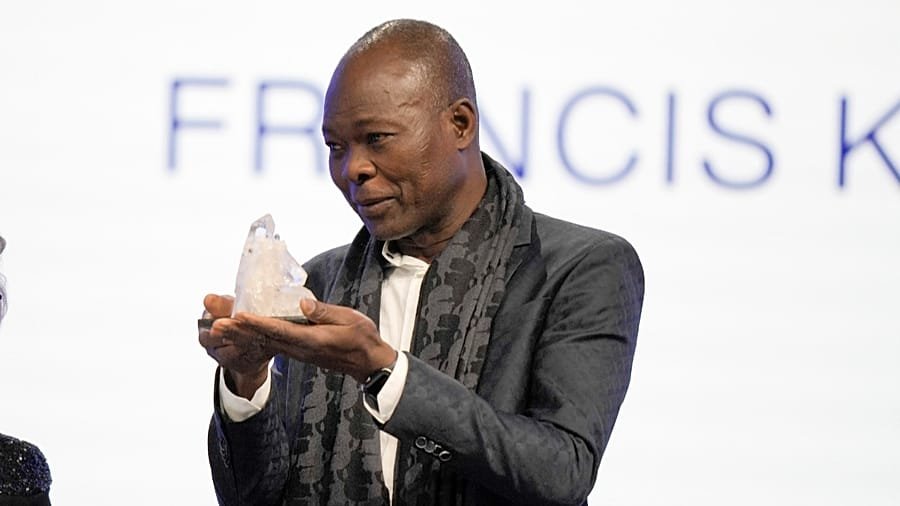
In 2022 Kéré became the only African architect to win the Pritzker Prize. The jury recognised his consistent use of local materials and his commitment to training young builders across the continent.
His Berlin-based firm Kéré Architecture maintains a trademark simplicity that begins with careful observation of climate and available resources. Projects now stretch from Europe to the Americas, yet the core approach remains rooted in African soil.
Even as commissions arrive from distant cities, Kéré continues to insist that every design must respond first to the people who will use it and the land on which it stands.
Building With the Earth: 124,000 Bricks and Bioclimatic Design
Workers produced 124,000 compressed earth bricks from West African red clay gathered near the site. Each brick was pressed and dried under the Dakar sun before being laid into the distinctive perforated walls.
The perforated brick wall system creates both visual rhythm and practical cross-ventilation. Air moves through the openings, cooling interior spaces without mechanical assistance during most of the year.
The building is cooled mainly by passive ventilation rather than air conditioning. Tall ceilings and strategic openings draw heat upward and outward, keeping classrooms and galleries comfortable even at midday.
Kéré often says, "If you give me sand, mud, and bamboo, I can guarantee you I will create a project for you." He adds that steel and water can extend the possibilities further, but the starting point remains the earth itself.
He challenges the assumption that glass and concrete are the only true building materials, noting that many have convinced themselves these are the only options because alternatives are wrongly seen as suitable only for poor people.
Bioclimatic principles guided every decision, from the orientation of the courtyard to the depth of the roof overhangs. The design accounts for local climate conditions and the resources already present in the landscape.
A New Home for Cultural Exchange
The Goethe-Institut serves as Germany's global cultural exchange organisation with 75 years of history promoting language, arts and dialogue. Its new Dakar home marks the first purpose-built institute in Africa and the first purpose-built building in the organisation's entire history.
Programmes at the centre will include language courses, cultural events, exhibitions, music performances and film screenings. Senegalese artists and German counterparts will share the same spaces for collaborative projects.
A German cultural institution embracing African earthen architecture sends a powerful message of respect. The choice of compressed earth bricks and local labour demonstrates that sustainability and cultural exchange can reinforce each other.
The centre becomes a daily meeting point for Senegalese artists, writers and musicians who now have a dedicated venue in the heart of Fann Résidence. Workshops and rehearsals take place beneath the branches of the central baobab.
The symbolic power of a baobab standing at the centre of a German cultural institution in West Africa cannot be overstated. The tree links the building to centuries of regional tradition while welcoming new forms of creative exchange.
Visitors already describe the atmosphere as both familiar and forward-looking, a place where Wolof conversations mix easily with German and French during evening events.
Kéré's Vision for African Cities
Kéré believes bioclimatic techniques can be integrated into the urban fabric when policymakers and designers provide the necessary backing. He points to successful village projects as proof that the methods scale when given proper support.
He references the energy crisis caused by the Strait of Hormuz closure as evidence that the world needs new ways of building. A well-executed earthen building can contribute significantly to reducing energy consumption across entire neighbourhoods.
When a massive project cannot rely on earthen bricks throughout, such as his forthcoming National Assembly building in Benin, Kéré states plainly that concrete will be used the way that is efficient, never as a default choice.
Sustainable architecture is not a luxury reserved for the poor but a smart response to climate and energy challenges facing every city. The Goethe-Institut demonstrates that these principles produce buildings of international standing.
African cities facing rapid urbanisation and rising energy costs now have a visible model in Dakar. Policymakers from other capitals have already visited to study the passive cooling systems and material choices.
The project shows that local labour and local materials can meet the demands of a modern cultural institution without importing expensive technologies that increase long-term operating costs.
Beyond Dakar: Benin, Las Vegas, and a Global Stage
Kéré's forthcoming projects include the new National Assembly building in Benin and the downtown Las Vegas Museum of Art. Each commission adapts his methods to different climates and available resources.
In Las Vegas he plans to use native red rock alongside earthen techniques, showing that the same respect for local materials applies whether the site is in West Africa or the American desert.
Global commissions have thrust him into a completely other world, yet he remains focused on the continent that shaped his first buildings. His work now spans Europe, the Americas and Africa, including projects as far afield as Las Vegas and Rio de Janeiro.
He has expressed concern that success might pull him away from Africa, stating, "The only thing that I'm worried about, and I'm working to not let it happen, is to be taken away from Africa."
His growing portfolio raises the profile of African architecture worldwide and opens doors for younger practitioners. Universities across the continent now invite him to speak with students who see their own futures reflected in his path.
A pipeline of African architects is already drawing inspiration from his example, carrying forward the lessons of Gando and Dakar into new cities and new generations of builders.
What This Means for African Architecture
The Goethe-Institut Dakar carries broader significance for the continent's creative economy by proving that world-class cultural infrastructure can emerge from African materials and African labour. The building challenges the notion that African cities must copy Western glass-and-steel models.
Growing interest in earthen and bioclimatic construction is visible across Africa, from community schools in Burkina Faso to new cultural venues in Senegal. The Dakar project adds momentum to this movement.
Cultural institutions play a vital role in validating African design traditions when they choose local solutions over imported templates. The Goethe-Institut's decision to commission Kéré signals that such choices are both practical and prestigious.
Senegal's own architectural heritage, from the colonial-era buildings of Saint-Louis to Dakar's modern landmarks, now sits alongside Kéré's vision in a continuous story of adaptation and creativity.
The message is clear: African materials, African labour and African creativity can produce cultural infrastructure that meets international standards while remaining deeply connected to place. This truth resonates far beyond the walls of the new centre.
The next generation of African architects will build on this foundation, carrying forward a renaissance that honours the earth while shaping the cities of tomorrow.
By Amara Diop, Staff Writer
This article was produced with AI-assisted research and editorial support. Reporting is based on sources cited in the article.
What's Your Reaction?
 Like
0
Like
0
 Dislike
0
Dislike
0
 Love
0
Love
0
 Funny
0
Funny
0
 Wow
0
Wow
0
 Sad
0
Sad
0
 Angry
0
Angry
0

West Africa/Sahel Correspondent at Global1.News. Dakar-based journalist covering politics, security, climate, and development across Francophone and Anglophone West Africa. Tells the stories of a region undergoing profound transformation.










Comments (0)